Short stories and essays by Shaun Costello, as well as excerpts from manuscripts in progress.

Latest

REMEMBER – THE J-GOD IS CANTANKEROUS AND HE KNOWS WHERE YOU LIVE

ATONE – YOU’LL BE GLAD YOU DID


GOYBOY SHABBOS GOY SERVICE opens its doors and lends a helping hand on this day of atonement. All of our helpers are certified graduates of the GOYBOY Shabbos Goy Academy.
YOM KIPPUR IS UPON US, and, once again, it’s time to atone. Remember, the J-God is a cantankerous, and vengeful God, and he knows where you live. Think Bernie Sanders with a bushy white beard. Use your toaster, and expect a lightning strike. Play it safe – call for GOYBOY.


Keep SHAUN COSTELLO’S BLOG up and running.
Creating and maintaining this BLOG is time
consuming. If you like what you’ve been reading,
please help me keep it going.
DONATE ANY AMOUNT Through PAYPAL at:

THE MACING OF AMERICA

AMERICA – YOU’RE GETTING MACED, YOU’RE GETTING HOSED, AND YOU’RE GETTING NOWHERE!


Thanks to our extraordinarily right of center Supreme Court’s ruling earlier this year, Americans have no shot whatsoever at campaign reform in the next decade. Publically funded elections? Sure, a nice idea. Go tell it to the Supremes. Not only is Congress in bed with the corporate colossus, but the Federal Bench climbed in, as well. And that bed is getting pretty crowded. Comparing these Wall Street demonstrations, as many have done, to Vietnam era unrest is not only naive, but patently untrue. Instead of rolling up their sleeves and making Congress accountable, thousands of well intentioned, albeit naively so, Americans are camped out in tent cities in urban parks, participating in a preposterous re-enactment of Woodstock. Young people are being maced, while the Wall Street brokerage community spends weekends sipping pina colada’s at their beach houses in the Hamptons. The individual citizen has NO capability to impact the Banking Community, but we DO have the power to hold Congress, which sanctions the Banking Community, accountable, if only Americans could understand that and act on it. The source of America’s plight is the malignant curruption in Washington. Do you know your Senator’s voting record for the last year? I’ll bet you don’t, even though that voting record is readily available over the internet. I guarantee you that that voting record will surprise you. Even the ‘good guys’ in Congress vote against the welfare of their constituents from time to time, because that’s how the system functions. That’s how deals are made. That’s how corrupt the system is.

HOLDING CONGRESS ACCOUNTABLE! Doesn’t sound like much fun, does it? Nowhere near as entertaining as holding signs,

 shouting protest rhetoric, getting maced, singing folk songs, squatting in urban Tent Cities, and experiencing a sense of communal righteousness in the re-enactment of the political upheaval of a long-gone era. And what exactly do these protesters think will come of their exhausting, and well-intentioned efforts? Do they actually think that, way up there in the air conditioned forty third floor offices of Goldman Sachs, brokerage executives are looking down at the spirited upheaval of sign-waving demonstrators, and having second thoughts? Do you really think that the CEO of Goldman is calling the CEO of Bank of America to tell him, “You know Brian, maybe these people are right? Maybe we should clean up our act. Change the way we do business”. Do you really think that’s happening? Yeah, right. That phone call will be made on one condition, and one condition only – that Congress finally listens to the American electorate, and votes to sanction the Banking Industry into compliance with the law. Then, and only then, will America find its economic balance again. So, it’s up to you, people. You’re getting maced, and you’re getting hosed, and you’re getting nowhere. It all starts on the Hill – with Congress, You people voted those people into office.

Don’t you think it’s about time you held them accountable? 


*

© 2011 Shaun Costello

Keep SHAUN COSTELLO’S BLOG up and running.
Creating and maintaining this BLOG is time
consuming. If you like what you’ve been reading,
please help me keep it going.
DONATE ANY AMOUNT Through PAYPAL at:


MAKE GOVERNMENT WORK

MAKE GOVERNMENT WORK

It can be an instrument of good. It can’t be ignored. It can’t be replaced.

Do the work. Make it work!

 I truly believe that, when all is said and done, these Wall Street protests will prove fruitless. Also, it’s the lazy way out. Do you want to see change? Do you want to make a difference­? Do you want to clean up Wall Street? Then hold your elected representa­tives accountabl­e. Pay attention to what is going on in both houses of Congress. And I mean every vote that Congress makes. The majority in both houses is re-elected­, on a regular basis, with the helping hand of corporate America. The Banking Lobby. The Tobacco Lobby. The Oil Lobby. The Mining Lobby. Big Pharma. They fund the Congressio­nal campaigns of these clowns, and when an important vote happens, they want payback – and they get it, at the expense of the American consumer, and the American taxpayer. General Electric pays less in tax than the average fire fighter in your home town. That ought to piss you off. America isn’t easy.

Stop making useless noise. Get up off your ass. Roll up your sleeves. Put in the time. Pay attention to what is going on in Washington. These idiots work for you – or have you forgotten? Morons put flags on their cars, and think they’re patriots. They’re just lazy. Do you want to practice good citizenship? Then make sure you are registered to vote, and when Election Day rolls around, know the issues. Find a candidate whose goals and values resemble your own, and vote for him/her. Then make damn sure that every campaign promise made is kept. And if not, then never vote for that person again. Sounds simple, doesn’t it? Then, why are Americans letting this mess continue? For God’s sake, people – HOLD CONGRESS ACCOUNTABLE – AND I MEAN BOTH SIDES OF THE AISLE!!!!!!!!!!!!!!!!!!!!!!!!!!!!!!!!!

*

© 2011 Shaun Costello

Keep SHAUN COSTELLO’S BLOG up and running.
Creating and maintaining this BLOG is time
consuming. If you like what you’ve been reading,
please help me keep it going.
DONATE ANY AMOUNT Through PAYPAL at:

ANN COULTER IS AN ALIEN

“ANN COULTER IS AN ALIEN”, claims Lou Dobbs.

ASSOCIATED PRESS September 26, 2011 In a shocking revelation today, former CNN anchor Lou Dobbs dropped an emotionally charged bombshell on the already fractured landscape of Republican politics. In a sometimes tearful recounting of his four year affair with Right Wing Barbie Doll Ann Coulter, which evidently began during the Iowa Caucus in 2007, and ended at that same political venue four years later, Dobbs went into great detail about his fatal attraction for Coulter’s bellicose beauty, and the eventual, and inevitable break-up that occurred in Des Moines last month. “When I found out the truth”, said Dobbs, “I tried to stay the course. I mean, I loved this woman, or whatever she turned out to be. I knew I couldn’t go on without her. But there is only so far a man can go when confronted with circumstances beyond the pale of any acceptable form of human behavior. When I found out the truth, I was devastated”.

Dobbs recounted the early blissful days of their affair. “Love sometimes makes you blind. I knew there was something different about Ann, that she was not quite normal, but I let it go. Then that night in Wilkes Barre, well, that’s when Ann’s charade ended, and my world turned into a living nightmare”. Dobbs and Coulter were attending a fund raiser for then Senator Rick Santorum in Wilkes Barre Pennsylvania in October of 2009. “We shared a room at the local Holiday Inn. I was awakened by an odd noise in the middle of the night. I instinctively reached for Ann, but she was not in bed. As I sat up, I noticed an intense light coming from under the bathroom door. As I approached the door, the sound grew louder – like a thousand voices speaking a hundred different languages all at once. Not speaking really, but kind of chanting. Chanting in a hundred languages, rhythmically, like some kind of pagan ritual. I quietly cracked open the door just a half inch or so, just enough to see inside. And that’s when I saw it. That’s when my life came crashing down around me”. Dobbs claimed that the bathroom was filled with smoke, and bright flashing lights. “And there she was, or it was, right there in those bright lights. It was Ann, and then it wasn’t Ann.

She kept changing shape, and shifting into different colors, and then it happened. Her head changed shape as the chanting grew louder, turning and changing until it was unmistakable. I stood there, frozen with shock and fear, but there it was, right on Ann’s unmistakable body – it was the head of J. Edgar Hoover. And his mouth was moving – the chanting sounds coming from somewhere inside. And then I heard a voice in the middle of all that babble. A voice singing in English, and the head started changing shape again, and the flashing lights like strobes in a disco became even brighter, and the song became recognizable. It was God BlessAmerica, and suddenly the head morphed into, it was horrible, and yet it was so familiar, and right there on Ann’s beautiful, slender body was the head of Kate Smith singing God BlessAmerica. And I was so horrified that I must have moved and somehow pushed the door open, and in a furious nanosecond of rearranged reality, the lights disappeared, and the chanting too, and the form in front of me changed shape rapidly right before my eyes, until all that was left was Ann. She was naked, and covered with sweat, and breathing heavily, like someone who had just run a marathon, and we just stood there, me in the doorway, and Ann in the center of the bathroom, and the only sound was Ann’s gasping for air”.

Boggs claims that Coulter revealed everything to him that night, at least everything she knew. She told him of her earliest memories, as a child-like form, without structured memory or familial connections, who was from another world, but she didn’t know where. She wound up in foster care and was then adopted, never revealing her true alien indentity to her new family. At a young age she had discovered that she had the ability to shape-shift during certain lunar cycles, and morph into those people she found heroic. She told Dobbs of her great loneliness, longing for someone to know the truth, and love her in spite of it. And then they met that night in 2009, at the Iowa Caucus.

“She wanted to tell me the truth, but she was afraid of my reaction. So that night in Wilkes Barre, I found out everything. But I loved the girl, so what could I do? I know this sounds crazy, but I decided to try and stick it out. I mean, she didn’t look like an alien most of the time. Just every so often she got all smarmy and noisy and morphed into her heroes. So what? Nobody’s perfect”.

According to Dobbs, her morphing habits changed abruptly about six months later, when she dissolved into Ronald Reagan during the act of sex. “I’ve never been so horrified in my life. I mean, there I am porking the woman I love, and right at the best part, I mean just when I’m about to come, she morphs into the great communicator, and Ronnie starts sticking his tongue in my mouth. Hey, there are limits, you know?” Coulter’s sexual changeling conflagrations became more frequent, yet somehow Dobbs managed to remain intrepid. “It was humiliating. Ann’s need to become her heroes now happened every time we had sex. One night I’m boinking Dwight Eisenhower, and the next night it’s Roy Cohn. And then the dressing-up and acting-out started. I’ve got to admit, Ann was pretty hot in black leather, but not when she turned into Richard Nixon, and made me crawl around on all fours on the floor and eat a can of Alpo while he told me how he had been unfairly crucified by an unfriendly press, most of whom were employed by the Kennedy’s. I guess I must have boffed just about Ann’s whole heroic line up: Joe McCarthy, Genghis Kahn, Ted Bundy, Donald Rumsfeld, Margaret Thatcher, Al Capone, Vlad the Impaler, Torquemada, Ma Barker, even Dubya, and each one with their own particular quirky sexual needs – boy, it was exhausting.”

Dobbs then talked about events at this year’s Iowa Caucus, events that would bring his extra-terrestrial love affair to a sad end. “And there we were, in Des Moines for this year’s caucus. In the same hotel where it all started four years ago. Seems like yesterday, but then again it doesn’t. I had just hung up on my editor, a little difference of opinion on my new book, “In God’s Way”, when Ann came out of the bathroom in some silky thing that clung to that luscious, tight body of hers like nobody’s business. Well, one thing led to another, and we were going at it hot and heavy, and all the while I’m thinking, ‘Please don’t turn into Mussolini’, but it keeps getting better and better, and Ann’s all worked up like she’s been stuck between floors for an hour in an elevator filled with Democrats, and I’m just about ready to unload when, all of a sudden Ann’s head starts growing and growing, and splitting in two, and I start hearing music and, low and behold, growing out of Ann Coulter’s delicious body are two heads in cowboy hats, singing, ‘Happy trails to you, until we meet again….’, and I realize that I am staring into the faces of Roy Rogers and Dale Evans. And I’m still boinking away, as unfazed as possible, under the circumstances, when I hear the unmistakable sound of a horse whinnying. And old Roy looks me right in the eye and says, ‘Ok Lou boy, time to turn yourself around and make Trigger one happy Palomino.’ Well, that was just about all I could take. I loved this Coulter woman, or whatever she was, but I’d be damned if I’d give it up for Trigger”.

Dobbs claims that he got dressed, and stormed out of that hotel room, made a call to the AP, and arranged this Press Conference. “I wanted to get out my side of the story before Coulter made with the extraterrestrial machinations to the Press as these alien creatures will do. It’s weird story I know, but the God’s honest truth. Why, I’d stake my reputation on it”. Calls made to Ms. Coulter, as well as NASA were not returned. Both the Republican National Committee and Fox News refused comment.

*

© 2011 Shaun Costello

Keep SHAUN COSTELLO’S BLOG up and running.
Creating and maintaining this BLOG is time
consuming. If you like what you’ve been reading,
please help me keep it going.
DONATE ANY AMOUNT Through PAYPAL at:

NON CHIEDERE, NON CHIEDETE

February 5, 2014 Associated Press. In Rome today, Cardinal Vincenzo Pantangelli, The Vatican’s Director of Information, made a startling announcement to the world’s gathered press. “Ina order to addressa the misconceptzione that homosexuale activity is conadoned ina the Holy Mother Churcha, and at the directa wishesa ofa Il Papa himself, I ama announcing a new polizia that willa take affecta froma this momento. We are calling thisa new polizia ‘NON CHIEDERE, NON CHIEDETE’. So any of you that hava any questiones, about a thisa sensitive subjecta, pleasa to remember, that any homosexuale activitiesa of any ordaineda personsa ina the Holy Mother Churcha comesa under thisa new polizia, ‘NON CHIEDERE, NON CHIEDETE’, Whicha translatesa in English asa ‘DON’T ASKA, DON’T ASKA’. Thatsa right, ‘DON’T ASKA, DON’T ASKA’. This only makes sensa, because for sure, ‘non abbiamo intenzione di dirvi merde’. Anda you can figure that outa for yourselvsa”. This announcement puzzled the correspondents gathered at the Vatican’s Press room, who were later informed by The Church’s translators that, “Non abbiamo intenzione di dirvi merde”, translates as, “We’re not going to tell you shit”. The American Ambassador to the Holy See refused comment.

*

Keep SHAUN COSTELLO’S BLOG up and running.
Creating and maintaining this BLOG is time
consuming. If you like what you’ve been reading,
please help me keep it going.
DONATE ANY AMOUNT Through PAYPAL at:

DICK CHENEY SPEAKS OUT

Associated Press December 12, 2011 In an exclusive interview granted to Heywood Sargent of the Associated Press today, former Vice President Dick Cheney is pressed to respond to tough questions about his new book, his relationships with Former Secretaries of State Colin Powell, and Condoleezza Rice, the American presence in Iraq and Afghanistan, and his alleged suggestion to then President George Bush in 2006, that America should not rule out a full scale invasion of France.

Sargent…Mr. Vice President, in your new book, ‘In My Time’, you suggest great attitudinal differences that existed between the Bush White House and the State Department, under both Colin Powell, and Condoleezza Rice. Could you elaborate?

Cheney…Attitudinal, huh? That’s a good one. You don’t mind if I tuck that away somewhere and use it later, do you? First of all, you’ve got to get this ‘Chain of Command’ thing straightened out. The President hires the Secretary of State. The President is the boss, and the Secretary is, well, not the boss. You follow me so far? First of all, the President would come to me, as his father instructed him to do, and he would say, “Vice?”, he always called me that, a term of endearment and respect, and also my title back then. “Vice”, he would say, “We’ve got to get this blame thing about Iraq worked out. I mean, if we’re going to incinerate their country, we’ve got to make it seem like it’s their fault, you see what I’m saying?” I told him we had Saddam dead to rights. He had the nukes, and he had the gas, and the rockets too, and we could prove it. And he said, “Look Vice, I talked with Colin this morning. He wants to go to the United Nations with this thing. Have them investigate. Get the goods on the towel heads. Then we’re in the clear – good to go – bombs away”. I explained to the President that we had a schedule to keep. We had to coordinate the vacation plans of several of our key Generals, and then, there’s The Masters. You can’t have a war going on when they’re playing The Masters. I mean, I’m a member down at Augusta National. I’ve got a locker with my name on it, and everything. If we were going to blow Iraq to smithereens, we had to adhere to a reasonable timetable, and the UN would take their dear sweet time with this thing. Look, you hire a Secretary of State, and of course you ask his advice. But you don’t want him getting creative on you. You want him to tell you one thing, and one thing only – what he thinks, you think, you want to hear. Not what he actually thinks. You get what I’m saying here? I mean, you look back at the Nixon White House. Boy, those were the days. Haldeman had scripts written for the Cabinet meetings, and he rehearsed them. Every Secretary of every Department in the Government had to know his lines. That’s my kind of White House. My kind of government.

Sargent…You criticized Condoleezza Rice for being President Bush’s lap-poodle. You also alluded to some connection between Secretary Rice and Muammar Gaddafi. You mentioned inappropriate gifts being exchanged. Given the recent discovery of Gaddafi’s Condi Shrine and suggestive photo album, could you expand on these statements?

Cheney…First of all, let’s set the record straight on this Condi Rice business. Secretary Rice is an outstanding and loyal American, and one of President Bush’s most important and historic appointments, being the first African American to ever hold that office.

Sargent…Mr. Vice President, Ms. Rice followed in the footsteps of Colin Powell, as Secretary of State, and of course, Colin Powell is also an African America.

Cheney…You’re kidding. Colin is colored? I always thought he was Armenian or something. You live and learn. About Condi, look, I don’t want the hired help getting creative, but Condi took condescension to a whole new level. I mean, the President would ask her, “Condi, I want your input on this ‘weapons of mass destruction’ business. Does this hummus-eater have ‘em, or what.” And her robotic response was, “Mr. President, on January 21st, you made a statement condemning Saddam Hussein for having huge stockpiles of fissionable material, with the intention to use it against America and her allies. I whole heartedly agree with that statement, Mr. President, and all other statements made by you on all matters foreign and domestic, during both your Presidency, and your tenure in Austin as governor of Texas. And also your statement to the New Haven police after your DUI arrest when you were a student at Yale, that your father covered up.” Look, I don’t want them getting creative, but Jesus.

Sargent…And Gaddafi?

Cheney…Oh, that. Well, let’s just say that the boys over at the NSA hear it all. Secretary Rice had made a diplomatic visit to Tripoli, which had to be extended for a few days, because Gaddafi evidently had the hots for her. There were some, well let’s call them inappropriate gifts exchanged. My favorite was the life sized, anatomically correct Colonel Gaddafi inflatable doll. What she did with it is anybody’s guess, but it was the subsequent phone calls that aroused interest at the NSA. I remember one call in particular. They played it back for me. I can remember it almost verbatim:

Gaddafi…Oh, my LeezaLeeza, My African Queen of the night, you must call me MooMoo, and in our love-tent we will make harmonious music together. Yes, MooMoo and his LeezaLeeza, in the harmony of the love motions. We make the music of the romance.

Rice…Listen Colonel, I like your outfits, but I draw the line at baby talk. Let’s just put on some Barry White, and get funky.

Well, you can imagine the NSA boys getting a kick out of this. I’ve got the tape around here somewhere.

Sargent…In your book, you mentioned the hunting accident, back on 2006, and you said you missed. What did you mean by that?

Cheney…That was on a quail hunt down in South Texas with Happy Harry Wittington. Hap was a contributor to my campaign. Always smiling and joking around. Real fun guy. Ever been around somebody who’s always smiling? It can get on you nerves, believe me. So I got to thinking – what if I put a couple of pellets in Hap’s behind? I bet that would wipe that smile off his face. So Hap’s about twenty feet ahead of me, and I yell, ”Over there, Hap. Over the trees” And when old Hap turned to shoot, I accidentally/on purpose unloaded in his direction. I meant to aim just to the left of him, so he’d just catch just a few pellets. Hell, everybody catches a few pellets in the behind, once in a while. But I stumbled, and the gun went off pointing right at the smiling son of a bitch. Wound up in intensive care. Jesus. I’ll tell you something though. I went to see him in the hospital. They had him all wired, on life support – lots of tubes. And there was old Hap, doing his Cheshire Cat thing. Quite a guy. He still contributes.

Sargent…I was wondering if you saw Oliver Stone’s film “Dubya”, and if you thought it was an accurate depiction of the Bush White House?

Cheney…I did see parts of it. It won some awards, didn’t it? Like Best Documentary, or something?

Sargent…Not exactly. It was a dramatization. The characters were played by actors. Your own roll was played by Richard Dreyfuss.

Cheney…Actors? Richard Dreyfuss? I don’t know what you’re talking about. The scenes I saw were all real. It was in the Oval Office. All of us were there: The President, Colin, Condi, Tenet, Rummy, and Carl Rove too.

Sargent…Mr. Vice President, that wasn’t Carl Rove. It was an actor named Toby Jones. You yourself were portrayed by Richard Dreyfuss.

Cheney…Actors? Now, wait just a minute here. I saw what I saw. It was us. I lived it. I saw it played back. That’s what happened. This some kind of  journalistic trick? I wasn’t born yesterday, Mister. Besides, I’m better looking than Richard Dreyfuss.

Sargent…With the 2012 election just around the bend, could you size up the GOP’s candidates, and their chances. How about Michele Bachmann?

Cheney…Certainly. First off, let me say that the entire GOP field is made up of outstanding Americans, who understand the meaning of Capital Gain, and all that that entails. You won’t find a wuss in the bunch. Ms. Bachmann has an outstanding record in the House, and comes from a dairy state, which never hurts. But I’ll tell you, this homophobic thing she’s got happening is going to come back and bite her in the ass. So what if a guy’s light in the loafers. My daughter is an openly gay woman. Nothing wrong with that. Look, I’m not saying that I’m going to play the back nine at the Congressional with any homos, but they should have the same rights as the rest of us., or at least it should seem like it. And I’ll tell you one thing about your average homo that escapes Ms. Bachmann – he votes.

Sargent…Mit Romney?

Cheney…Governor Romney did some fine things up there in Massachusetts. Good looking guy too, which never hurts with the female voters. He’d run America like a fine tuned corporation, and that’s the way it should be. But I just don’t know about this Mormon thing. I mean, this is America, where every man can realize his dream, but a Mormon in the White House? These people have polygamy on the brain. Did you ever read the Book of Mormon? If it were a movie, it would be a cross between The Day the Earth Stood Still, and Starman.

Sargent…Rick Perry?

Cheney…Governor Perry’s got that Texan cow puncher spirit, I’ll tell you that. Americans respond to a man in boots and a Stetson. Evokes that pioneer spirit. A sense of toughness and independence. Conjures up images of John Wayne, even Ronald Reagan. Hell, Reagan took on the Soviet Union – face to face – mano a mano – And Mr. Gorbachev blinked and that wall came down. Yessir, never go one on one with a man in a fine set of boots. Of course, Governor Perry wears Tony Lama’s. They’re OK, I guess, but it’s a mass produced boot, the kind of thing you can pick up at Sears. A real Texan only wears a Lucchese boot. Made in San Antonio. Old world craftsmanship in every stitch. I’ve sent the Governor memo’s about this, but he’s still strutting around in those Tony Lama’s. Reagan wore only Lucchese, and look where it got him. And the American voter knows the difference, believe me.

Sargent…Mr. Vice President, are you saying that the outcome of the election can come down to the brand of boots a candidate wears?

Cheney…If the shoe fits.

Sargent…Newt Gingrich?

Cheney…A fine American in every way. As Speaker of the House he took out a contract on America. Remember that? My kind of guy. That’s the way to run the country. Take no prisoners. But if a few stragglers do wind up in your camp, interrogate the hell out of them. That’s the way you find things out.

Sargent…Sarah Palin?

Cheney…Ms. Palin is a fine conservative, and an attractive woman. Sure, she had some minor glitches, like that bridge to nowhere, when she was Governor, up there in Alaska. And keeping an eye on the Russians, across the Bering Straight, from her office window. But she’s got this soccer mom thing happening, and that could bode well for her, come election time. But those names she gave her kids. Track? Bristol? Willow? Piper? Trig? What’s up with that? I mean, would it have killed her to name one of them Robert, or Delores, or Mary Sue – you know, names people can relate to. She might as well of named one of them Dump Truck for all the good it will do her at the polls. Sounds like a bunch of God damned hippies. Excuse my French.

Sargent…And speaking of France, you mentioned in the book that, back in 2006, you advised President Bush to not rule out a full scale invasion of France. Could you elaborate on that?

Cheney…Certainly. You know, 2006 was not a good year for us. Iraq was not working out the way we planned. The Taliban were making a comeback in Afghanistan. Secretary Rice was preoccupied, having a lurid affair with that towel-head fruitcake in Tripoli. Wall Street was in the throes of collapse. The American electorate was looking for someone to blame, and that’s never good when you’re in power. America needed a diversion, and I was all for giving it to them. It’s like, the television networks know how to do this. The scheduled programs show their last episode in the Spring. So now, the people have nothing to watch. What do the networks do? They present the Summer shows – something completely different, like a sitcom where a homo couple complete their odd family picture by adopting a chimpanzee. They could call it “Chumps”. I like that. And the viewers forget that their favorite shows won’t be back on until the Fall. That’s what I wanted to give the American voters – a Summer show. And I thought, why not invade France. Hell, they’re an arrogant bunch. Don’t agree with us on anything. We saved them from Hitler, and what thanks do we get? The French adoration of Jerry Lewis. France is a socialist country anyway, so why not invade them. And that means we could take prisoners and interrogate the bejesus out of them. And here’s the best part, we’ve done it before. We’d just do the Narmandie invasion all over again. I figured the plans for D-Day must be in the basement of the Pentagon somewhere. It would be a piece of cake.

Sargent…So, what happened?

Cheney…Well, we were ready to go. The President was on board one hundred percent. Carl Rove and Rummy thought up a whole bunch of crimes that France had committed against the world. You know, to justify obliterating a third of their population.

So what happens? Some jerk-off bureaucrat at the Pentagon misplaced the D-Day invasion plans. We’d have to start again from scratch. The boys at Central Command said ‘No can do’. Well, that was that. America never got the Summer show it so needed and deserved.

Sargent…Five dinner guests?

Cheney…That’s easy. Let’s see – there’s George Patton, old blood and guts. There’s a lot you can learn from a guy like that. And Julius Caesar, of course. And the Romanian, Vlad Dracul, also known as Vlad the Impaler. I sure would like to pick his brain on his interrogation techniques. He made water boarding look like scrabble. And someone funny. I know, how about Ayn Rand, with that pungent sense of humor of hers. She’d keep the conversation moving. Oh, and for the fifth, Mickey Rooney.

Sargent…Why Mickey Rooney?

Cheney…Balance. With a crowd as distinguished as that, I’d like to know that there’s at least one guy at that table who’s shorter than me.

Sargent…Thank you Mr. Vice President.

Cheney…My pleasure.

*

© 2011 Shaun Costello

Keep SHAUN COSTELLO’S BLOG up and running.
Creating and maintaining this BLOG is time
consuming. If you like what you’ve been reading,
please help me keep it going.
DONATE ANY AMOUNT Through PAYPAL at:

A TALE OF TWO MOVIES

A TALE OF TWO MOVIES

Two films I recently saw that were shot on shoestring budgets, and that took two very different paths in story telling. One I liked, and one, well………………

By Shaun Costello


NOVEMBER

Greg Harrison   2004


This low budget indie made quite a splash at the 2004 Sundance Festival, and was well received the following year at the Festivals in LA and Seattle. Considering its budget, November is visually dazzling, but there’s much less here than meets the eye. When a director on a low budget film decides to compensate for lack of funds with dizzying camera tricks, editorial gimmickry, and story telling razzle-dazzle, the result is usually disappointing, and lovely-to-look-at though it is, November is no exception.  Who exactly died here? Did he die? Did she die? Did they both die? Do I really care?

This Lynchy, Shyamalanesque, neo-Roshomon attempt runs out of steam early on, and becomes unforgivably derivative and imitative. On the evening of November 7, photographer Sophie Jacobs (Courtney Cox, who does not change her facial expression once throughout the film) and her attorney boyfriend Hugh (James LeGros) go to dinner at a Chinese restaurant. As they travel home afterward, Sophie develops a craving for “something sweet” and stops their car at a convenience store. While Hugh is in the store buying some chocolate for Sophie, an armed man (Mathew Carey) arrives and holds up the store, shooting the store clerk, his son, and Hugh dead. He runs away as Sophie arrives.

Sophie sinks into a deep depression, and cannot bring herself to erase Hugh’s voice from their apartment’s answering machine. She consults her psychiatrist, Dr. Fayn (Nora Dunn), about persistent headaches that she has been suffering from since his death. She tells Dr. Fayn that the headaches started to occur before the incident at the convenience store, and that she had been having an affair with a co-worker, Jesse (Michael Ealy). After Hugh’s death Sophie has dinner with her mother, Carol Jacobs (AnneArcher), who accidentally knocks a glass over.

During a college photography class that she teaches, Sophie sets up a slide projector for the students to showcase their best photographs. One slide in the slide show depicts the exterior of the convenience store on the evening of November 7. Sophie contacts Officer Roberts (Nick Offerman), the head of the investigation into the shootings at the convenience store, who is as puzzled as she is as to who is responsible for the photos. Sophie’s headaches continue, and she begins to hear strange noises coming from within her apartment building and mysterious voices on the phone. Later, Officer Roberts discovers that the photo of the convenience store was paid for with Sophie’s credit card.

The film presents two more different versions of these events, and Sophie must figure out which is real before she loses grip on her sanity, and her life. The second version suggests that Sophie was present at the shootings and was only spared because the shooter ran out of bullets, and the third suggests both Sophie and Hugh were killed. In the words of Cox, her character “goes through three phases. First there’s denial. Then she feels guilty and sad about the situation. Then she has to learn to accept it.” According to Greg Harrison, the events in the film were Sophie’s memories as she and Hugh lay dying on the floor of the convenience store: “Each movement of this memory was her process of coming to terms with the terrible trauma, which was that she was killed for absolutely no reason, and it was some random act of violence she couldn’t confront”. He added he felt November was “open-ended” enough that he hoped viewers would “come up with the most beautiful stories themselves that are very different from how I saw it.”

Really, Greg?  As each version of the story unfolds, the plot becomes almost laughably confusing, and ultimately unsatisfying. By the last shot, of the two lovers, hands extended toward one another in some cinematically sculpted mini-apocalypse, lying in pools of blood on the convenience store floor, I had long since stopped caring what had happened to whom, and why.

Oddly, I both liked and hated this movie, and am glad to have seen it, if for no other reason than Nancy Schreiber’s hypnotic visuals. Shot on mini DV at 24 FPS, the ‘look’ of November is worth the time spent watching it. If only Greg Harrison knew how to tell a story.

http://www.moviefone.com/movie/november/17619/video/november-trailer/1352858


PLEASE GIVE

Nicole Holofcener   2010


I was hooked 15 seconds into the credits, which are supered over a montage of breasts being squeezed and flattened onto mammogram plates at a radiology center, scored to the Roches’ hilarious and wise song, “No Shoes”, with its litany of self-mocking complaints, “I had no shoes and I complained/Until I met a man who had no feet.” Please Give is a wonderful example of movie-making on a budget, without resorting to gimmickry.

The last words in “Please Give,” Nicole Holofcener’s latest comic drama of spiky manners, are “you’re welcome.” They’re uttered by Kate, a New York malcontent played with complex appeal by the wonderful actress Catherine Keener. Kate’s daughter, Abby (Sarah Steele), a stridently truculent teenager, has in a rare instance of filial generosity just thanked her mother for agreeing to pay for a pricey pair of jeans. From the near-beatific look on Kate’s face, it seems that after struggling to make amends for some vague, unarticulated wrong — by doling out cash to homeless people, for instance — she has found her moment of grace.


Few American filmmakers create female characters as realistically funny, attractively imperfect and flat-out annoying as does Ms. Holofcener, whose features include “Friends With Money” and “Lovely & Amazing.” You may not love them, but you recognize their charms and frailties, their fears and hopes. They may remind you of your friends, your sisters or even yourself, which makes them attractive and sometimes off-putting, an unusual, complicated mix. We don’t necessarily or only go to the movies to see mirror versions of ourselves: we also want (or think we do) better, kinder, nobler, prettier and thinner images, idealized types and aspirational figures we can take pleasure in or laugh at in all their plastic unreality. The female characters in Ms. Holofcener’s films don’t live in those movies: they watch them.


“Please Give” involves a cluster of such women, including Kate and her only child, the 15-year-old Abby, and their irascible next-door neighbor, Andra (Ann Guilbert), a nonagenarian with two granddaughters, Rebecca (Rebecca Hall) and Mary (Amanda Peet). Kate and her husband, Alex (Oliver Platt), expect to take over Andra’s apartment when she dies, a macabre objective that they compensate for with strained smiles and by running an occasional errand for her. Kate and Alex also own a store specializing in midcentury Modern furniture, lamps and the like, which they stock from the apartments of the dead. It stings when a customer calls them ambulance chasers, but there’s a touch of truth to that remark.

Given how unpleasant Andra is, you can almost understand Kate and Alex’s impatience, though I don’t think that is exactly what Ms. Holofcener had in mind when she gave her characters so many thorns. Kate and Alex want to expand their already spacious Upper West Side apartment, a desire that slightly embarrasses them and creates tension, particularly during a birthday party that Kate gives for Andra. Mary, who comes with so many spikes she could star in a “Hellraiser” sequel (as Mrs. Pinhead), and has had too much to drink (as is her habit), urges Kate to explain her renovation plans to everyone, Andra included. It’s an uncomfortable exchange, but like too many scenes, it also feels rigged for maximum outrage.


Most of Andra’s needs are met by Rebecca, who works as an X-ray technician taking mammograms. Ms. Holofcener doesn’t overdo the scenes of Rebecca tending to the patients, who might soon learn the worst. But the delicacy of Rebecca’s touch speaks a great deal about a woman who is also so depressed or repressed or something that she can’t even admit that she wants to see the leaves turn colors in the fall.


What’s eating Rebecca? What isn’t? Certainly she doesn’t have it easy. Her mother died when she and Mary were young, and their dad soon headed out the door. (Maybe he was running from Andra.) Having been raised by her grandmother, Rebecca now buys Andra’s groceries and doles out her medications, living with Mary in a dreary, sterile apartment where they eat microwave dinners and watch television amid sisterly sniping. A sloppy, mean drinker with a quiver full of insults, Mary works in a spa and spends far too much time browning in a tanning bed — she looks like a Creamsicle. Neither sister seems to have any outside friends or, initially, a love life, which strikes a false note until you get to know them.


Generationally, Abby, Mary and Andra embody the ages of woman — youth, adulthood and old age — a sort of variation on Gail Sheehy’s “Passages.” But because they’re so unmodulated, barely saying a kind word among them, they become tough to take. (Ms. Peet, nonetheless, keeps you watching and engaged.) The appeal of Ms. Holofcener’s films, which are visually unmemorable, rests almost entirely in her characters, so the lack of shading among these three throws the story off balance. Rebecca lacks a similar modulation until she meets a guy, Eugene (Thomas Ian Nicholas). Men might not make women happy here, but left to their own devices, women tend only to make one another unhappy.


The more you get to know these women, the less time you want to spend with them — they’re so full of complaint that it feels as if Ms. Holofcener were worried about making them false, turning them into movie characters. The exception is Kate, because she comes with the most dimensions and is played by Ms. Keener (a Holofcener veteran). No one in American movies does difficult women better than Ms. Keener, who’s fearless when it comes to nasty, cold roles, yet resists caricature. (At her most withering, she can recall George Sanders.) Her character in “Please Give” isn’t acerbic, but Kate has bite, along with a lot of underexamined — by her and by Ms. Holofcener — guilt, most of which appears to have something to do with being bourgeois.


Kate’s habit of giving money to homeless people, along with the film’s title, suggests the scope of Ms. Holofcener’s intentions. There’s so much hurt in the world, and Kate wants to help. But she’s a rotten volunteer, weepy and self-conscious, and she doesn’t seem to see the pain closer to home. She’s the definition of the guilty white (presumed) liberal and might have been a rich source of comedy and pathos. But only if we saw her working through her issues (and her narcissism) with more obvious intelligence and greater self-awareness, wrestling more thoughtfully with life the way that Ms. Holofcener herself has tried to do in this likable if frustrating film. Ms. Holofcener didn’t need to come up with answers for Kate — the ones in the movie are less than satisfying — but it would have been nice if she had let Kate ask some harder questions.

That said, I really liked this movie.


      http://www.youtube.com/watch?v=tZQEu7bTwIc


© 2011 Shaun Costello

Keep SHAUN COSTELLO’S BLOG up and running.
Creating and maintaining this BLOG is time
consuming. If you like what you’ve been reading,
please help me keep it going.
DONATE ANY AMOUNT Through PAYPAL at:

MOVIE MAGIC

MOVIE MAGIC

Ten fantasy-driven films I saw on TV, while home from school, pretending to be sick in the fourth grade, that changed my life forever.

By Shaun Costello


 My life-long love affair with motion pictures began, not in the cavernous movie palaces of New York City, although I regularly accompanied my parents, or my grandmother to see the latest offerings at Radio City Music Hall, The Roxy, The Loews State, and the Palace; but instead on the 15 inch screen of my family’s black and white Dumont television set, that occupied a place of honor in the finished basement of our house at 9 Elderberry Lane, in the suburban village of Valley Stream, about a 40 minute car ride to mid-town Manhattan. I was 9 years old and in the fourth grade at the local Catholic School, and for purposes of full disclosure, have to admit to taking full advantage of every trick imaginable in order to accrue more than my share of sick days, pretending to be at death’s door, in order to not be held accountable for homework not done, or book reports not finished, or maybe just giving in to chronic laziness in a Herculean attempt to keep my eyes glued to our television screen, without interruption, for, if possible, the entire day.

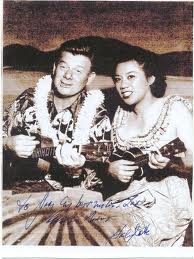
Daytime TV in the mid-Fifties offered a cornucopia of entertainment, beginning with NBC’c Today Show with Dave Garroway and his chimp Mr Muggs, followed by Arthur Godfrey and His Friends, featuring The McGuire Sisters, Julius LaRosa, and Hawaiian Hottie, Haleloke, who sang songs like ‘Lovely Hula Hands’. Then came a half hour watching Jack LaLane pumping iron and drinking carrot

 juice, followed by an assortment of Game Shows and Soap Operas. The afternoon kicked off with Joe Franklin’s Memory Lane, which offered Franklin talking with people I’d never heard of and showing old shorts and Feature Films.  There were two channels, WOR Channel Nine, and WPIX Channel Eleven that regularly showed old movies. Channel Eleven showed mostly Westerns – lots of Hopalong Cassidy, Tom Mix, Bob Steele, Gene Autry, Tex Ritter, and Westerns were right up my alley, but Channel Nine showed a variety of movies, some of which got my attention, and had me clambering for more. Movies about the supernatural which included ghosts, goblins, fairy tale characters, outrageous swindles, outlandish inventions, mermaids, men who could walk through walls, statues that came to life when you kissed them; genies, giants, magic carpet rides, magicians, and friendly spirits who could appear and disappear at will. I was hooked. I was mesmerized. I couldn’t get enough of this newly discovered form of entertainment.
The purpose of this list, dear reader, is to share ten of these gloriously outlandish movies with you. Ten preposterously unearthly and undignified examples of fantasy cinema, that thrilled me beyond my wildest expectation, and changed my life forever. Of course, you might excuse my reaction to these movies by suggesting that I was nine years old, but here we are, a half century later, and I can still hear that haunting musical score, the sound of singing, the kind of singing that only comes from out near Key Ora, as Mr. Peabody rows his boat through that thick fog bank, following the song, and searching for his mermaid.


So, in alphabetical order:


BABES IN TOYLAND

1934   Charles Rogers and Gus Meins


Based on Victor Herbert’s popular 1903 Operetta of the same name, Babes in Toyland was later released under the titles ‘March of the Wooden Soldiers’, and ‘Wooden Soldiers’.
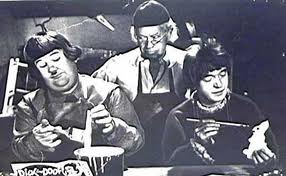
                                                                                                 

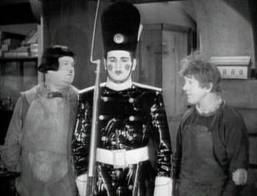
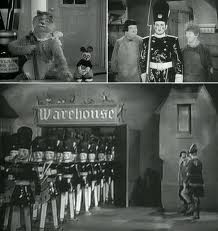
This is a delightfully silly fantasy amalgam of Fairy Tale characters with Laurel and Hardy at its center as Stanley Dum and Ollie Dee. The film’s story takes place in the fictional Kingdom of Toyland, inhabited by Mother Goose, Tom-Tom Piper, Mother Peep and Bo Peep, Stan and Ollie’s boss the Toymaker, and the evil Silas Barnaby, who holds Toyland in a constant threat of siege from his henchmen, the Bogey Men, who lurk just outside the gates of the city. Stan and Ollie live in a shoe, with “The Old Woman”, who turns out to be Mother Peep, her daughter Bo Peep, a mouse that is actually played by a monkey in costume, and so many children she didn’t know what to do. The mortgage on The Shoe is owned by the villainous Silas Barnaby, who has his eyes on the lovely Bo Peep. Stan and Ollie try to borrow enough money to pay off the mortgage from their boss the Toymaker, but the normally kindly gentleman is furious at our boys for mixing up an order from Santa Claus, and building one hundred Toy Soldiers six feet tall, rather that what Santa really wanted – six hundred Toy Soldiers one foot tall, so he fires them. With Stan and Ollie unemployed, and The Shoe in foreclosure, Barnaby’s got his clutches into Bo Peep, and the horrible Bogey Men are breaking down the gate to the city. All seems lost, until Stan comes up with the solution. “The Soldiers, the Toy Soldiers”, so our heroes wind up their army of one hundred six foot tall Toy Saviors, Victor Herbert’s March music begins to swell, and Toyland is saved in the nick of time.

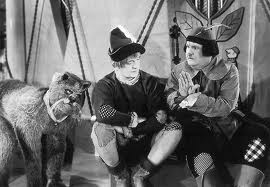
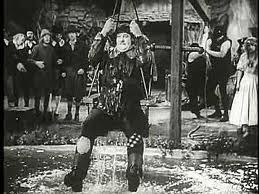
Directed by Gus Meins and Charles Rogers (whoever they are), Produced by Hal Roach, and released through MGM. Silly, delicious fluff that I must have seen 20 times down through the years. I can still hear that ‘March Music’.


http://www.youtube.com/watch?v=O1KgZX2D5Fg


THE BARON OF ARIZONA

1950   Sam Fuller
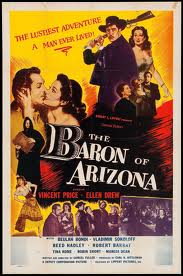
 

How can a person own a whole state? That’s the question I asked myself when I first saw this Hollywood ‘land-grab’ fantasy. But the fact is, it turns out to be based on a true story, as preposterous as that might seem, and not really a fantasy at all. It’s based on the story of master forger James Reavis, who, in the late Nineteenth Century, almost got away with taking over the entire State of Arizona, forging documents claiming that the area then called Arizona had been granted to his family by the King of Spain, centuries earlier. The U.S. government recognized land grants made when the West was under Spanish rule. This inspired James Reavis to forge a chain of historical evidence that made a foundling girl the Baroness of Arizona. Reavis married the girl and pressed his claim to the entire Arizona territory. And he almost gets away with it. Makes you wonder where John McCain would be today, had this delightful bit of mischief actually succeeded. The real James Reavis (1843 – 1914) was found guilty of creating forged documents, paid a fine of five thousand dollars, and spent two year in jail.

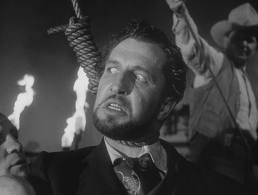
A nice turn here by Vincent Price, as the adventurous forger, and Ellen Drew as the foundling child, who almost became the Baroness of Arizona. Solid direction by war film maven Sam Fuller, and stunning, as usual, black and white lensing by the inimitable James Wong Howe. An aside – Ed Wood does a turn here as a stunt double.


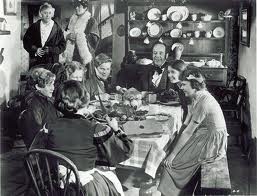
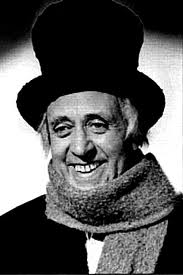
A CHRISTMAS CAROL

1951   Brian Desmond Hurst
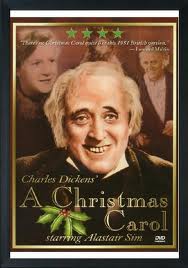
 

The one and only. So many movies have been produced from Dickens’ classic story (even my own), but this Alistair Sim version still holds up as the all-time champ. A wonderful story, simply told, with a bumbling, befuddled, and delighted Sim at its core. The word “humbug”, forever connected to this story and with the Scrooge character, is misunderstood by many people, which is a pity since the word provides a key insight into Scrooge’s hatred of Christmas. The word “humbug” actually describes deceitful efforts to fool people by pretending to a fake loftiness or false sincerity. So when Scrooge calls Christmas a humbug, he is claiming that people are only pretending to be charitable and kind in a scandalous effort to delude him, each other, and themselves. In Scrooge’s eyes, he is the one man honest enough to admit that no one really cares about anyone else, so for him, every wish for a Merry Christmas is one more deceitful effort to
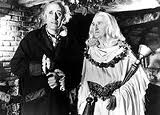
 fool him and take advantage of his good nature. This is a man who has turned to profit because he honestly believes everyone else will someday betray him or abandon him the moment he stoops to trust them.

At least, this is what he thought before that fateful Christmas Eve, when the spirit of his long-dead partner, Jacob Marley, made his ghostly appearance at Scrooge’s bedside, foretelling of the coming of three apparitions that would all appear to Scrooge that very night, in the hope of saving his soul. At the age of nine, I hadn’t read the Dickens book, and was unaware of the story, and this movie scared the bejesus out of me. Although this film is carefully directed, beautifully shot and art-directed, and a typically solid early-Fifties British Production, it’s Alistair Sim’s delicious performance, as the transformed miser, that drives the bus here.

Beyond Sim, there’s Mervyn Johns and Hermione Baddelee as the Cratchits, Michael Hordern as Marley’s ghost, George Cole as a hopeful but broken-hearted young Ebenezer Scrooge, and Glyn Dearman as Tiny Tim, who has the last word, “God bless us, everyone”.


http://www.youtube.com/watch?v=SpbthuKFuFA


THE GHOST AND MRS. MUIR

1947   Joe Mankiewicz


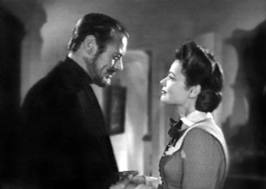
In early 1900s England, a young widow, Lucy Muir (a devastatingly beautiful Gene Tierney), moves to the seaside village of Whitecliff and into Gull Cottage with her daughter Anna (Natalie Wood)) and her maid Martha (Edna Best), despite

the fierce disapproval of her mother, and sister-in-law. She rents the house despite discovering that it’s haunted. On the first night in her new digs, she is visited by the ghostly apparition of the former owner, a roguish sea captain named Daniel Gregg (Rex Harrison), who reluctantly promises to make himself known only to her; Anna is too young for ghosts. When Lucy’s source of investment income dries up, he dictates to her his memoirs, entitled Blood and Swash. His racy recollections make the book a bestseller, allowing Lucy to stay in the house. During the course of writing the book, they fall in love, but as both realize it is a hopeless situation, Daniel tells her she should find a real (live) man.

When she visits the publisher in London she becomes attracted to suave Miles Fairley (George Sanders), a writer of children’s stories known as “Uncle Neddy” who helps her obtain an interview. Despite a rocky beginning, the publisher agrees to publish the captain’s book. Fairley follows her back to Whitecliff and begins a whirlwind courtship. Captain Gregg, initially jealous of their relationship, decides finally to disappear and cease being an obstacle to her happiness. He ends their relationship and convinces her that his ghostly apparitions were only a dream.  Shortly thereafter, while visiting her publisher in London (the book has become a bestseller), Lucy pays a surprise visit to Fairley’s home and discovers that, not only is Miles already married with two children, but that this sort of thing has happened before with other women. Lucy leaves heartbroken and returns to spend the rest of her life as a single woman in Gull Cottage with Martha to look after her.
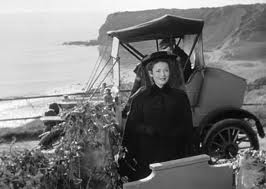
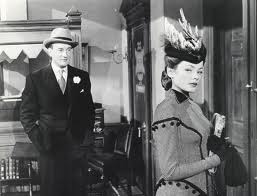
About ten years later, Anna (Vanessa Brown) returns to the cottage with her Navy Lieutenant fiancée and tells her mother that she knew about Captain Gregg and Miles Fairley all the time, rekindling faint memories in her mother of the captain (we also learn that Miles Fairley has become fat and bald and that his wife and children finally left him).

After a long peaceful life spent at the cottage, Lucy dies. This being a movie, Captain Gregg appears before her at the moment of her death – reaching out, he lifts her young spirit free of her old dead body. The two walk out of the front door arm in arm, into the mist. Two spooks in love, and together at long last.
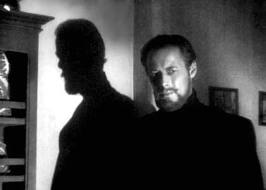
This movie hooked me from the very first moments, and kept my nine year-old eyes glued to that screen. Nicely directed by Joe Mankiewicz, and released by Twentieth Century Fox and Darryl Zanuck. I could spend my whole life in Gull Cottage by the sea, listening to Bernard Herrman’s fabulous music, and playing bridge with ghostly apparitions. I’m just saying………………….


http://www.youtube.com/watch?v=zN6S6FwT5HM


THE MAN IN THE WHITE SUIT

1951                Alexander Mackendrick
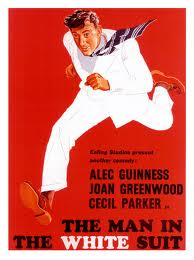
 

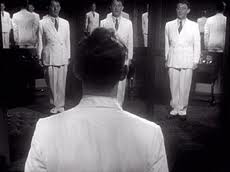
A delightful satirical comedy from England’s ever-fabulous Ealing Studios, who brought us The Lavender Hill Mob, and The Lady Killers. It followed a consistent  Ealing theme of the common man (Alec Guiness) against the establishment (everyone else). Sidney Stratton, a brilliant young research chemist and former Cambridge scholarship recipient, has been dismissed from jobs at several textile mills because of his demands for expensive facilities and his obsession to invent a long-lasting fiber. While working as a research chemist at the Birnley Mill, his daily toil accompanied by the constant, almost musical sound of bubbling liquids, he accidently invents an incredibly strong fiber which repels dirt and never wears out. From this fabric, a suit is made – which is brilliant white because it cannot absorb dye, and slightly luminous because it includes radioactive elements.

Stratton is lauded as a genius until both management and the trade unions realize the consequence of his invention – once consumers have purchased enough cloth, demand will drop precipitously and put the textile industry out of business. The managers try to trick Stratton into signing away the rights to his invention but he refuses. Managers and workers each try to lock him up, but he escapes.
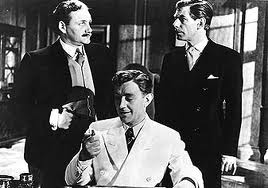
The climax sees Stratton running through the streets at night in his glowing white suit, pursued by both the managers and the employees. As the crowd advances, his suit begins to fall apart as the chemical structure of the fiber breaks down with time. The mob, realizing the flaw in the process, rip pieces off his suit in evil triumph, until he is left standing in his underwear. Only Daphne Birnley, the mill-owner’s daughter, and Bertha, a Mill laborer, have sympathy for his disappointment.

The next day, Stratton is dismissed from his job. Departing, he consults his chemistry notes, and slowly, an expression of revelation overcomes him, as we hear that sound of those bubbling liquids once more. “I see!”, exclaims young Stratton.  And off he goes, with another outlandish invention in his crosshairs.
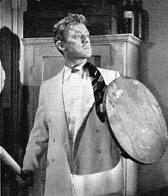
As a nine year-old, what I liked most was that the white suit glowed in the dark. Guiness, as usual, is a delight, as is Joan Greenwood – she of the voice like tinkling crystal. Early, and solid black and white lensing by British cinematographer Doug Slocombe. You might find a dvd of this at your local library – mine has all the Ealing classics. Grab it, if you can.


http://www.youtube.com/watch?v=8ri3JpPvplg


MR. PEABODY AND THE MERMAID

1948   Irving Pichel
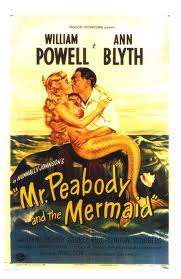
 

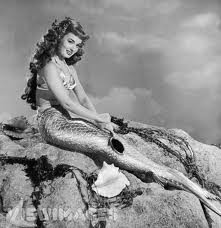
This one absolutely knocked me out. It was my first exposure to the idea that Mermaids were a possibility. This fish fantasy stars William Powell as Arthur Peabody, who is undergoing a mid-life crisis as he approaches his 50th birthday. Much of the story is shown in flashback as Peabody tells his skeptical doctor a fish tale for the ages.
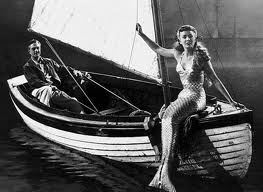
Peabody had gone on vacation with his wife Polly (Irene Hervey) to a sea side resort in Bermuda. One evening, he hears singing coming from the distant Key Ora, singing, the likes of which he’s never heard before. He asks s few of the locals, and some of them have heard it too, but long ago. So, our song-smitten hero decides to do a little fishing. To his surprise, he reels in a beautiful mermaid played by Ann Blyth. He names her Lenore (shades of Poe here), and although mute, Lenore is mischievous and childlike and not just a little bit alluring – so much so that before long Peabody has taught her the art of kissing. She shows him an extraordinarily beautiful comb, made from a shell, that she wears in her hair. He hides Lenore by letting her soak in a suds-filled bathtub, then later in the resort’s fish pond. But confusion ensues as his wife thinks he has a big fish in their bathtub and later suspects him of infidelity with Cathy Livingston (Andrea King), a vacationing singer. Things get even more complicated when, after an angry Polly returns home without Peabody, police suspect him of her murder. But they’re British Police (hey, it’s Bermuda), after all, and it would be uncivilized to arrest a man in his home, even if it’s a rental.
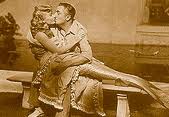
And Peabody hears that singing again, out from somewhere near Key Ora. Out in that thick fog bank. And off he goes in his little boat, searching for the lost Lenore. A wave capsizes his craft, and while trying to survive under the water, he see’s and reaches for Lenore’s beautiful comb.

We dissolve here, ending the fishy-flashback, to his shrink’s office, back in Boston. He’s told his story to a doubting psychiatrist, who knows a mid-life crisis when he see’s one. But wait – Peabody’s got something in his hand. Something he’s been holding all the while he’s been telling his tale. “What’s that”, asks his shrink. “Oh nothing”, say’s Peabody. “Just a comb I found somewhere”. “How extraordinary”, say’s the Doctor, “I’ve never seen anything quite like it before”. And we begin to hear that singing again, like the kind of singing that only comes from that thick fog bank, somewhere out near Key Ora.

Well, this being my first mermaid experience, I was just as smitten as poor Peabody – smitten, but combless.


http://www.youtube.com/watch?v=d7yTUTAS8Rc&feature=related


MR. PEEK-A-BOO

1951   Jean Boyer


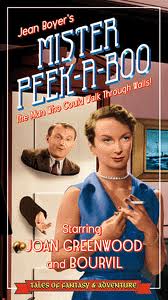
      This one also knocked me for a loop. In Paris, a simple civil servant named Léon, who has the unusual ability to walk through walls (who cares why – he can really do this), falls madly in love with a hotel thief by the name of Susan. He poses as Garou-Garou, a dangerous gangster to attempt to woo her affections, but is mistakenly arrested and sent to jail. While incarcerated, he annoys the guards by walking in and out of his cell, right through the bars, and the cell walls. It’s a bizarre, modern/fantasy/adventure/ romance.  It’s boy meets girl with an walk-through twist. Leon’s friends suggest he use his odd ability to become the criminal of the century, walking through bank vaults and off with the loot. But, Leon instead, see’s his strange gift as a way to help Susan, who is being blackmailed. A very moralistic tale – love triumphs over crime. The film stars Bourvil, as Leon, who up until this effort, had been a semi-successful French lounge singer and comedian; and the delightful Joan Greenwood (that voice again) as Susan the Cat Burglar. Fantasizing about having Leon’s abilities took up a great deal of my young life. The possibilities were endless. Unlike other films on this list, I confess to only having seen this that one time, on my family’s black and white Dumont, but I never forgot this delightful French fantasy. I know it’s a one trick pony – but what a trick.


ONE TOUCH OF VENUS

1948 William A. Seiter 
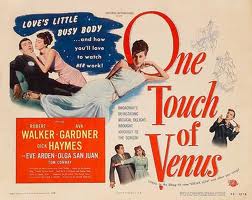
Kiss a statue, and it turns into Ava Gardner? Yikes! Since I’ve turned parts of this Blog into a my own private confessional, I might just as well go on record here, as having laid the smooch on countless pieces of marble and granite, in a futile attempt to recreate the aforementioned morphing, after seeing this movie, at the tender age of nine, in the confines of my basement. I even talked my puzzled parents into a trip to the Metropolitan Museum so that I could sneak up on renowned statuary and, when no one was looking, do some furtive fondling. The idea of possessing my very own Ava Gardner overwhelmed me, and probably was the beginning of my inability, throughout my life, to nurture and maintain a lengthy and lasting relationship with a member of the opposite sex. I was looking for a statue, instead. But, before I rant on about one of my favorite fantafilms, let me give you some of the surprising background for this production from Universal’s fluff department.


One Touch of Venus was a Broadway musical with the score written by Kurt Weill, lyrics by Ogden Nash, and book by S. J. Perelman and Nash, based on the novella The Tinted Venus by Thomas Anstey Guthrie, and very loosely spoofing the Pygmalion myth. The show satirized contemporary American suburban values, artistic fads and romantic and sexual mores. Weill had been in America for ten years by the time he wrote this musical, and his music, though retaining his early haunting power, had evolved into a very different Broadway style.

The original Broadway production opened at the Imperial Theatre on October 7, 1943 and closed on February 10, 1945 after 567 performances. The original production was directed by Elia Kazan and featured choreography by Agnes de Mille. It starred Mary Martin, Kenny Baker and Paula Laurence. Marlene Dietrich reportedly backed out of the title role during rehearsals, calling it “too sexy and profane”, which gave Martin the opportunity to establish herself as a Broadway star. The show was made into the 1948 film, directed by William A. Seiter and starring Ava Gardner and Robert Walker. The movie version omitted much of the Broadway score and received poor reviews.
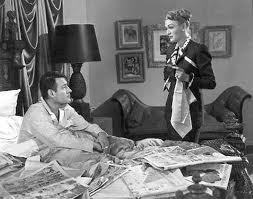
OK, enough surprising background. Let’s get back to kissing a statue and getting Eva Gardner in the bargain. Wealthy department-store mogul Whitfield Savory II (Tom Conway) buys a statue of Venus for $200,000. He plans to exhibit it in the store.

Eddie Hatch (Robert Walker), a window dresser, kisses the statue on a whim. To his shock, Venus comes to life as Eva Gardner. She leaves the store and Eddie is accused of stealing the work of art.

Nobody believes the truth, including secretary Molly Stewart (the one and only Eve Arden), who is Savory’s right-hand woman, and Kerrigan (James Flavin), a detective. Venus turns up at Eddie’s apartment, forcing him to hide her from girlfriend Gloria and roommate Joe.

Entranced by Venus’s song of love, Joe falls for Eddie’s girl Gloria. At the store, meanwhile, Venus has fallen asleep on a sofa and is discovered there by Whitfield, who is instantly smitten.
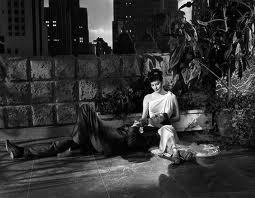
Kerrigan decides it’s time for Eddie to be placed under arrest for the statue’s theft. Venus, to save Eddie, is willing to seduce Whitfield, but a threat by Molly to leave him brings Whitfield back to his senses. He realizes it’s Molly he truly loves. Aw Geeze.

Venus is called home by Jupiter and must return to Mount Olympus, so she returns to her pedestal. Whitfield can now display his work of art to the public. Eddie is the only one left alone, at least until he meets a new salesgirl who is, I’ll bet you knew this was coming, a dead ringer for the goddess of love.

I’ve spent my life trying to turn marble into flesh, only to find that the opposite usually happens.

  

http://www.youtube.com/watch?v=6STa-t34Z9c


THIEF OF BAGDAD

1940      Michael Powell, Ludwig Berger, and Tim Whelan
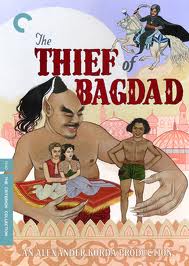
 A fantasy for all seasons! Years ahead of its time, in special effects, cinematography, and directorial vision, this movie, maybe more than any other, just plain blew my sox off. When the giant genie, all 100 feet of him, lowers his hand, allowing Sabu to climb aboard, and then flips the little fellow up onto his shoulder, telling him to take hold of the long pig tail, and with Sabu holding on for dear life, and an echoing, thunderous laughter, the Genie takes flight, I just stood up and started screaming…..screaming! I couldn’t contain my joy.
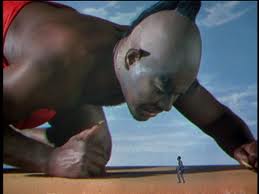
 OK, I’ll calm down now, enough to explain the story. Ahmad (John Justin), the naive King of Bagdad, is convinced by the evil Grand Vizier, Jaffar (Conrad Veidt), to go out into the city disguised as a poor man to get to know his subjects (in the manner of his grandfather Harun al-Rashid). Jaffar then has Ahmad thrown into a dungeon, where he is joined by Abu the thief (Sabu), son of Abu the thief, grandson of Abu the thief. Abu arranges their escape.

They flee to Basra, where Ahmad becomes acquainted with its Princess (June Duprez). However, Jaffar also journeys to Basra, for he desires the Princess. Her father, the Sultan (Miles Malleson), is fascinated by the magical mechanical flying horse Jaffar offers and agrees to the proposed marriage. Upon hearing the news, the Princess, by now deeply in love with Ahmad, runs away. Confronted by Ahmad, Jaffar magically blinds him and turns Abu into a dog; the spell can only be broken if Jaffar holds the Princess in his arms.
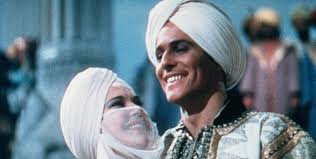
The Princess is eventually captured (but not recognized) and sold in the slave market. She is bought secretly by Jaffar and taken to his mansion, but falls into a deep sleep from which he cannot rouse her. Ahmad is tricked by Jaffar’s servant Halima (Mary Morris) into awaking the Princess. Halima then lures the Princess onto Jaffar’s ship by telling her that there is a doctor aboard who can cure Ahmad’s blindness. The ship immediately sets sail. Jaffar informs the Princess about the spell; she allows herself to be embraced, whereupon Ahmad’s sight is restored and Abu is returned to human form. They chase after the ship in a small boat, but Jaffar conjures up a storm to shipwreck them.

Abu wakes up alone on a deserted beach and finds a bottle. When he opens it, an enormous djinn or genie (Rex Ingram) appears. Embittered by his long imprisonment, the genie informs Abu that he is going to kill his rescuer, but Abu tricks him back into the bottle. The genie then offers to grant Abu three wishes if he will let him out again. The hungry boy uses his first wish to ask for sausages. When Abu demands to know where Ahmad is, the genie flies Abu to the top of the highest mountain in the world. On it sits a temple, and in the temple there is an enormous statue with a large jewel, the All-Seeing Eye, set in its forehead. The genie tells Abu that the Eye will show him where to find Ahmad. Abu fights off a giant guardian spider while climbing the statue and steals the gem.

The genie then takes Abu to Ahmad. When Ahmad asks to see the Princess, Abu has him gaze into the All-Seeing Eye. Ahmad despairs when he sees Jaffar arranging for the Princess to inhale the fragrance of the Blue Rose of Forgetfulness, which makes her forget her love. In agony, Ahmad lashes out at Abu for showing him the scene. During the ensuing argument, Abu unthinkingly wishes Ahmad to Baghdad. The genie, freed after granting the last wish, departs, leaving Abu alone in the wilderness.
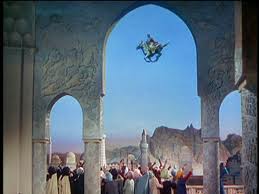
Ahmad appears in Jaffar’s castle and is quickly captured, but seeing him restores the Princess’s memory. The furious usurper sentences them both to death. Abu, unable to watch his friend’s impending doom, shatters the All-Seeing Eye and as a result is transported to the “land of legend,” where he is greeted by the Old King (Morton Selten) and thanked for freeing the inhabitants, who had been turned to stone. As a reward, he is given a magic crossbow and is named the king’s successor. However, in order to save Ahmad, he steals the king’s magic flying carpet and rushes to the rescue.

Abu’s marvelous aerial arrival (which fulfills a prophecy often cited in the course of the story) sparks a revolt against Jaffar. Abu kills the fleeing Jaffar with his crossbow, and Ahmad regains his kingdom and his love. However, when Abu hears (with growing alarm) Ahmad tell the people of his plan to send him to school to train to become his new Grand Vizier, Abu flies away on the carpet to find his own fun and adventure.
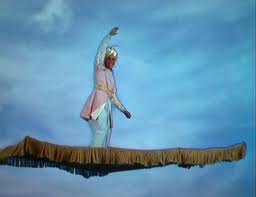
Did you get all that? Just checking. And every frame is gorgeous and thrilling. Nominated for four Oscars, it won three: Best Cinematography, Special Effects, and Art Direction. Shooting began in England, but with the outbreak of WWII, the picture was finished in Hollywood. Produced by Alexander Korda, it took three directors to make this happen; Michael Powell (later to dazzle with The Red Shoes, Black Narcissus, and many more), Ludwig Berger, and Tim Whelan. Absolutely dazzling, from beginning to end.


http://www.youtube.com/watch?v=JrpukRr3c9s


TOPPER

1937      Norman McLeod 
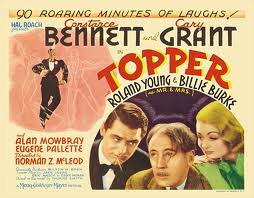
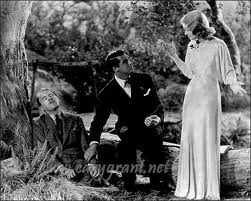
Well, we’ve come down to it – ghosts, fun loving, hard drinking, practical joking ghosts. Appearing and disappearing at will. What could be better? Those funloving Kerbys, George (Cary Grant) and Marion (Constance Bennett), stockholders in the bank of which henpecked, stuffy Cosmo Topper (Roland Young) is president, drive recklessly once too often and become ghosts. In limbo because they’ve never done either good or bad deeds, they decide to try a good one now; rehabilitating Topper. Lovely, flirtatious Marion takes a keen personal interest in the job. Will Topper survive the wrath of jealous ghost George? Will Mrs. Topper (Billie Burke) find that a scandalous husband isn’t all bad?

“Topper”, a delightful and original film directed by Norman Z McLeod, should be on everybody’s ‘must see’ list. It is one of the best films Hollywood produced, at the height of the madcap comedy craze of the thirties. Just to watch Roland Young, Constance Bennett and Cary Grant in the same film is pretty delicious.

 Constance Bennett and Cary Grant made a fabulous couple. Ms. Bennett had the uncanny gift of blending with all her leading men well. She was a charming actress with such a sense of style and an amazing figure to boot that made her an irresistible presence on the screen. Cary Grant is also seen at his best in the film as the carefree  and fun loving George Kerby.

 But it’s Roland Young who steals the show! He plays the staid banker Cosmo Topper, who is all business until he starts being made the object of the Kerby’s antics. Cosmo Topper’s wife is the incomparable Billie Burke, the Queen of Ditz.

 Produced (uncredited, for some reason) by Hal Roach, shot by Norbert Brodine, and music by Marvin Hatley, Topper, referred to as ‘Toppie’ by Ms Bennett, makes me happy every time I see it. Delicious fluff!
  

http://video.tvguide.com/TOPPER/3590449


© 2011 Shaun Costello

Keep SHAUN COSTELLO’S BLOG up and running.
Creating and maintaining this BLOG is time
consuming. If you like what you’ve been reading,
please help me keep it going.
DONATE ANY AMOUNT Through PAYPAL at:

A DAY AT THE RACES

A DAY AT THE RACES

Remembering Steeplechase Park

By Shaun Costello


When I was nine years old I lived at Nine Elderberry Lane, in the suburban subdivision of Green Acres, a delightfully park-like, child-friendly community, in Long Island’s Nassau County – about a forty minute car ride from midtown Manhattan. I’m not sure if this effected my lunar alignment, but during my short, ill-fated liaison with the Cub Scouts that year, I was assigned to Den Number Nine – the third in an inexplicable series of numeric coincidences that would connect me to this ninth digit throughout my life.

We lived in a two story brick house that was identical to every fourth house in the community, Green Acres offering four designs to choose from. This meant that on Elderberry Lane, which had a total of fourteen houses, our house was repeated three or four times, pretty typical in post World War II cookie-cutter subdivisions. Our house design was shared with the Coopers, the Ainbinders, and one other family whose name escapes me. The Calise’s house was identical to the Lupo’s, and two others, whose occupant’s identities have long since disappeared, along with most of my memory cells. The Noke’s house was duplicated by the Kelly’s, who lived across the street from my family, and two others who lived on the North end of the street. Sounds a bit like Baltimore, but people seemed to find their way to their own houses unaided, with the exception of my philandering father, who was often accused by my mother of spending just a bit too much time offering domestic assistance to neighboring housewives, which was the cause of many interruptions in our familial tranquility. Virtually all of the streets in Green Acres were cul-de-sacs, which meant no through-traffic, or paradise to a kid on a Schwinn. Sections of the community were separated by small parks, so that you could walk from one end to the other without crossing a single street, allowing our extremely eccentric Dachshund ‘Ronzoni’ to wander freely about the neighborhood, sometimes for days at a time.

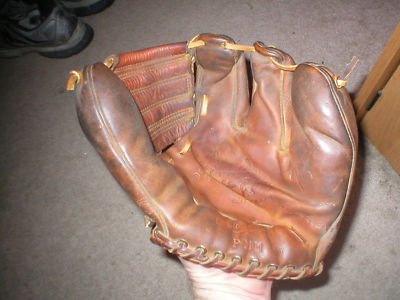
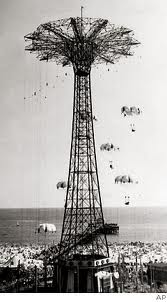
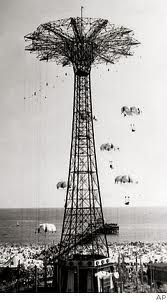
Our house had a finished basement, which was the location of extremely noisy New Years Eve parties given by my parents, and the family television, a large black and white Dumont, which thrilled me with episodes of Flash Gordon, Davey Crockett, The Wonderful World of Disney, and sporting events like the World Series, and the Kentucky Derby. There were two bedrooms on the first floor, one for my parents, and the other for my little sister.  The second floor however, was all mine, and I reveled in the privacy of my domain. My room was filled with the typical accoutrements of masculine childhood: my Rawlings Stan Musial baseball glove, a junior-sized Louisville Slugger bat, assorted books and box games, my comic book collection, a fairly large Emerson radio on which I listened to serials like The Green Hornet, The FBI In Peace and War, Gang Busters, and Sergeant Preston of the Mounties and his dog Yukon King. In drawers and on shelves were lots of little metal soldiers, painted appropriate colors, some of which defended my model of Fort Apache against the heathen redskin, in the never-ending battle to tame the frontier. In my closet was a large box containing my Lionel Electric Trains, which I took out and assembled whenever I was overtaken by the need for a railroad experience. Lost amongst the kiddy-clutter, unless you knew where to look, was a small, metal statuette of a tower, not quite six inches tall. This was a souvenir of my greatest childhood experience. A replica of the tower from which I had taken a leap into the great unknown, floating almost weightlessly through the air, slowly descending toward the dense crowd of bathers that covered the beaches of Brooklyn. It was the day I took the Coney Island Parachute Jump, just a few years  before they finally shut it down.

I’m not sure how many times my family made the ritualistic trek to Coney Island, but it had to have been at least once a year since I was five. I say ritualistic because the day’s activities developed into a pattern that never changed. Our family of four would pack ourselves into our freshly washed Nash Rambler Station Wagon, my father at the wheel, telling stories of his own childhood trips to Coney Island from his family’s home in the Bronx, as we left the suburban confines of Green Acres, taking the Belt Parkway past Idlewild Airport, and following the Atlantic coast of Queens and then Brooklyn, until arriving at the bastion of exotic entertainment possibilities that was Coney Island. Oh, what joy.

My father was tour guide, and pretty much supervised the day’s agenda which, after parking the car, always began at The Cyclone, the world’s largest wooden roller coaster. My father mainly served in an organizational, as opposed to a participatory capacity. He would watch while we went on the rides, but The Cyclone was different. Maybe it served as some conduit to memories of his childhood, or possibly a challenge to his masculinity, but riding The Cyclone was always first on my father’s Coney Island agenda, and he always rode with the rest of us. You waited on line for the coaster cars to come a halt, the attendant releasing the safety bars that allowed the dizzy, exhausted, riders to stagger to their feet, and make their woozy exit. You jumped into one of the empty cars (the first was best), and waited for the safety bar to lock you in. The cars began to move slowly forward, until you found yourself in a dark tunnel, suddenly bombarded with blaring horns and flashing lights, meant to tantalize those of us to who confused mortal terror with fun. And then we were in the light again, as the car-train began the ascent to the inevitable, gravity-driven plunge into five minutes of thrill-ride that you hoped could be accomplished without the occupants of the car ahead of you losing their lunch.

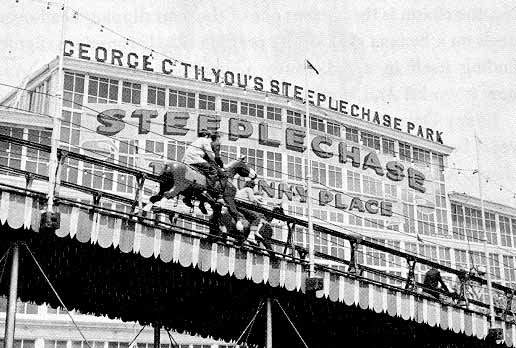
And next, as always – Nathans.  The men in the family wolfed down a few hot dogs, while my mother had something called a Shrimp Boat, and my sister, always a picky eater, had to be cajoled and persuaded into eating anything at all – probably something disgustingly sweet like a candy apple. Once properly satiated with junk food, we took the short walk down Surf Avenue to the entrance of the building that housed the most extraordinary assortment of sensory pleasures since man discovered fun – Steeplechase Park.

Steeplechase Park was the brainchild of George Tilyou, who saw the ferris wheel at the World’s Columbian Exposition in Chicago in 1893, and decided to build a bigger wheel back on Brooklyn’s Coney Island, where his family had restaurants. Tilyou’s enormous Wonder Wheel quickly became Coney Island’s biggest attraction. He surrounded the Wonder Wheel with many other rides and attractions, including a mechanical Steeplechase ride, that raced around the borders of the park, giving the popular amusement venue its name. Steeplechase Park was swept by fire in 1907, and almost totally destroyed. The morning after the fire Tilyou posted a sign outside the park. It read:


To enquiring friends: I have troubles today that I had not yesterday. I had troubles yesterday which I have not today. On this site will be built a bigger, better Steeplechase Park. Admission to the burning ruin – Ten cents.


The park reopened for business in 1909, and contained a “Pavillion of Fun”, an indoor venue that covered five acres. At the close of the 1939 World’s Fair, Tilyou purchased the Fair’s Parachute Drop, and moved it to Steeplechase Park. The ride, which was originally a training device for paratroopers, became popular until the end of World War II, and wound up outliving the park itself, operating until 1964. Too expensive to tear down, the tower was finally declared a “Landmark” in 1977, and added to the National Register of Historic Places. Today, it is the only remaining artifact of Steeplechase Park.

As I remember, and this reminiscence is mainly from memory, tickets to Steeplechase Park were purchased at the entrance, and entitled the bearer endless and repeated participation on any of the attractions in the park. The popularity of an attraction would limit the number of times you could participate. The most popular ride was, of course, the Steeplechase itself, the line for which could sometimes take two hours, so it was a ‘one time’ attraction, and worth the wait. The smaller, but still exciting attractions inside the building, had lines that might be as short as ten minutes, so you could repeat the experience until you dropped, or until your parents lost patience with your hunger for thrills. Almost everything inside the five acre ‘Pavillion of Fun’ was made of wood that, over the half century of use, had become the smoothest, softest surface imaginable. My favorite interior ride was a tower that was accessible by a long stairway, and contained a circular slide inside itself. You entered at the top, and by the time you reached the bottom you were moving fast enough to be propelled out onto the surface of an enormous wooden disc, some seventy five feet in diameter that was rotating clockwise. The disc contained on its surface, many smaller discs that were rotating both clockwise and counter clockwise, spinning its delighted victims from disc to disc, in many directions, until finally dumping them into a surrounding pit. The trick, of course, was staying on as long as possible, until too exhausted to stay on, you slid off into joyful oblivion.

The Barrel of Fun was another favorite. A hollow wooden cylinder, about twelve feet in diameter, and fifty feet long, that slowly revolved, dumping squealing thrill seekers all over each other. The Human Roulette Wheel was a raised, round, wooden platform, maybe thirty feet across. About fifty thrill riders would climb aboard, and the platform would begin to revolve, slowly at first, then faster, and faster, until the centrifugal force dumped the last passenger out into the smooth wooden circle surrounding it. This was a ‘last man standing venue’, and the last one off was given a prize. My father watched me try most of the more adventurous rides, while my mother accompanied my little sister on the smaller, slower slides and merry-go-rounds.

We were now about half way through our allotted five hours at Steeplechase Park, and thought had to be given to the two hour line for the Steeplechase ride itself, which was always the culmination of our day at the park. Usually, one parent and one child would take a place on the line, to be replaced by the other parent and child, in shifts. It was cheating of course, but not a serious enough breach in the line code for anyone to grumble much about. My father suggested my mother and sister taking the first line shift, while the men of the family walked about. This happened during every visit to Steeplechase, and I knew what was coming.

We wandered in the direction of the exit, my father suggesting that he needed a break. This was just another familiar element in the agenda of the day. Exiting the cacophonous thunder of Steeplechase Park, out into the bewildering quiet of Surf Avenue was always a shocking transition. My father led the way, like a man who knew where he was going, without necessarily having been there before. But, he knew what he was looking for, and within a few blocks, found it. We entered the darkened, smokey room, and my father’s pace noticeably quickened, like a man drowning in a churning sea of self-doubt, and entirely too much familial contentedness, who had been thrown a rope, that dragged him toward safety, and, arm over arm, he pulled himself closer and closer until an understanding face with a knowing nod silently enquired as to the brand of assistance he might need. “A VO Manhattan, on the rocks, and a coke-a-cola for my uncle here”, answered the familiar voice that was lost, but now was found. I had accompanied my father to many bars like this one, and they all seemed the same. Silent people, mostly men, sitting on bar stools, staring down at glasses filled with dark liquid, or at a soundless, fuzzy television screen, seeking salvation from their daily drudgery amongst fellow passengers who had all boarded at different stops, but seemed headed toward the same destination.

Not much was said here, the lingua franca of the cocktail lounge being the knowing nod. I sipped my coke, all the while awaiting the crunchy sweetness of the maraschino cherry that now sat at the bottom of my father’s glass, but would soon be passed to me as peace offering, and payment for both my silence, and my company. My father, as always, sat quietly sipping his VO Manhattan, temporarily relieved of the responsibility for having experienced entirely too much of someone else’s idea of a good time for one afternoon.

The line for the Steeplechase ride had surprisingly shortened by the time we rejoined my mother and sister, who were in immediate need of a bathroom break. As I think back on the safety precautions that were taken for the riders of the park’s famous Steeplechase Ride, there is simply no way that this kind of danger would be allowed, much less legally sanctioned, in today’s liability culture. Eight wooden horses, each carrying two riders, and mechanically propelled along a monorail, just fast enough to thrill the squealing riders, up and down manufactured hills, all the way around the outside border of the five acre building, to a finish line off in the distance that came all too soon. Children were allowed to ride, not by their age, but by their height. There was a line drawn on the wall next to the entrance, and if you were tall enough, you got to go, if not, you went back to your family, crying and squealing, having experienced crushing disappointment. The only safety precaution taken was a small leather harness that I doubt would have prevented you from falling to serious injury, not to mention death. By now, I had ridden the Steeplechase enough to understand that boys like me had no shot whatsoever at riding the winning horse. The winner was, of course, determined by the ride operator, who always let cute little girls win at his venue. The

horses all left together at the start, exchanging the lead often to make the whole experience seem more competitive. The Steeplechase was the only ride, other than The Cyclone, that my father liked, so he mounted a horse with me, and my mother rode with my little sister.

The thrill of this experience is beyond description. The course was about fifty feet above street level, and surrounded the entire park, so you’re holding on for dear life while riding over Surf Avenue, and past the fringe of the Boardwalk, and the ocean, and cars with beeping horns, and the constant whirring sound of the mechanics of the equine vehicle you’re astride, and then the thrill of the false finish, and the ultimate disappointment of losing to some cute little girl, who walks off with a Blue Ribbon.

So, we had done it – five glorious, thrill-filled hours at Steeplechase Park, that left you with an exhausted sense of accomplishment, and satisfaction. But, it was not over – not yet. There was one more necessary, although sorrowful element to this saga. One more tearful, groveling, begging, pleading fit of humiliating condescension, dear reader, all perpetrated  by me, as I begged my parents to let me ride the Parachute Jump, all the while knowing that there wasn’t a chance in hell they’d let me do it. You can not ride alone on the Parachute Jump, and my father had laid down the law. NO WAY! My father wouldn’t go with me, and they wouldn’t let me ride with a stranger. I knew my begging was folly, but was willing to experience the humiliation, just in case.

So, we found our Nash Rambler Station Wagon, got back on the Belt Parkway, and took the short drive to Sheepshead Bay, the last destination of the day. The last element in our Coney Island ritual – dinner at Lundy’s. Lundy’s was an enormous restaurant, specializing in seafood, that had been open

since my father was a kid, and no visit to the Borough of Brooklyn would be complete without chowing down on one of Lundy’s lobsters. So that’s exactly what we did. My father and I ordered the Lobsters, my mother, as always, had fried shrimp, shrimp being the only seafood she would eat, and my sister, who had to be cajoled and persuaded to eat anything at all, probably had a shrimp cocktail.

So, our day was over, but not this story. I haven’t told you about the tower yet. About my leap into the great unknown. About my most thrilling childhood experience.  Let’s play back the day’s events exactly as they happened: the car ride in our Nash Rambler Station Wagon, past Idlewild Aiprport, and our arrival in Coney Island. The ride on The Cyclone, lunch at Nathans, Steeplechase Park, my father’s temporary salvation in the cocktail lounge, and the Steeplechase ride. And finally, dinner at Lundy’s. Let’s do it all exactly the same way, but this time add the element of two additional characters.

My father had a boyhood friend named Alex Mechanic, who I had known all my life, and who worked on the Ocean Liner S.S. United States. I’m not sure what he did exactly, but he was at sea most of the time, visiting exotic ports of call like Southampton (UK), Bremerhaven (West Germany), and LeHavre (France) on a regular basis. And he always brought back toys for me as presents, the best being from Germany. So somewhere along the way, Alex met and fell in love with a French woman named Maurice Plumile, who he brought to America to be his bride. I suspect that my parents had a hand in sponsoring Maurice’s presence in America, because, when she first arrived, she stayed with us for a month or so. Or, until Alex could find them an apartment somewhere in Queens. Most of what I remember about Maurice’s tumultuous stay in our house was her cooking, which drew ooh’s and ah’s from all concerned, causing my mother to have a series of anti-Maurice meltdown fits, that resulted in a ‘her or me’ ultimatum, upon which the woman was resettled in her new Queens apartment. Maurice, insecure on unfamiliar turf, did what most newly immigrated people do, she complained. “Thees ees not like France. Een France theengs are much better. I can not eat thees food. They eat like barbarians here. Thees ees not like France”. This went on until my mother finally exploded. “If things are so great in France, what the hell is this woman doing in my house?” So, off went Maurice with her sailor boy Alex, to their Queens love-nest, and the cuisine at 9 Elderberry Lane sadly returned to burned meat and frozen vegetables.

In time, Maurice found a job as a manicurist somewhere near her love-nest, and my mother’s furious resentment settled down enough to allow Alex and Maurice to visit on a regular basis. At my father’s suggestion, an invitation was extended to Alex and Maurice to accompany our family on a journey to Coney Island, and so we did just that, and the six of us crammed into our Nash Rambler Station Wagon, ready to share the experience.

So it began, this time with six of us; riding The Cyclone, eating at Nathans, doing Steeplechase Park, sneaking off for secret drinks (this time I got two maraschino cherries), taking the Steeplechase ride, and now it was time for my ritualistic fit of crying, begging, and groveling in the off chance that my parents would remotely consider my Parachute Ride. And I got the usual reaction: NO, NO, NO, NO! And then the impossible happened. Alex Mechanic spoke up, “No, wait. I’ll go with Shaun. It’ll be fun. I’d love to do it”. And just like that, my life was transformed. What could my parents do? They had to agree. Alex would go with me, and we got on line. Nine year-olds are fearless, and I was no exception, but the chair that you sat in on the Parachute Jump was even flimsier than the harness on the Steeplechase Ride. A simple wooden chair for two with a wooden safety bar, and leather belt of some kind. Madness! Not that I considered it at the time, but this thing was downright dangerous. The height at which the victims were released was 260 feet. The thought of it now makes me shiver. But, Alex and Shaun were strapped in, and slowly we rose above the hustle-bustle of the beach crowd, silently climbing higher, and higher, the noise of the lift’s mechanism growing louder as we approached the top. Off to the East we could see the Long Island beaches for miles and miles. And to the West New York’s vast harbor, and behind us Manhattan’s skyline, and then it happened. There was a loud cracking sound as our chute was released into a free-fall of about fifty feet, until the mechanism caught us, stopping the fall. The stopping of the free-fall was so abrupt that we were both lifted what seemed like a few feet off our skimpy wooden chair, crashing back into it as we settled into the gradual and mechanically-aided descent. From here on in, the view was the thing, and we savored it. I’m not sure of the elapsed time of the entire event, but it seemed much longer than it probably took. My parents, my sister, and Maurice were waving as we descended, and we joined them on the ground. I had done it. Finally! After years of pathetic groveling, all it took was someone to say, “No, wait. I’ll go with Shaun”.

I bought the statuette of the tower at the concession’s booth, next to the exit, and it immediately found a place of honor in my room – something to boast about, exaggerate about, add adjectives to, until it became another story entirely – told among boys who tend to boast. That trip was my family’s last journey to Coney Island. And the only time I took the para-plunge. As an adult, I visited the rapidly decaying community two or three times a year. Steeplechase Park was long closed, and the whole place seemed smaller with each visit, slowly becoming a haven for drugs and hookers and the accompanying dangers of that element. During a winter visit in the early Seventies I found a starving, abandoned guard dog, in a fenced-in area that contained a ride that was closed for the season. I broke through the fence, and cautiously approached the starving animal, who timidly licked my hand. I carried her, she couldn’t walk, to my car, put her in my trunk, and took her to New York’s amazing Animal Medical Center on York Avenue in Manhattan. She weighed only thirty five pounds. I named her Miss Coney Island, and she remained with me for another eight years, living with me in the country, up in Ulster County, and growing to be a vigorous 110 pound Belgian Shepherd.  

As my family’s last Coney Island Adventure came to a close, and we began to walk away from the glorious venue of my one and only para-experience, Alex Mechanic, who had come to my aid, and my salvation, enabling me to take that leap into the unknown for which I would forever own bragging rights, and who was walking just ahead with my father, suddenly stopped and turned around, slapping his hands together and rubbing them back and forth, looked right at me and said, “What do you say, young man? How about some lobster?”


*

© 2011 Shaun Costello

Keep SHAUN COSTELLO’S BLOG up and running.
Creating and maintaining this BLOG is time
consuming. If you like what you’ve been reading,
please help me keep it going.
DONATE ANY AMOUNT Through PAYPAL at:

CHRISTIAN AMERICA

CHRISTIAN AMERICA

Revisionist History, Pulp Fiction, and new set of Graphite Irons.

By Shaun Costello

 Bewildering as it might seem to those who actually take the time to think about it, not to mention the efforts of founding fathers like Thomas Jefferson who tried to prevent it, America considers itself a Christian Nation. Even though prayer in public schools has long since been abolished, and federal funding of faith based activities is allegedly monitored by our three branches of government; during the almost two hundred years preceding the implementation these much-needed and often questioned safeguards, Christianity sank its teeth so far into the fabric of our Nation that removing the embedded dental debris is now impossible. The idea of deleting slogans like “In God We Trust” from our money, or public buildings would be political suicide to any enterprising public servant foolish enough to suggest it. And that’s OK, I guess – what harm does it do? But Fundamentalist Christians not only want to propagate their beliefs, at the public expense, they want America to have a National Religion – theirs. And a set of laws based on their beliefs. The  Florida Senate is in the midst of debating legislation the would make it illegal to obtain an abortion, regardless of the  circumstances of the pregnancy, without the pregnant woman involved first seeing a sonogram image of the fetus. Perhaps the woman in question should also be required to view the Shroud of Turin.

Christians have an exaggerated sense of entitlement regarding their relationship with America – basically that it belongs to them, and coloring their chronicle as the stalwart founders and defenders of the nation, any which way they choose, is their birth-right. But, it’s not just revisionist meanderings about American history that intrigues and befuddles them, but the history of their own religion, as well. Ninety percent of Christians think Jesus (if there was such a person) spoke Hebrew. Of course, the lingua franca of that time and place would have been Aramaic, but simple facts such as that seem unimportant to the true believer. Eighty percent of all Christians believe that Saint Paul (if there really was such a person) was a contemporary of Jesus. Of course, the person historically known as Saint Paul, who is alleged to have been born in 67 AD (AD-that’s after the death of Christ – for those keeping score), was more likely to have been several different people, who lived and successfully propagated and propagandized the neo-messianic political cult that became known as Christianity, between the mid-first century, and two hundred years after the death of the aforementioned Jesus.

And those Gospel guys; Mathew, Mark, Luke, and John – whom almost all Christians believe to have authored those compelling stories, signed in their Anglicized noms de plume. Of course, these

 stories were gleaned from folk lore handed down over several centuries, and compiled by medieval monks into the volumes that became known as the New Covenant, or New Testament.

Christianity got its first big break at the conversion of Emperor Constantine, also known as Constantine the Great, the first Christian Emperor of Rome, who issued the Edict of Milan in 313 AD, making tolerance of all religions, particularly his newly acquired Christianity, the law of the Empire. So the missionaries carried the word north, on the shoulders of the Roman Legions, and the rest was easy. The Christian storybook, which was never intended to be taken literally by its readers is, unfortunately, taken quite literally by Christian fundamentalists, who see no reason to question any of what they see as God’s word. They seem to want to force their particular beliefs on the rest of us, but can’t seem to get the particulars of those beliefs straightened out.

I live in Florida, where Jesus, who lives in South Carolina (see the signage), plays golf regularly with Elvis, Michael Landon, and former President Ford. Hey, I’ve seen them, and it’s every bit as feasible as the Christian Storybook, and considerably more entertaining.


(In Jefferson we trust) 

*

© 2011 Shaun Costello


Keep SHAUN COSTELLO’S BLOG up and running.
Creating and maintaining this BLOG is time
consuming. If you like what you’ve been reading,
please help me keep it going.
DONATE ANY AMOUNT Through PAYPAL at:
Design a site like this with WordPress.com
Get started