Short stories and essays by Shaun Costello, as well as excerpts from manuscripts in progress.

Latest

THE TEN BEST PRIVATE EYE MOVIES

 THE TEN BEST PRIVATE EYE MOVIES

Ten rainy day whodunits that have stood the test of time.

By Shaun Costello


Just exactly who was the best cinematic Private Eye, anyway? For my money, Phillip Marlowe is tough to beat, even though he was beaten up fairly often, staggering to his feet after being cold-cocked with a heavy object (usually a gun butt) held in the hand of a beguiling femme fatale who had gotten the drop on him. Marlowe leads the chase in three of the titles I’m listing here, and is played by three different actors.  Two of these films were adapted from the same book, Raymond Chandler’s Farewell My Lovely. The first, Murder My Sweet (1944) was renamed as box office strategy, which I suppose worked, to a degree. And, the 1975 remake with the original Farewell My Lovely title intact. The third Marlowe caper, Howard Hawks’ The Big Sleep, had maybe the greatest writing team ever assembled, even though the audience had a tough time figuring out what, in God’s name, this movie was about. Sam Spade, a Dashiell Hammett creation, and a Marlowe contemporary is of course, the chief sleuth in The Maltese Falcon, which has Bogie and Huston and the fabulous Warner Bothers repertory company, and lines like, “You’re good. You’re very good”.   

But, what about Sherlock Holmes, Hercule Poirot, Nick and Nora Charles and their clue-finding pup Asta, Mike Hammer, Jake Gittes – snappy snoops all; tough, relentless, with a curiosity that won’t quit. These guys will stop at nothing in getting to the bottom of things, sorting out the details, finding out exactly who killed whom, and why.


In alphabetical order:

The Adventures of Sherlock Holmes

Alfred L. Werker   1939


The best of the Basil Rathbone/Nigel Bruce Holmes/Watson capers, from Fox and Darryl Zanuck. Holmes and Watson again do battle with that criminal genius, Professor Moriarty, nicely played here by George Zucco. And, this one’s got the fabulous Ida Lupino to add a bit of heat.
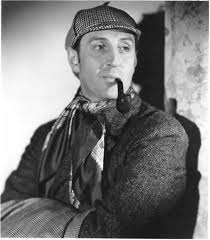
Moriarty has a plan to make off with the Crown Jewels, but Holmes stands in his way. Juicy Holmesian dialogue like:

Holmes, “You’ve a magnificent brain, Moriarty. I admire it. I admire it so much I’d like to present it pickled in alcohol to the London Medical Society.”
Moriarty, “That would make an interesting exhibit. Holmes, you’ve only now barely missed sending me to the gallows. You’re the one man in England clever enough to defeat me. The situation has become impossible.”
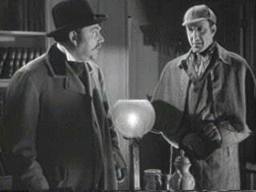

Holmes, “Have you any suggestions?”
Moriarty, “I’m going to break you Holmes. I’m going to bring off right under your nose the most incredible crime of the century, and you’ll never suspect it until it’s too late. That will be the end of you Mr. Sherlock Holmes. And when I’ve beaten and ruined you then I can retire in peace. I’d like to retire; crime no longer amuses me. I’d like to devote my remaining years to abstract science.”

Crafty direction by Alfred Werker, and a solid screenplay by Edwin Blum and William Drake. And, lovely black and white cinematography by Leon Shamroy.

Solid sleuthing, all around.


http://www.videodetective.com/movie_trailer/THE_ADVENTURES_OF_SHERLOCK_HOLMES/trailer/P00003200.htm


The Big Sleep

Howard Hawks   1946


Raymond Chandler’s Philip Marlowe finds himself in a nest of vipers, as usual, in this brilliant, if a bit confusing, film noir. Howard Hawks, probably Hollywood’s best dialogue director, has

 a field day, juggling juicy lingo penned by an incredible writing team that included William Faulkner, Leigh Brackett, Jules Furthman, and Hawks himself. The problem is, the story makes no sense. But, who cares, with Bogie as Marlowe, and Betty Bacall as a devious femme fatale. The now-famous jockey/horse-Bogie/Betty scene, filled with hilarious sexual innuendo, was added to the troubled production over a year later to spice things up. A solid cast, including a surprisingly sprite Dorothy Malone, makes this movie work, even if you may have trouble understanding what’s going on. Nice black and white lensing by Sidney Hickox, and a haunting, if sometimes abrupt, musical score by Max Steiner.  I’ve seen this picture an embarrassing number of times, but for you, once should be enough – but see it!
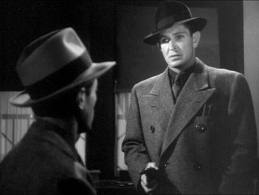
Best scene: Bogie and Malone in the book store.


 http://www.youtube.com/watch?v=5zDqrSctpV


Chinatown 

Roman Polanski   1974

1 Oscar


“C’mon Jake, it’s Chinatown”, pleads Gittes’s friend, attempting to drag him away from the horrific car scene at the very end of the film. “Chinatown” means what you think, but it’s also an old expression meaning crazy, upside-down, or meshuganah – something best left alone. This is may be the best period film ever

made, and Polanski does it without the usual cheap tricks like historical references. He does it instead, with a fabulous cast, John Alonzo’s scorched cinematography, Jerry Goldsmith’s luscious score, Anthea Sylbert’s glamorous costumes, and Robert Towne’s Oscar winning screenplay. It’s all about water – Los Angeles doesn’t have any. And the Hollis Mulwray character is based on William Mulholland, the brilliant head of LA’s water department, who turned this parched patch of Southern California into the metropolis it was to become.

Jack Nicholson, as Jake Gittes, a private eye who makes a living on matrimonial cases, is sucked into a noirish whirlpool, where virtually nothing is as it seems. Polanski does a masterful job of slowing down Nicholson’s usually manic delivery, turning the performance into something more sensual and cunning. Faye Dunawaye is elegantly deceitful, and Polanski himself, plays a murderous knife wielding midget. But it’s John Huston’s Noah Cross that steals the show.

One of my all-time fave films. If anyone reading this hasn’t seen it, you’ll probably find a disc at your local library. Delicious sleuthing.
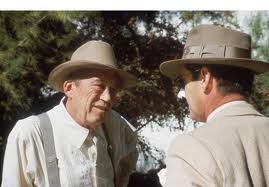
Best scene: Anything with John Huston, and “My sister – my daughter, my sister-my daughter, my sister AND my daughter.”


http://www.youtube.com/watch?v=3aifeXlnoqY


 Farewell My Lovely

Dick Richards   1975


This is the third and, in my opinion, best movie made from Raymond Chandler’s  1940 novel. As I’ve previously stated, Philip Marlowe is my favorite Private Eye and, although Bogie was near-perfect in The Big Sleep, Robert Mitchum is even better, as a big, hulking Marlowe, who seems constantly recovering from a whack on the noggin, or the woozy effect of the knock-out drops that some swell dame slipped in his drink. Unlike Polanski’s Chinatown, director Dick Richards uses the historical reference of Joe Dimaggio’s 57 game hitting streak throughout the movie to maintain a feel for 1940 period. OK, so it’s a gimmick, but a forgivable one – it works. Come to think of it, just about everything in this movie works. Great Chandler narration like, “I’d hardly reached the corner, when a hand so big I could of sat in it, landed on my shoulder”. Besides a wonderfully effective Mitchum, Charlotte Rampling provides the heat in a cast rounded out by John Ireland and Sylvia Miles. There’s even a quick glimpse of Sly Stallone in one of his first movie roles. Dark and sultry lensing, once again by John Alonzo, and a delicious musical score by David Shire make this recreation of 1940 Los Angeles believable. If you can find a DVD of this – pounce.
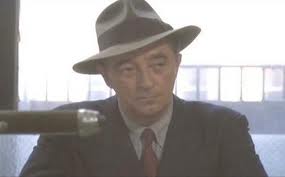
  

http://www.youtube.com/watch?v=htf7JgTmjdY


   Kiss Me Deadly

Robert Aldrich   1955


No more Mr. Nice Guy – not with Mickey Spillane’s brutal, tough, take-no-prisoners Mike Hammer on the case, and in this case, the case is a box – Pandora’s Box, filled with nuclear material ready to go off. Ah, the Fifties, when every right-thinking American had the A-Bomb on his mind, 24 hours a day. An apocalyptic murder mystery? You bet, and Mike Hammer’s the right guy to put the pieces together. A nice turn here by Ralph Meeker, as the Private Eye with an attitude problem. And the movie debuts of Cloris Leachman, and Maxine Cooper

On a lonely country road, Hammer gives a ride to Christina (Cloris Leachman), an attractive hitchhiker wearing nothing but a trench coat. She has escaped from a nearby mental institution. Thugs waylay them and Hammer awakens in some unknown location where he hears Christina screaming and being tortured to death. The thugs then push Hammer’s car off a cliff with Christina’s body and an unconscious Hammer inside. Hammer next awakens in a hospital with Velda (Maxine Copper) at his bedside. He decides to pursue the case, both for vengeance and because, “She (Christina) must be connected with something big”.

The great whatsit”, as Velda calls it, at the center of Hammer’s quest, is a small, mysterious valise that is hot to the touch and contains a dangerous, glowing substance. It represents, of course, the 1950s Cold War fear and nuclear paranoia about the atomic bomb that was all the rage back then.

A dark, noirish nightmare, deftly handled by director Aldrich. Murky, night time Los Angeles locations, made to shine by cinematographer Ernst Laszlo. This is a low budget ($400,000), no nonsense, first rate film noir, with a game cast, and a savvy director. A film not to miss.
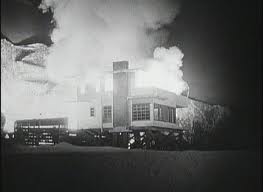
 

http://www.youtube.com/watch?v=qCuhR_SyH8k


Laura

Otto Preminger  1944
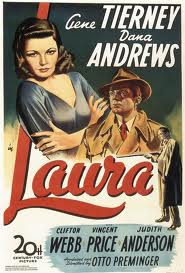
 

OK, I know, I know – it’s not a private eye movie, it’s a cop caper, but it’s Laura, the one and only, and this is MY list so it’s just tough. We have to get past this. Good.

A detective (Dana Andrews) investigating the grisly murder of a famous actress (Gene Tierney) falls in love with her painting. The more he hears about her, the deeper his spell. (I’d do the same thing if that music followed me around all the time) Everyone Andrews interviews seem to be in love with her too. Venomous gossip columnist Waldo Lydecker (Clifton Webb) seems to be the late Laura’s biggest booster. Her grief stricken fiancé Shelby (Vincent Price) is beside himself. Just who would kill such a beloved creature? Just when the audience settles in to accepting lovely Laura’s demise, plot twist of plot twists, the door to her apartment opens, and in walks, you guessed it, Laura, live and lovelier than ever.  Andrews, who had fallen asleep on the couch under Laura’s portrait, is awaked to find his obsession, alive and kicking, and wondering what this stranger is doing in her apartment. As Andrews adjusts to this new situation, he finds the living Laura to be everything he’d hoped. But, who was the disfigured corpse, who everyone mistook for Laura? It turns out that Lydecker’s obsession with our leading lady got the better of him. If he couldn’t have her, he’d kill her instead. But he shot the wrong woman, and she was too disfigured to identify, so everyone assumed it was Laura’s body. A living Laura is just too much for Lydecker to accept, so he tries once again to kill her. Andrews intercedes, shooting the murderous Lydecker in the knick of time. As Waldo lies dying on Laura’s carpet, and of course under the portrait, his last words are, “Goodbye. Laura. Goodbye, my love.”
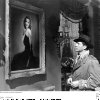
It sounds pretty silly, but it works. Tierney is simply too beautiful to believe, and a game cast does wonders with this material. But, maybe the most important element, the glue that binds this classic together, is David Raskin’s haunting, memorable musical score – one of the real champs. I wonder what happened to the portrait?


http://www.youtube.com/watch?v=u6f8jRplej8


The Maltese Falcon

John Huston   1941


This 1941 Warner Brothers release is the third movie version of Dashiell Hammett’s novel. The first, released in 1931, starred Ricardo Cortez as Sam Spade, while the second, Satan Met a Lady, was a loose adaptation that was a bit more comedic. It was released in 1936, with Warren William, and a very young Bette Davis in the leading roles. Warner Brothers had been prevented from re-releasing the 1931 version by the Hays Office censors, because of its “lewd” content, so they went into production in 1941, on a new, cleaned up version, which is the beauty we all know and love.
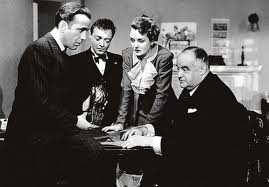
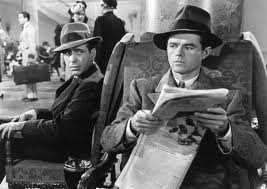
First-time director John Huston wanted Bogie to play Sam Spade, but producer Hal Wallis wanted veteran leading man George Raft, who rejected it because he didn’t want to work with a first-time director. Raft also turned down the lead in Raoul Walsh’s “High Sierra”, the film that launched Bogie’s career as a leading man.

An aside here – I’m reading the Hammett novel for the first time as I’m writing this. I’ve read all of Raymond Chandler, but somehow missed Hammett.

So, is The Maltese Falcon the ultimate private eye caper? You be the judge, but if it’s not, then it’s certainly close. Warner’s had the best ensemble of character actors in Hollywood, and most of them strut their stuff here. Beyond Bogey and Mary Astor, there’s Peter Lorre as Joel Cairo, Sidney Greenstreet as Gutman, Barton MacClane and Ward Bond as Spade’s detective buddies, and Lee Patrick as Effie, who Spade addresses as “Precious” and “Darlin”.  Huston even hired his father Walter, to play the ship’s Captain.

Whose got the bird, is the game played here. What exactly IS this Maltese Falcon, anyway? And why is it worth so many murders? Astor wants it, Greenstreet wants it, Lorre wants it, and the body count is mounting. Juicy, nest of vipers stuff here, and Huston is up to the task of getting the most out of this remarkable cast. A solid, tangy screenplay, written by the first-time director, nice dark lensing by Arthur Edeson, and a warm musical score by Arthur Deutsch. A bird for all seasons.

“You’re good. You’re very good”, say’s Bogie to Astor, and who among us could argue? 


http://www.youtube.com/watch?v=yRSCV2qc2IY


Murder, My Sweet

Edward Dmytryk   1944


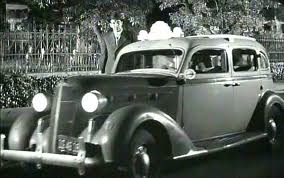
This is the second movie made from Raymond Chandler’s Farewell My Lovely novel, and has a very different feel from the 1975, and third remake, above. The powers that be at RKO thought that changing the title to Murder, My Sweet would add some zip the film’s box office. Who knows, but the film did well.

Casting crooner Dick Powell in the Marlowe role was a gamble, but he’s an effective, if different gumshoe. With a small budget to work with, and 1944’s censorship problems to overcome, Dmytryk does an admirable job creating a dark, violent world for Marlowe and his cronies to inhabit. Nice turns by Claire Trevor, Anne Shirley, and Otto Kruger. And, solid black and white camerawork by Harry Wild, plus a low-key musical score by Roy Webb rounds out the production. Powell is surprising here, and worth a look. Like Alec Guinness as George Smiley, when I read Chandler, I hear Mitchum’s voice, but Powell gives us an alternative.  
http://www.youtube.com/watch?v=hIVAF6AVaSw


Murder on the Orient Express

Sidney Lumet   1974


Agatha Chistie had been quite displeased with some film adaptations of her works made in the 1960s, and accordingly, was unwilling to sell any more film rights. When Nat Cohen, chairman of EMI Films, and producer John Brabourne attempted to get her approval for this film, they felt it necessary to have Lord Mountbatten of Burma (of the British Royal Family and also Brabourne’s father-in-law) help them broach the subject.

In the end, according to Christie’s husband Max Mallowan, “Agatha herself has always been allergic to the adaptation of her books by the cinema, but was persuaded to give a rather grudging appreciation to this one.” Christie’s biographer, Gwen Robyns, quoted her as saying, “It was well made except for one mistake. It was Albert Finney, as my detective Hercule Poirot. I wrote that he had the finest moustache in England — and he didn’t in the film. I thought that a pity — why shouldn’t he?”

Hey, Finney’s waxed lip-rug worked for me, but so did everything else in this dazzling film. I’m not the biggest fan of star vehicles, but Sidney Lumet somehow coaxed, cajoled, persuaded, and probably black-mailed this extraordinary ensemble of show business luminaries into one remarkable performance after another. Finney is a fastidious, almost effeminate Poirot, surrounded by a passenger list that includes (I’m going to name them all because it’s just such an amazing group) Lauren Bacall, Sean Connery, Ingrid Bergman, Michael York, Vanessa Redgrave, Jacqueline Bisset, Richard Widmark, John Gielgud, Anthony Perkins, Martin Balsam, Rachel Roberts, Wendy Hiller, Denis Quilley, Colin Blakely, Jean-Pierre Cassel, and George Coulouris. And, their performances are all uniquely effective, and totally entertaining.
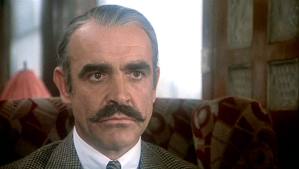
A complex Agatha Christie mystery, in the hands of a neurotic, self-involved detective, on the world’s greatest train, with a trainload of odd characters as suspects. Top notch lensing here by the masterful Geoffrey Unsworth, a lovely, waltzy score by Richard Rodney Bennett, and Lumet’s crafty direction make this memorable.
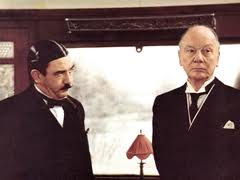
Best lines:

A throaty Finney, “Touch notheeeeeeng”

John Gielgud as a British valet, “It all started in a fracas in the mess, over a desert called “Spotted Dick”

Igrid Bergman as a Swedish missionary to Africa, “I vont to, um, help little brown babies, who, um, are less fortunate than, um, myself”  

http://www.youtube.com/watch?v=JTYA01glGqo


The Thin Man

W. S. Van Dyke   1934

Dashiell Hammett’s crafty couple Nick and Nora Charles are on the case here, in the original of, what would become, a series of detective capers. They’ve even got a snoopy, clue-fetching dog, Asta – played by a wire haired fox terrier named Skippy. Nick (William Powell), a retired detective, and his wife Nora (Myrna Loy) are attempting to settle in to retirement when the disappearance of a friend pulls him back into professional snooping. Nick decides he’ll solve the case, much to the amusement of his socialite wife. The dead bodies, and empty martini glasses pile up, as an ever-tipsy Nick and Nora, endlessly clever banter at the ready, roll up their sleeves, along with their pup, and do some slippery sleuthing.
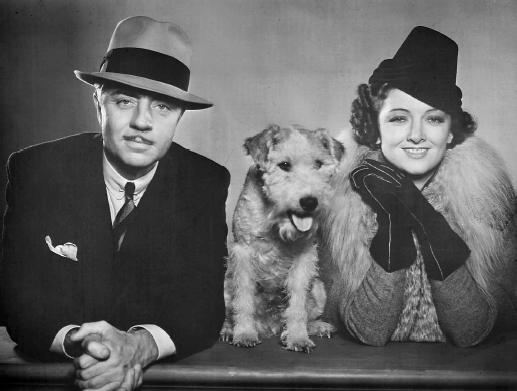
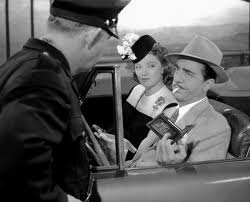
All of the suspects are invited to a hilarious dinner party, where Nick and Nora, in a series of brilliant, if tipsy, deductions, solve the mystery. Clever dialogue, written by Albert Hackett and Frances Goodrich, and deftly delivered by two pros, drives this unique, comedic mystery. Sparkling black and white lensing by James Wong Howe, and strong ensemble work by Metro’s talent pool make this a movie not to miss. Funny doings.


http://www.youtube.com/watch?v=nSNJ-8ouQEM


*

© 2011 Shaun Costello

Keep SHAUN COSTELLO’S BLOG up and running.
Creating and maintaining this BLOG is time
consuming. If you like what you’ve been reading,
please help me keep it going.
DONATE ANY AMOUNT Through PAYPAL at:

SALVATORE’S MAID

SALVATORE’S MAID

She had breasts the size of basketballs.

By Shaun Costello

This story is excerpted from my childhood memoir:

THE LAST TIME I SAW JESUS

Surviving God and Elvis in the time of ‘Duck and Cover’


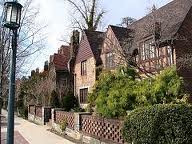
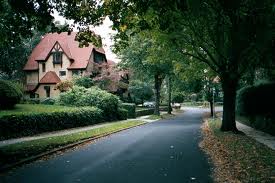
My new friend Jimmy’s family had recently moved to the Gardens from Brooklyn. His father was a famous theatrical photographer who took pictures of movie stars. They lived in an enormous Tudor house on Greenway South, one on the nicest streets in the Gardens where I began to spend a great deal of time. One day Jimmy asked me if I had ever touched a breast. Other than the pictures I saw of Eddie Mann’s mom, I had never even seen one. He told me that he had touched a breast, and if I was interested, he could arrange for me to touch one too. Jimmy had a neighbor named Salvatore, who lived just down the street, and Salvatore’s family had a black maid named Jessie who, for fifty cents would let you fondle her breasts for five minutes. “And they’re really big too”, Jimmy added. This was a shocking revelation. Breasts. Actual breasts. You could touch them and even kiss them, and all for fifty cents. I was nervous but game, and Jimmy made the arrangements.

“What do you do with them?”, I asked. “Anything you want”, said Jimmy. “But why do I want to touch them?” I’m nervous now. “Because they’re beasts, stupid”.

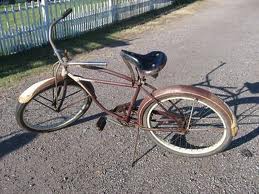
Salvatore lived in a big brick house just down the street from Jimmy. Jessie, the maid lived in a room over the garage, and Salvatore, with Dolphy Maggiore in tow, met us outside. We hid our bikes in the bushes behind the house. Salvatore was very concerned that everyone had their money in their hands because Jessie could get ornery and make a fuss. As Salvatore opened the outside door to the stairway that led to Jessie’s room there was a horrible smell, something I had never smelled before, and it became worse as we climbed the stairs. A smell of something burning. A pungent, rancid smell. Salvatore knocked on the door. “Who?”, came from the other side. “It’s me”, said Salvatore. “Well c’mon honey, I ain’t got all day”. The door opened, and inside, sitting in front of a large mirror, applying hot irons to straighten her hair, was the biggest, fattest black woman I had ever seen. She spoke to us through the mirror. “You chilluns got my jingle?” she asked. Salvatore made a gesture that suggested giving her the money, so we did. At this point she let the robe she was wearing slip to her waste revealing huge brown breasts the size of basketballs, to the amazement and delight of the white chilluns. “C’mon now, don’t be shy. You got five minutes. Love’m up. C’mon now, love’m up”. With hesitation, fearing the unknown but mesmerized by the possibilities, the little fingers of the white chilluns

reached for the huge,  soft, brown basketballs, while  Jessie applied the hot irons to her singed hair, creating an unbearable smell, and Symphony Sid’s radio theme song wafted through the smoke,  and all I could think of was how I could tell this in confession on Saturday.

 *

© 2011 Shaun Costello

Keep SHAUN COSTELLO’S BLOG up and running.
Creating and maintaining this BLOG is time
consuming. If you like what you’ve been reading,
please help me keep it going.
DONATE ANY AMOUNT Through PAYPAL at:


IN SHERMAN’S GARAGE


IN SHERMAN’S GARAGE

 She Looked So Peaceful

By Shaun Costello

 Excerpted from the manuscript of my childhood memoir:

THE LAST TIME I SAW JESUS

Surviving God and Elvis in the time of ‘Duck and Cover’


 The Kew Forest School was located right on the border between the Forest Hills Gardens, and Kew Gardens, the next community to the East. Their student body was made up of a pretty even smattering of Protestants and Jews, with a few recovering Catholics thrown in for good measure. It was a small, secular, private school, attended by students from all over the borough of Queens. My friend Jimmy went there, and the Bullock twins, the Baxter brothers, Jeff McGann, Frank Sperandeo, and several other kids I knew from the Gardens. It was the kind of institution that was completely outside my experience. There was no hitting, no statues with internal organs showing, no threats, no Sousa marches, no praying, no music room/punishment chamber, and no promise of the eternal agony of roasting in the fires of hell for the egregious crime of talking on line. I don’t think they even had a line. A very mysterious place.

Knowing their route home from school, I would sometimes intercept Stuart and Stephen Bullock, and the three of us would cruise the Gardens on our bikes for a while before winding up at their house for a snack. I liked the Bullocks. They were my size, had the same coloring, were totally unchallenging, and were even worse at sports than I was. Sometimes it was comforting to wallow in the company of compatible mediocrity. My friend Jimmy, on the other hand, who was a constant mental challenge, was good at everything. He was the best natural athlete I had ever seen, the best tennis player his age in the borough. The first time he ever picked up a basketball in his life I saw him make six shots in a row from the foul line. Six shots. It took me a year of daily practice before I even came close to that. He was just better than I was at everything, and probably always would be. He was my best friend, but sometimes I needed a short respite from constantly coming in second, and the Bullock twins were just what the Doctor ordered. The boys were funny, their parents were welcoming and friendly, and the whole after school experience at their house was pretty positive. When it was time for me to return home, we said our good-byes, and made plans for a repeat performance the next day.

It was about a five-minute bike ride from their house to mine, and riding a bicycle around the Gardens was one of the best things about living there. There was very little traffic, and after a while you got to know most of the residents, so that people would wave to you as you cruised by. After collecting waves from Mrs. Watson, and Doctor Kauer, I passed by Sherman Becker’s house, and there was old Sherm, sitting on a bench next to his garage. The word on Sherman Becker was that he was some kind of genius. He went to a special school in Manhattan for kids with extremely high IQ’s and, although a bit strange, he was a nice enough kid to be around. Sometimes in the middle of a sentence Sherman would drift off to some place far away, and just stare at nothing that was visible to anyone else. I never saw it, but kids told me than Sherman had seizures, where his whole body would shake, and he would fall on the floor and try to swallow his tongue. He had an illness called Epilepsy, and had to take medication that sometimes made him moody. “Hey Sherm”, I yelled, as I cruised by, but he didn’t seem to notice me, and I continued on down the street. After a few blocks I stopped. Something was wrong. Sherman looked like he was doing one of his, “staring into oblivion” routines, and if his parents weren’t home maybe it was dangerous, so I turned abound and headed back to his house.

He was sitting on the bench next to his garage, and just staring into space. I had seen him do this many times and, sooner or later, he would just snap out of it. I tried talking with him, but got no response. Sherman was somewhere far away, and I’m sure he had no idea that I was even there. It was at this point that I became aware of a noise. A humming, mechanical sound, like a car motor, but very quiet, like it was far away. But it wasn’t far away. It was in Sherm’s garage, and with the doors closed you could hardly hear it. The Sisters had shown us safety films at school about the dangers of running a car inside a garage. There was some kind of gas that put you to sleep, and you never woke up. So the logical thing seemed to be for me to open the garage doors and somehow turn the car off. I opened both of the large front doors, and the smoke inside was a silvery color, and had a gasoline smell. There was a small back door to the building so I ran around and opened it, thinking that the breeze would blow the poisonous fumes from the garage.

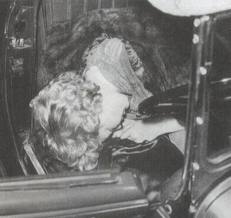
I stood there, waiting for the fumes to clear so that I could somehow shut the car off, when I saw it. There was something or someone in the car, behind the steering wheel. I froze. As the breeze blew the silver smoke past me I could see that it was a person. All I knew was that I had to turn the car off, so I covered my nose and mouth and ran for the front door on the driver’s side. I opened the door to reach for the keys when I came face to face with Mrs. Becker. I gasped and flew backwards, crashing into the garage wall. My lungs were expanding and contracting with such force that I could hear my breath over the din of the motor, and I could barely see through the tears. I was violently crying, not from sadness, but from shock and fear. I had to turn that car off, no matter what, so I opened the door again and reached across Mrs. Becker’s lap and fumbled with key, which was on the right of the steering column. Doing this bought my face inches from hers, and my whole body was trembling so violently that I couldn’t seem to turn the key. But then I did, and the motor stopped, and I was still only inches from Mrs. Becker, and I could hear myself gasping for air. I wanted to say something to her. Maybe she was only asleep. She looked so peaceful. But my mouth wouldn’t move. The words wouldn’t come. Maybe she would open her eyes, and stretch her arms the way people do when they wake up, and look down at me and invite me to dinner. But she didn’t. She didn’t move. I realized that Sherm was still outside so I backed slowly out of the garage, never taking my eyes off Mrs. Becker.

Sherm hadn’t moved a muscle. His mind was occupying another world altogether, either because be was steeped in the denial of this horrible event, or because that’s just what his mind sometimes did. There was no 911 back in the fifties. Emergencies were reported to the telephone operator, who then forwarded the information to the appropriate authorities, so I dialed “O”. When she answered I said that my name was Sherman Becker, told her the address, and that there had been a terrible accident, and I hung up. Outside I tried to communicate with Sherm, but had no success. He had no idea that I was there. I had done what I could do. I had tuned off the motor, and reported the tragedy, and the best thing for me to do was to get out of there before the police came. No one would ever know that I had been there. They would simply assume that Sherman turned off the car motor, called the operator, and then flipped out, which was pretty understandable under the circumstances. I just didn’t want to be involved in this.

I raced toward home as fast my legs could peddle, but after a while I came to a stop, dropped my bike, sat down on the curb and started sobbing, completely overwhelmed by the events of the past few minutes. Or was it longer? I had lost track of time. My lungs seemed near exploding, my breath gushing in and out, wheezing like an asthmatic gasping for air. I had seen dead people before on Wayne Baxter’s cadaver tour, but this was different. I knew Mrs. Becker. She had always been nice to me, and now she was dead. She wanted to be dead so she closed her garage doors, slid behind the wheel, turned on the motor, fell asleep, and then died, just like in the safety film we saw in school. But she didn’t look dead. Not like the translucent cadavers at the Fox Funeral Home. She looked like she was asleep. She looked so peaceful.

*

 © 2009 Shaun Costello

Keep SHAUN COSTELLO’S BLOG up and running.
Creating and maintaining this BLOG is time
consuming. If you like what you’ve been reading,
please help me keep it going.
DONATE ANY AMOUNT Through PAYPAL at:


THE EXORCIST

THE EXORCIST

 Drowning Satan with Holy Water-boarding

By Shaun Costello

This story is excerpted from the manuscript of my childhood memoir;

“The Last Time I Saw Jesus”

Surviving God and Elvis in the time of ‘Duck and Cover’


Children, like sharks with blood in the water, or wild dogs who smell fear, can spot weakness a mile away, and will bide their time until the moment is right to pounce. Sister Lenore showed up one day at Our Lady Queen of Martyrs, and became our teacher. She replaced Sister Saint Gerald, who was ill and had to be sent to convalesce wherever nuns went to do that sort of thing. Nuns never talked about themselves so, other than being our teachers, having incredibly clean fingernails, wearing rimless spectacles, enjoying hitting children with inanimate objects, and seldom smiling, we knew little about them. We knew that their order, The Sisters of the Immaculate Conception, came from Scranton Pennsylvania, but that’s all. I’m not even sure how we knew that, but somehow we did. So when Sister Lenore showed up that morning, the occasion was ripe for supposition.

Maybe she had been a missionary in darkest Africa, and was laid low with jungle fever, to be sent back to the States as a teacher. Maybe she toiled for many years in a convent dedicated to the glory of cleaning the toilets of the poor, and as a reward for always producing the cleanest bowl she was sent to our wonderful Parish. Maybe she worked as the personal assistant to the Pope himself, right there in Rome, but was caught with her fingers in the poor box, and was sent to teach at our school as punishment for her sins. We’d never really know for sure, but it was fun to pretend.

Anyway, here she was, so we’d just have to make the best of it. She seemed nice enough. Certainly nicer than that cranky Sister Saint Gerald, who was always coughing into a handkerchief, and swatting kids on the hands with rulers. She seemed friendly, eager to please, even helpful, but something was wrong. It was hard to put your finger on just what, but something was wrong with Sister Lenore.

The exorcisms began when, one morning, we found a Holy Water Fountain just inside the door to our classroom. Sister instructed us to dip our fingers in the sacred waters and cross ourselves before entering the classroom, a common practice when entering or leaving a church. She told us that little children have tiny demons inside them that cause bad behavior, and demons just could not abide the sacred, soul-cleansing waters. This level of demon control lasted for only a few weeks, before she began sprinkling Holy Water directly from a bottle onto the heads of the unruly little perps, whose behavioral irregularities were obviously a direct result of Satanic possession.

During playground conversations over the next few weeks among the core group of class troublemakers, of which I was certainly a part, we came to the conclusion that the woman was a fruitcake, and if pushed far enough, she was bound to crack. Since we knew that she was the only nun in the school who sprinkled water on misbehaving kids rather than swatting them with yardsticks, we figured it was safe to go on the attack.

So it began. Spitball wars, paper plane dog fights, strange messages from Satan that somehow wound up on the blackboard, demonic drawings left in her desk drawers, and the odd behavior of Jim Freeny, the class arch-criminal, whose whole body sometimes shook as a direct result of Satanic possession. For our new teacher, this was the beginning of the end. Sister would walk up and down the aisles spraying her students with Holy Water chanting, “You’re possessed, possessed by devils, possessed by Satan, possessed, possessed. It started as a muffled giggle, but Jim Freeny started laughing and couldn’t seem to stop. The more he laughed, the wetter he became, as sister had singled him out as Satan’s host. She kept dousing him with the sacred fluids, and the wetter he got the louder he laughed, and the more she kept screaming at the devil to leave this child, until finally, frustrated to a point of holy rage, she cold-cocked Freeny with the Holy Water bottle.

So, Sister Lenore stood above Jim Freeny’s unconscious form, now lying in the aisle next to his desk, as fifty-nine little mouths silently hung open, stunned at what they had just witnessed, and wondering what would happen next, and she began to scream. She screamed out the classroom door, and screamed down the stairwell, and screamed all the way back to the convent, intensely watched by fifty nine sets of little eyes pressed against the classroom windows. Freeny was taken to the hospital with a concussion, and never admitted whether he was really unconscious, or just pretending, a subject of discussion for years afterward. The next day someone saw Sister Lenore, suitcase in hand, being helped into a sedan with Pennsylvania license plates. She was never seen again. Maybe she should have stayed in Africa. Accidentally wondering into a pride of lions had to be safer than teaching fourth grade at Our Lady Queen of Martyrs.

*

 © 2009 Shaun Costello

Keep SHAUN COSTELLO’S BLOG up and running.
Creating and maintaining this BLOG is time
consuming. If you like what you’ve been reading,
please help me keep it going.
DONATE ANY AMOUNT Through PAYPAL at:

THE THIRD HAND

THE THIRD HAND

by Shaun Costello

Excerpted from the “Seventies” manuscript:

RISKY BEHAVIOR

Sex, Gangsters, and Deception in the time of ‘Groovy’

By the middle of 1974, my time was pretty evenly divided between CBS Sports, and Star Distributors, the porn unit of the Gambino Crime Family. Out in Hunterdon County, my girlfriend Jane had quickly outgrown my birthday gift to her the previous year, a little chestnut gelding called Applejack. She was an athletic and natural rider, and wound up buying an open jumper who nobody except Jane seemed able to ride. She called him Bojangles and did wonders with him. I tried riding him only once, and was so terrified by the experience that I almost quit riding altogether. I sold little Applejack to a local teenager, and started riding school horses during lessons, which never lasts long. Show Barns make their money on lessons and on selling expensive horses to horseless riding students like me. After a few weeks of taking lessons on their school horses the sales routine began. “Shaun, what can I say? You’ve outgrown the school horses, and if you’re really serious about riding then it’s time to find you a nice thoroughbred.” Essentially they were saying, “Either you’re going to own an expensive, fine tuned jumping machine, or you’re going to remain a horseless slob, looked down upon by all concerned.”  So within a few weeks, not wanting to remain a horseless slob, I forked over the money for a stunning bay thoroughbred gelding who I called Dawn Patrol. The problem was that Dawn Patrol was a five year old and only a year off the track, so he was completely green. This meant that I could only ride him under professional supervision, which wound up costing quite a bit of money. If I wanted to go hacking with Jane off in the woods and fields I had to rent a school horse from the barn, while my difficult-to-ride thoroughbred remained in his stall eating me out of house and home. I was now in way over my head.

August passed into September, and my porn production output continued at a frantic pace while I still spent weekends trying not to look foolish attempting to ride my fine tuned jumping machine, and watching Jane tear over Jump courses on her

chestnut monster with the reckless abandon of the fine rider she had become. She had risen to a full level above me, but I was happy with our situation. My life seemed to work. I was maxed-out, but as long no surprises came my way I could manage this level of activity. It was at this point that my mother called to tell me she was getting re-married.

This matrimonial announcement immediately put Jane into wedding-present mode. So, with our gift perfectly wrapped, we jumped on the Metroliner and headed to Washington DC, where the event was to take place.  Both the ceremony and the reception were to be held at the townhouse of Michael Gill, a close friend of my mother’s new victim, and a man who had made a

lifetime career out of being the nephew of Mamie Eisenhower. He was one of those Washington political parasites who lived on the perks when his party was in power. The republicans still held the Whitehouse so Michael Gill was on the dole. It was never made clear to me exactly what Gill did, but from the look of him, I was certain that not all of it was legal.

The ceremony was to be presided over by a Seventh Circuit Appellate Judge, and attended by a collection of Washington’s best and worst characters. My mother’s new husband had owned restaurants in the Washington area for years, and seemed well liked. Bob Dole was there, as was Dick Cheney, Ed Musky, and what seemed like every lobbyist in the capital.


On the other side of the reception was a delegation of boys from the Bonnano family in New York, some of whom looked familiar. What an amazing gathering. Some of them had gone to law school to learn how to defend criminals, and some of them had attended “The University of the Streets” to learn the subtle nuances of the import/export business, but all of them were gangsters. I hadn’t seen this many republicans in one room since the televised coverage of the 1972 Convention.

I introduced Jane to the happy couple, who really did seem like a happy couple, and who in turn, introduced us to our host. Michael Gill took Jane in tow, “Young lady, before the ceremony begins, let me introduce you to our guests”, and off they went. While Jane was glad-handing the guest list, I decided to explore Gill’s house. The main floor contained the cavernous living room, its walls decorated with many photographs of Ike and Mamie, and where the wedding guests were milling about. Just down the hall was an equally large formal dining room with more photographs of the Eisenhowers, a chefs kitchen where the caterers were busy


prepping the banquet, and various and sundry pantries and storage cabinets. The floors above contained bedroom after bedroom, each one with walls covered with more Ike and Mamie pictures, that seem to go on forever. Next to the kitchen was a door that led to the stairway to the basement. I decided that Gill’s basement might be worth exploring, and I was right.

Michael Gill’s secret subterranean playground was a wood paneled wonderland of adult entertainment. A screening room, with couches instead of chairs, where guests could watch adult films while stretching out together in total comfort. The next room was decorated in a kind of cruise ship motif, with port-holes painted on the walls, round life-preservers hanging everywhere, and deck chairs for the comfort of the ship’s passengers. In the

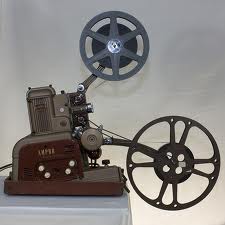
 center of the room was the biggest hot tub I had ever seen, accommodating maybe ten to twelve wet revelers at one time. As in the previous room, there was a large movie screen, and through one of the port-holes I noticed an 16MM movie projector.

 The shelves in the projection room contained 16MM prints of feature films, all pornographic. As I went through the titles I was horrified to find several little movies that I had made for Sid Levine the previous year, and I was in about half of them. So Michael Gill had seen me in action. But how could he have gotten his hands on theatrical films that I had made for the DeCavalcante crime family? Then I remembered the boys from the Bonnano family who were upstairs for the wedding. The wedding! I made a bee-line for the stairway and arrived just in time. Jane was furious whispering, “Where have you been? Everybody’s been waiting for you.” I just said, “Don’t ask.”

The ceremony passed without a hitch, my sisters cried, and the reception began. Michael Gill hadn’t taken his eyes off Jane since we arrived, and it was making her uncomfortable. Gill, who’s constantly filling my glass, was telling me a series of bizarre stories about the sexual capabilities of his insatiable, nymphomaniac girlfriend. She was a mousy little thing, who I’m sure no one at the reception  suspected of having a third hand located in her vagina, yet Gill maintained that this was the case. Now I knew that he recognized me from the movies. Why else would he be constantly whispering in my ear about his girlfriend’s sexual exploits? If he knew, did his pal who was in the midst of marrying my mother also know? Did Cheney? Dole? Musky? Just how many members of the United States Senate had watched, in the comfy confines of Michael Gill’s underground pleasure chamber, the movies I had made for the Mob? Gill was still relentlessly whispering. “I guarantee you young man, the slippery grasp, the velvety fingers, your zorch will be the happiest little guy on planet Earth.” Zorch? I hadn’t heard that word since I was twelve. At this point Gill decided that I should meet his pal Dick Cheney who, for the past few months, had been running Gerry Ford’s transition team, working just under his buddy Don Rumsfeld. “Dick, I’d like you meet the bride’s son Shaun. He’s a film maker you know.” Cheney turned with an outstretched hand, “A real pleasure Shaun. They make quite a handsome couple. A film maker, huh. Not a member of the press are you?” “No sir, not at all.” Cheney was sizing me up. “What kind of films do you make?” He was peering at me over the top of his glasses. “Golf sir, my last film was about the British Open.” Cheney smiled, “Golf. That’s the ticket. The great American common denominator. Everybody loves golf. Did you know that President Ford is quite an accomplished golfer? Plays with the pros all the time.”

So here we were at my mother’s wedding reception. Michael Gill was standing between Bob Dole, who was endlessly telling great jokes, and Dick Cheney, who was explaining how his friend Gerry Ford would save the GOP from ruin; and in between Dole’s Jokes and Cheney’s explanations, Gill was whispering in my ear about how it would feel when his girlfriend got that third hand in her vagina around my zorch. The only improvement that I could see on the theatricality of this moment might be the addition of a little acid, but I guess you can’t have everything.

The reception began to wind down and, before I could tell Jane about Gill’s subterranean amusement park, he was already telling her about his new gazillion gallon hot tub which, he proudly told her, was big enough for the whole neighborhood.  He was having an intimate get together after the reception ended. Just a few couples would be there. Fun, open-minded couples, and we were invited. How could I have been so stupid? Gill was selling me on the sexual talents of his mousy girlfriend, while my mother was saying “I do”, in order to get his hands on Jane. This was truly hilarious. So my mother and her new hubby went over Niagara Falls in a barrel, and Jane and I took the short walk to Union Station, leaving Michael Gill and his three-handed girlfriend to swim laps in their hot tub.

Back in New York, I had stopped by Sid’s office to pick up a couple of checks from Star, and their office had a different feel. The young guys who did the grunt work, carrying boxes of film cans from one floor to the next, were all wearing suits. Normally these guys wore tee shirts, so I asked them what was going on. Paulie, who was the youngest, and always joking around, seemed strangely serious. “We’re in the banking business now”, he said. “Got to look good.” The banking business?


So I took Star’s checks down to the Franklin National Bank, like I always did, and a change had been made. The Franklin sign above the building had been replaced by  one that read European American Bank. Inside all seemed as usual, with the exception ofsome of the bank’s personnel. Sitting at desks formerly occupied by the branch’s officers were employees of Star Distributors, wearing suits and looking a bit out of place. Charlie, the manager who had worked for Franklin, was still there and greeted me. “Hi Shaun, what have you got today?” “Just a few checks, Charlie.” He smiled. “No problem. Come on in the back.” As we walked toward the back of the bank, some of the “officers” winked or gave me the high-sign. In the bank’s back room four long tables had been set up, and they were covered with cash in various denominations, some of it stacked, and some of it just in piles. There were five or six men, all wearing suits, and all recognizable to me as employees of Star, sitting at the tables, counting the money, and putting the cash in large corrugated cardboard boxes. I gave the checks to Charlie, who reached into one of the boxes and handed me an enormous stack of freshly laundered hundred dollar bills. “Things are going to be easier from now on”, he said while counting out the last of my cash. It took a few of these odd transactions before the scandal hit the papers.

The Sicilian Mafia, fronted by an Italian businessman named Michele Sindona, had bought out the failing Franklin National Bank, renaming it EAB.  The administration of the bank’s branches was to be the responsibility of New York’s Gambino crime family, along with the DeCavalcantes. So that’s what happened. I wondered why they didn’t just call it the Mafia National Bank and get it over with, but of course I never suggested this idea to the boys. So the European American Bank went about doing business with most of its employees bearing a strange resemblance to the cast of Mean Streets.


*

© 2011 Shaun Costello

Keep SHAUN COSTELLO’S BLOG up and running.
Creating and maintaining this BLOG is time
consuming. If you like what you’ve been reading,
please help me keep it going.
DONATE ANY AMOUNT Through PAYPAL at:

WALKING IN A WICCA WONDERLAND

WALKING IN A WICCA  WONDERLAND

Original music by Felix Bernard

New lyrics by Shaun Costello.

Just sing these lyrics to the melody of that old Christmas Classic:

WALKING IN A WINTER WONDERLAND


Casting spells must be thrilling,

to ensure off-shore drilling.

I can’t wait to see,

that dear GOP

Walking in a Wicca Wonderland


In the meadow we will build a pyre,

Witchy ones will watch us with a frown.

I’ll say grab those logs and pile them higher,

‘cause which hunts are the biggest game in town.


Turning Newts into toadstools,

While Gulf oil fills our tide pools.

She’ll just grab her broom,

while singin’ that tune,

Walking in a Wicca Wonderland


While in Congress Dems are really freaking,

wondering how long we’ll be in town.

Sarah Palin’s hope chest she’s been tweaking,

with Bachmann and O’Donnell still around.


Will that coven conspire,

 making healthcare costs higher?

And howl at the moon,

while humming that tune,

Walking in a Wicca Wonderland.


 Walking in a Wicca Wonderland,

Oh Yeah

Walking in a Wicca Wonderland,

Oh My

Walking in a Wicca Wonderland.

That’s all.

*

© 2011 Shaun Costello

Keep SHAUN COSTELLO’S BLOG up and running.
Creating and maintaining this BLOG is time
consuming. If you like what you’ve been reading,
please help me keep it going.
DONATE ANY AMOUNT Through PAYPAL at:


RED SKY AT MORNING

RED SKY AT MORNING

By 1982 my downward spiral was well under way,

not that I wasn’t enjoying myself.

By Shaun Costello


The sun was an hour from rising, and the sky was a fiery red when we drove the trailer over the Mid Hudson Bridge on our way to Rhinebeck. Skies like this always reminded me of the old sea shanty that began:

“Red sky at morning, sailor’s warning.

Red sky at night, sailor’s delight.”

There were three of us riding in the cab of my truck; myself, Harriett, and Becky, a local high-schooler who was working as our groom for the day. The lights in the barn had burned late the night before. There were coats to be washed and brushed, manes and tails to be pulled and braided, hoofs to be polished, tack to be soaped and scrubbed, and everything, other than our two now-immaculate horses, packed into the trailer for the next day’s competition. Then home to try to get some sleep, which never happened because I was too terrified of my dressage test. If only I could get through the dressage test, the next two phases of the competition would be a breeze. I could always get horses over fences. But the dressage test.

 I would lie awake staring at the ceiling, going through the test over and over. Enter at “A” at a working trot. Keep it straight, keep it straight. Collect and halt at “X”. Settle. Be still. Salute the judge. Be still. Wait for the nod. Pray to God that somebody’s truck doesn’t backfire. Exhale. Proceed to “C” at a working walk. What a nightmare. If I could just get through the dressage test.

In the back of the trailer were two one-thousand-pound animals; primped, polished, and ready to show their stuff. In the front was a changing compartment that contained our freshly cleaned tack, our riding clothes, our boots and helmets, and the various tools and horsey gadgets that would see us through the event. In my tack trunk hung my custom tailored riding jacket, and in the inside pocket of that jacket were four tiny glass one-gram bottles of Peruvian flake. It would be a four-gram day.

My dressage test was a blank. I entered the ring, I left the ring, and I couldn’t remember a thing. Probably better that way. When I looked at the scores that were posted outside the judge’s tent I was 58th, out of 65 riders. There were actually seven riders who were worse than I was. Not bad. Maybe the coke helped. I had already gone through the first gram. And, unknown to Harriett, my tiny coke spoon was secretly finding its way to Becky’s willing little nostrils throughout the morning. There’s a sexual dynamic to the shared cocaine experience. You do a line, and first there’s the exhilaration – the heightened awareness followed, only moments later, by the glow of sensuality, and sense of well being. Then she does a line, and you know what she’s experiencing, and you want her to know that you know, and you want to kiss her, and hold her, and touch her everywhere. You want to join her experience. Of course, this could be embarrassing if she’s only sixteen, and the two of you are standing in the middle of three hundred other people, so you keep your hands to yourself. And as the day progressed, and we kept up the coke consumption, the heightened sexuality between us became more intense. I worried that Harriett would notice the amount of time I was spending with Becky in the dressing compartment of the trailer, but she was preoccupied with her own riding and didn’t seem to pay attention.

I did well in the cross-country phase, and was now 20th, out of the 65 competitors. I was also now half way through my third gram, with the help of my loyal groom, who was assisting me through the obligatory wardrobe changes that happen before each phase in the competition, her young hands brushing dangerously close to places where they should never have been. I was second in stadium Jumping, the third and last phase of the competition, and wound up sixth overall, getting a green ribbon for my efforts.

It was after nine by the time we dropped Harriett off at the house, and drove around to the barn to unload the trailer and feed the horses. Becky insisted that I drop her at the beginning of the long driveway to her parent’s house. There was an awkward moment, the two of us standing beside my truck, when I handed her twenty dollars, which was her groom’s fee for the day. I told her it should

be more and she said, “Are you kidding? I’d do it for nothing. I’d do anything for you. Have you got another hit?” And suddenly it happened. It had to. The kissing, and groping, and tearing of clothes, and the coldness of the metal bed of the pickup truck against my skin, and she was so willing to please me, and she was so young and delicious, and I’m not sure how long it lasted, and then there was nothing but the loud breathing, and then the cold. I don’t think we said another word to each other. There was nothing really to say. I dropped her off further up the driveway, closer to her parent’s house, and then drove home.

Harriett was still up, and she was bristling. When I asked her if she wanted me to fix a late supper she refused to talk to me. I guess my flirtation with Becky must have been obvious, and it had happened within full view of most of our friends. Harriett was livid. So I had a glass of port, and went upstairs to finally get some sleep. All in all, Harriett’s objections not withstanding, it had been a good day. A green ribbon day. A four gram day. That’s the way I saw it. That’s the way my mind worked. It was the logic of the coke spoon. Harriett’s taking exception to my behavior was simply an annoyance. A small bump in my road to self-satisfaction. A minor glitch.  And what was she objecting to? Just, my ingesting enough cocaine hydrochloride over the last fourteen hours to give a normal person a seizure. And sharing a good deal of it with an underage girl, with whom I had a felonious sexual encounter in the back of a pick-up truck. And, in my coked-out haze, I thought it had been a good day. Just how many more ‘good days’ like this one could I survive? How many could the people around me survive? The collateral damage was mounting.

My journey towards oblivion was gaining momentum now. I was riding a runaway train. I was out of control, and it didn’t scare me a bit. ‘Out of control’ was delicious. ‘Out of control’ was a safe haven from responsibility. ‘Out of control’ was my excuse-of-choice for all my sins. ‘Out of control’ was my last alias. It was the outfit I wore to the costume party that my life had become. Maybe ‘out of control’  had been my intended destination all along. Since, taking advantage of the youth-fare, and boarding the train as a

twelve-year-old, while negotiating with God about masturbation. Since hiding behind my first pseudonym. Since becoming comfortable with duplicity. Since telling my first lie. I had lied to Jane, and Jane had lied to her parents, and her parents had lied to themselves. All aboard. Next stop self-destruction.

I was spending more than I was earning, and funds were becoming dangerously low. My ability to generate income through producing pornography, something I had always taken for granted, was now seriously impaired by the cognitive congestion in my coked-out brain. Spending money was seductive. Another ounce. A new thoroughbred. “How much? Sure, I’ll take it. No, give me two. Hey everybody, I’ve got more

coke, have some. Want some quaaludes? Sure, I’ve got plenty. And have some more coke. Hey, lets go to Jamaica for the weekend, my treat. Let’s call a limo. I can charge it.  But please like me, OK? I just want everyone to like me. Please”. I needed compensation for my own self-loathing.

Harriett was fed-up with my charade, and I was spending more and more time in the city. I had been abandoned by Mark Silverman, who had gone off to Texas to help Joel and Ethan Coen make “Blood Simple”. Mark gave me his assistant Kevin, who took his place, and I drove him crazy. All night bacchanal’s at the Hellfire Club and three day drug/sex binges at Steve Tucker’s had taken their toll on my cognitive abilities. Where Mark, knowing what I needed, and where I had been the night before, made decisions without needing my approval, Kevin simply walked through the offices at 505 muttering to himself that I had lost my ability to focus on anything. He was right. I could barely focus on the meter to figure out the taxi fare from Steve Tucker’s to The Hellfire Club – my home away from home.

The Hellfire Club had been built as a working set for an Al Pacino movie called Cruising. In the film, it was supposed to be a gay sex club. The producers left it intact when they struck the production, and the owner of the building opened it as The Hellfire Club. It was gay, it was straight, it was rough, it was smooth, it was all things to all people, and there’s never been anything like it. As the hour grew later, and Donna Summer grew louder moaning, “Ooooooooooooo love to love ya baby”, and the dancers grew sweatier, and the sound of a distant whip crack grew more frequent, the night was just beginning. Jerzy Kozinski was in the corner practicing the art of manipulation, convincing unsuspecting girls into doing unthinkable things. Mickey Rourke seemed everywhere, groping and caressing ever-available flesh. Huntington Hartford, who was eating Quaaludes like candy, leaned against a wall trying to focus on the activities happening in front of him. Recognizable fashion models were strutting through the “Maze” in the back of the club, hands outstretched, stoking the hard cocks, sometimes twenty at a time, protruding through the glory holes on either side. If you had to take a leak, the only bathroom had a trough, about six feet long, containing a piss soaked guy in fatigues chanting, “Faggot, faggot, piss here, piss here, I’m a faggot, got some poppers?” Jamie Gillis, had leash in hand, connected to the collar on the throat

of Gael Green, a well known restaurant critic for New York Magazine, who was on her knees servicing a line of twenty guys waiting to be sucked off. “Oooooooooooooo love to love ya baby.” I just loved this place.


And when I got tired of the crowd at Hellfire I could always head back up to Steve Tucker’s apartment, which was a constant drug/sex binge. Cocaine, both snorted and free based, ecstasy, mushrooms, Ketamine (Special K), which made you feel like you had just been shot out of a cannon, and willing young girls in a quaalude haze, ready to do anything. It was a pharmaceutical phantasmagoria.

And I had a movie to do. I had to pay for all this. I sat in my office trying to write a script, and the sirens at Steve Tucker’s were sweetly singing. So I did another line of coke. It couldn’t hurt. I had two more pictures to do for Leisure Time, and I’d become a messy commodity. I hired an old friend, Ron Dorfman, to shoot both films. He was doing as much cocaine as I was, so my paranoia level was assuaged. I did the pictures. What a mess.

 *

© 2009 Shaun Costello

Keep SHAUN COSTELLO’S BLOG up and running.
Creating and maintaining this BLOG is time
consuming. If you like what you’ve been reading,
please help me keep it going.
DONATE ANY AMOUNT Through PAYPAL at:

FROM STAGE TO SCREEN

From Stage to Screen

Ten Broadway Musicals that, when adapted

 to the screen, held their own as Motion Pictures.

By Shaun Costello

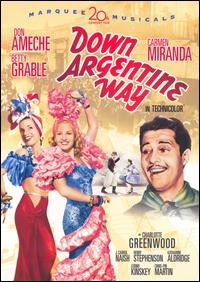
I had the good fortune to have grown up in New York City, the son of parents who enjoyed Broadway Theater, particularly musicals. On my mother’s side, there was a history going all the way back to Vaudeville, where, as a child, along with her older brother (My Uncle Tommy), she danced with her parents in an act billed as The Dancing Dowlings. They played theaters, mainly in the South, and shared the playbill with such Vaudeville luminaries as; Buck and Bubbles, The Nicholas Brothers, Jack Benny, George Burns and Gracie Allen, Fanny Bryce, and many others. Years later, my mother and uncle wound up as contract players for Twentieth Century Fox, dancing in Fox musicals like “Down Argentine Way” with Don Ameche and Betty Grable. In those days, movie musicals had specialty acts, who would perform as either background or foreground to the film’s principals. Down Argentine Way’s specialty acts included my mother and uncle who did an improvised Conga number, The Nicholas Brothers (Yes, the same guys they performed with as kids), who did their dazzling tap thing, and Carmen Miranda, who sang tongue twisters in Portuguese, and always appeared with fruit on her head.

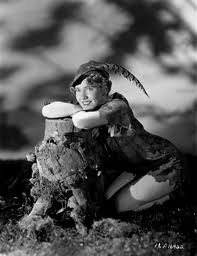
So, starting at the tender age of five or six, I was dragged along by my parents to Broadway Musicals, and loved every moment. My first Broadway memory was Peter Pan. Not the 1954 Mary Martin/Cyril Ritchard/Jule Styne/Comden and Green Peter Pan, which became the accepted standard bearer for the title. And, not the original either, which played back in the Twenties. No, I’m talking about the 1950 Leonard Bernstein (both music and lyrics) Peter Pan, with

 Jean Arthur as the dauntless leader of the lost boys, and Boris Karloff as his nemesis, Captain Hook. Unlike the foppish Cyril Ritchard, Karloff’s Captain Hook was terrifying, and scared the hell out of me. To say that Pater Pan, even at that tender age, got me hooked on musicals, would be shamelessly opportunistic, but, none the less – true. Throughout the Fifties and Sixties, I don’t think there was an important show that I missed, not one.

I went to high School in Manhattan, and learned the trick of ‘second acting’ Broadway Shows. It’s simple, and I’m sure would still work today. On Wednesdays, Matinee day on Broadway, a few of us at Rhodes Prep would cut our last class or two, and head over to the theater district. There is security at Broadway theaters only at the beginning of the show. When the audience begins to file back in after the intermission, no one checks their tickets. The trick is to mingle with the crowd, pretend to belong, and be the last ones in. With everyone else seated, any empty seats would be ours for the taking, and the second act of the show was seen, free of charge. I must have sat through the second act of Gypsy twenty times.

In 1957, at the Winter Garden Theater, I saw Leonard Bernstein conduct the Pit Orchestra for the overture, on the opening night of West Side Story. I was too young to have understood the significance of that moment, but never forgot it. So, I guess what I’m saying here, is that I’ve been blessed to have been exposed to musical theater from a very young age, and might as well put all this history to some practical use. I know most of you are thinking ‘Oh no, not another list’. But lists are useful, for me anyhow, and this is something I’ve given a great deal of thought to.

Not that long ago, I had a Facebook discussion with my old friend Mal Worob, about the film version of the Broadway Musical “Cabaret”, and how it was probably the best film adaptation of a Broadway Musical, ever. That got me to thinking. If Cabaret was the best, and if the inevitable Top Ten treatment were given to film adaptations of stage musicals, just what exactly would the other nine be? The single most important criterion would have to be, film adaptations of Broadway musicals, that, even if there had been no stage original to compare them to, would stand on their own as Motion Picture Musicals, marvelous entertainment vehicles in their own right.

I also realize that we’re back to the old subjectivity shenanigans again – my list will probably not match yours, but it’s a start, and that’s really all I’m after here.

So, in alphabetical order:


CABARET   1972

Bob Fosse

(8 Oscars)


From Christopher Isherwood’s ‘I Am a Camera’ stories of 1920’s and 1930’s Berlin. Bob Fosse, who made his bones as a stage choreographer, dazzles as few have, as a film director. From the

 very opening shot, Cabaret is startlingly fresh and different than anything seen before. I think you could blissfully sit through it, even if it had no story, which it has. Sally, an entertainer at Berlin’s Kit-Kat Klub, has affairs with Brian (Michael York), and Maximilian (Helmut Griem), both of whom are bi-sexual, and having a boy-boy thing with each other. Sally becomes pregnant, Brian offers to do the right thing, and none of it matters – the show’s the thing. And Kit-Kat’s MC, Joel Grey mesmerizes here for the camera as much as he did on the stage. Under Fosse’s keen, energetic direction, Kander and Ebb’s score still shines, some songs better in filmed close-up. And if the number at the gasthaus, “Tomorrow Belongs to Me” doesn’t put 1930’s Germany into perspective, then you need time at the Reality Resumptive Institute.

Beautifully shot by Geoffrey Unsworth, and edited by David Bretherton, Cabaret is like nothing before or since.


http://www.youtube.com/watch?v=3d4iHb3AP2Y


http://www.youtube.com/watch?v=LNMVMNmrqJE


CHICAGO   2002

Rob Marshall

(6 Oscars)


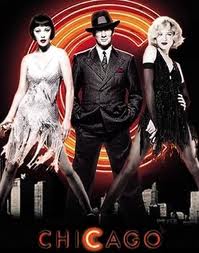
Death Row Musicals are few and far between. The stage production was designed in 1975 by Bob Fosse as a dance-driven vehicle for wife Gwen Verdon, and sassy Chita Rivera, and, while

 Kander and Ebb’s (Yes, those two again) songs shined, it was Fosse’s inventive choreography that drove the bus, in one number – literally.

But Rob Marshall’s 2002 adaptation, without attempting to imitate, absolutely glows, and with a surprising cast, including Renee Zellweger, Catherine Zeta-Jones, Queen Latifah, and Richard Gere – and, yes they sing their own numbers, and yes, they’re terrific. Marshall wisely chose to accurately recreate Fosse’s original choreography, but on film, Kander and Ebb’s score is given a more intimate performance, keeping pace

 with Fosse’s dance numbers. Solid Cinematography by Dion Beebe, and slick editing by Martin Walsh keep things moving. Nice to see modern film technique used to make a good show even better. So, Mr. Marshall, why not do it again? There’s a long list of wonderful shows, just waiting for this kind of transformation.


http://www.youtube.com/watch?v=8IxcfbldgBY


FIDDLER ON THE ROOF   1971

Norman Jewison

(3 Oscars)


Just who is this Topol guy, and why isn’t Zero Mostel in this movie? This troubled many back in 1971 who, like myself, had seen the show’s protagonist Tevye played by Zero Mostel on the

 stage, and would accept no substitute. But Director Norman Jewison had seen an Israeli actor named Chaim Topol do the part on the London stage, and saw him as a more realistic Tevye, more in keeping with his vision for this film. It took about fifteen minutes for Topol to win me over, and I’m a major Mostel fan.

About Jewison’s vision – never has a Movie Musical contained such striking visuals, reminiscent of early Chagall Paintings, and some Van Gogh, as well. Cinematographer Oswald Morris, on Jewison’s suggestion, shot much of the footage through a nylon stocking, in order to achieve just the right diffusion.

So, from the Jewish Mark Twain, Sholom Aleichem, come the Tevye stories. Tales of a milkman named Tevye, in the tiny shtetl

 of Anatevka, somewhere in the wilds of nineteenth century Czarist Russia. The name Fiddler on the Roof came from the

 image in a Chagall painting. The Bock and Harnick score is given lush visual treatment here, along with Jerome Robbins’ original choreography. Fiddler is a big, expensive, long (3 hours), elaborately produced film, and Jewison’s vision paid off in spades – just the right amount of realism, mixed with absurdity. A lovely, emotionally satisfying three hours of cinema, really done to perfection. I found no faults with it, truly. 

http://www.youtube.com/watch?v=6oD-FxyX6_c


A FUNNY THING HAPPENED ON THE WAY TO THE FORUM   1966

Richard Lester

(1 Oscar)


I guess you can call this Zero’s revenge for his exclusion from the aforementioned title, although this movie was shot five years


 earlier than Fiddler. But on this list, it comes alphabetically after Fiddler, so we’ll call it Zero’s revenge and be done with it.

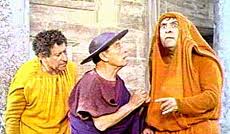
In ancient Rome, the Empire’s laziest slave Pseudolus (Mostel) wants his freedom if it kills him, which it might. Steven Sondheim’s music and lyrics, and Larry Gelbart, and Burt Shrevelove’s book make for some funny doings.

 I saw this on Broadway with both Zero Mostel, and Dick Shawn as Pseudolus, and it was a smart, riotously funny show. Handing this Material to film director Dick Lester however, added an element of frenzied energy, that makes it even funnier. And Lester added some spice to the cast with the addition of Phil Silvers, Jack Gilford, and Buster Keaton.

Wonderful, clever, frantic banter (Thank you Gelbart/Shevelove), and zany musical numbers make for a satisfying, if unusual, movie musical.

Best number – Captain Gloriosus enters the city.


http://movieclips.com/9WQVu-a-funny-thing-happened-on-the-way-to-the-forum-movie-captain-gloriosus/


http://www.tcm.com/mediaroom/index/?cid=9056 


GUYS AND DOLLS   1955

Joseph L. Mankiewicz

So, would Damon Runyan have gotten a kick out of the song and dance treatment given his eccentric Broadway caricatures; Nicely-Nicely Johnson, Nathan Detroit, Sky Masterson, Harry the

 Horse, Big Jule, and Benny Southstreet? I’d like to think so. How could anyone not fall in love with Frank Loesser’s take on Runyan’s happy-go-lucky gang? Loesser’s Guys and Dolls is one of the all-time great Broadway shows, and Joe Mankiewicz, along with writers Jo Swerling, Abe Burrows, Runyan, and an uncredited Ben Hecht, turn it into screen gold for Goldwyn. The big risk here, was hiring box office draw Marlon Brando. Marlon Brando? Could he sing? Could

 he dance? The answer is, well, sort of – enough to get by, anyway. But, with lyrics like “Luck, if you’ve ever been a Lady to begin with, luck be a Lady tonight”, the song can carry the singer, and here, it does.

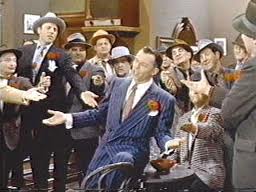
The plot is simple, Nathan Detroit (Frank Sinatra) is in charge of setting up “The Oldest Established Permanent Floating

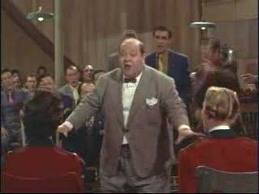
Crap Game in New York”. But he needs a thousand bucks to fund the game. So he bets gambler Sky Masterson (Brando) a thousand clams that Sky can’t persuade Sister Sarah Brown (Jean Simmons) to abandon her Times Square Mission and fly to Havana with him. Sky hands Nathan his “Marker”, and the game is on. Two Vets from the Broadway original, Vivian Blaine as Miss Adelaide, and the remarkable Stubby Kaye as Nicely-Nicely, whose show stopper, “Sit Down You’re Rocking the Boat” is pure joy on the screen, as well.

And Loesser’s glorious lyrics; “I got the horse right here, his name is Paul Revere”, and “And the Devil will drag you under, by the sharp lapel on your checkered coat”, still delight the senses of the otherwise sensible.


http://www.youtube.com/watch?v=VS5DU2cf2Co


GYPSY   1962

Mervyn LeRoy


I think we all know the story here. Incorrigible stage mother Mama Rose Hovick (Rosalind Russel) bets the ranch on daughter

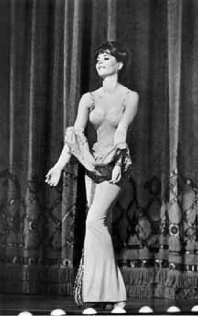
 Baby June (Morgan Btittany) becoming a Vaudeville star. But when June flees the theatrical nest, Mama Rose is forced to turn her questionable attentions to older, and less obviously talented sister Louise (Natalie Wood) who winds up becoming Gypsy Rose Lee, a famous stripper at Minsky’s Burlesque. The Styne/Sondheim Musical, starring the indomitable Ethel Merman, is one of Broadways real champs, and the switch from Merman to Rosalind Russell in the movie was risky, but paid off. Russell, while not as powerful in the musical numbers, created a far more complex and compelling Mama

 Rose on the screen. And, the addition of Karl Malden as Mama Rose’s relentless beau Herbie, rounds out a nice cast of principals.

The book for the show, written by Arthur Laurents, was based on gypsy Rose Lee’s memoirs. Unlike the predecessors on this list, Gypsy is stagey, but forgivably so. The delicious and familiar score, and a game cast make this memorably entertaining. Give Gypsy a chance. Let her entertain you.


http://www.youtube.com/watch?v=GuY578WWzu0


LITTLE SHOP OF HORRORS   1986

Frank Oz

I’ll bet I scared you with this one, but believe me, it belongs here. An unusual theatrical ancestry – The Off Broadway (So, sue me) Musical was based on Roger Corman’s 1960 absurdist

 horror/comedy (that’s how it wound up, anyway) that featured a very young Jack Nicholson. The Off Broadway production was a very dark musical indeed, but hilariously so. And, unlike others on this list, the movie wound up quite different from its theatrical parent, with several songs deleted and new ones added.

Nerdy florist Seymour (Rick Morainis) works in a flower shop, and has a crush on co-worker Audrey (Ellen Greene). Seymour finds that he has an unusual plant on his hands, an ever-growing carnivorous cactus with a hunger for human blood. He names his thirsty succulent Audrey II, after his love interest, and winds up feeding Audrey’s sadistic Dentist boyfriend (Steve Martin) to his plant-pal. Seymour’s boss, who witnessed the dentist’s demise, is the next man on the menu. Where will it end? The plant keeps growing larger, and has Seymour’s girlfriend Audrey in its crosshairs. The insatiable succulent has only one oft-repeated line, “FEED ME”.

Ridiculous, I know, but outrageously funny stuff here, and some catchy tunes as well. If you haven’t seen this, what’s stopping you? 


http://www.youtube.com/watch?v=4FKwPA-x4os


OLIVER   1968

Carol Reed

(5 Oscars)

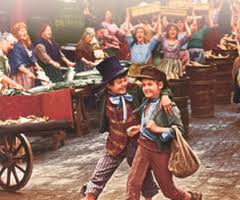
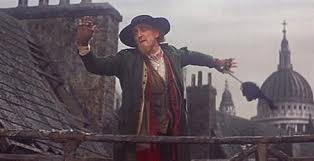
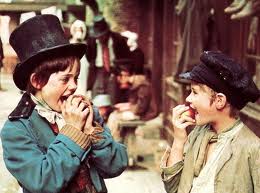
 Adapted from the London, then Broadway stage, and of course based on Charles Dickens’ Oliver Twist, Oliver was filmed at England’s Shepperton Studios. Lionel Bart’s (music and lyrics)

 Oliver was one of my very favorite stage musicals, featuring an inventive staging unlike anything I’ve seen before or since. Carol Reed’s movie version recreates a dark, somber, Dickensian London – a perfect background for the story at hand.

Young Oliver escapes a cruel orphanage, and winds up recruited by a band of Dickensian London’s homeless boys, and their greedy mentor Fagin, who

 teaches him, “You’ve got to pick a pocket or two”, in one of the production’s memorable musical numbers. Legend has it that over five thousand boys were auditioned before Reed settled on young Mark Lester for the title role.

Fagin’s character in the Dickens book, as well as subsequent movie versions (David Lean’s memorable film with a young, huge-nosed Alec Guiness as Fagin, comes to mind) had strong anti-Semitic overtones, but Lionel Bart, himself Jewish) softened the miser’s character to make him almost likeable.

“Food, glorious food”, sing the boys at the orphanage, and a glorious musical score this is, with songs expertly staged to match the story, with more dark lensing from

 cinematographer Oswald Morris, Production Design by John Box, Art Direction by Terence Marsh, and costumes by Phyllis Dalton. And, a tasty cast including Ron Moody as Fagin, Oliver Reed as Bill Sikes, Shani Wallace as Nancy, Harry Secombe as Mr. Bumble, and old Hugh Griffith as the Magistrate.

A lush, luscious feast for the eyes and ears.   

http://www.youtube.com/watch?v=TDIRNqNdsTI


THE SOUND OF MUSIC   1965

Robert Wise

(5 Oscars)

Once upon a time, in a pre-Star Wars world, before Steven Spielberg and George Lucas rewrote the game plan for box office bonanzas, there was one movie that broke all attendance records

 world-wide, and ruled the box office roost for many, many years. It had no special effects to speak of, no space ships or cute and fuzzy aliens, no super heroes saving mankind from dark misadventure. It was simply, the world’s favorite movie. All it had was a simple story of good triumphing over ignorance and impending evil, Rogers and Hammerstein’s

 magnificent music, and the visual splendor of Alpine Austria. And, that incredible opening sequence.

It was based on the true story (with the appropriate liberties taken) of the Trapp family, in late 1930’s Austria, and the nanny

Maria (Julie Andrews), a failed nun, who would change their lives forever. A family of musical prodigies, tutored by Maria, and led by their smitten (with Maria, that is) father Captain Von Trapp (Christopher Plummer), they would use their musical performances to escape their Nazi-occupied homeland. Most of them wound up in Vermont, where their descendents still operate the Trapp Family Lodge.

Hard to imagine film producers attempting such a thing today, but The Sound of Music was shot by Ted McCord in 70MM Anamorphic Panavision, and is visually glorious to behold.  The production was designed by Boris Leven, Costume Design by Dorothy Jeakins, and seamlessly edited by Bill Reynolds. Kudos to a top-flight crew.

If there’s anyone reading this who has not seen The Sound of Music, go find it. It’s out there. Probably Rogers and Hammerstein’s best all around score, and that’s saying something. You don’t have to tell anyone. Keep it a secret, if you like, but see it.

http://www.youtube.com/watch?v=KuWsQSntFf0


WEST SIDE STORY   1961

Robert Wise

(10 Oscars)


Shakespeare invades Hell’s Kitchen. Instead of the feuding Montagues and Capulets, we have the Sharks and the Jets. Instead of Romeo and Juliet, we have Tony and Maria. Different names

 and situations, but star-crossed, ill-fated lovers, just the same. And to bring it all about, we are blessed with the sheer genius of two men, Leonard Bernstein and Jerome Robbins, who would each do their best work here.

In New York’s Hell’s Kitchen, competing gangs vie for supremacy, and there is no love lost, or room for negotiation. The lyrics say so:

“When you’re a Jet,

you’re a Jet all the way,

from your first cigarette,

to your last dying day”

Riff leads the white Jets, and Bernardo the Puerto Rican Sharks, and there’s no room for intermingling. But, at a dance, while Jets and Sharks compete through ethnically-driven dance routines, Riff’s cousin Tony and Bernardo’s sister Maria suddenly notice each other across the gym, and, for this ill-fated couple, the world simply disappears. Sounds corny, I know, but it works, and you’re hooked.

 Jerome Robbins creates original, high energy choreography, as the Sharks and Jets dance across streets and playgrounds singing Leonard Bernstein’s unprecedented score, all along headed toward the tragic conclusion that we all know is coming. During a gang fight, Tony, while trying to stop the violence, accidently stabs Bernardo, and the Sharks and the Jets go to the mattresses. Regardless of the lyrics, there is no place for the love between Tony and Maria, who, like that couple in Verona, succumb to the hatred and prejudice of their peers.

Natalie Wood is a compelling Maria. You know her voice is dubbed in the songs, but somehow it doesn’t matter. Richard Beymer however, is a questionable, even effeminate Tony, the only real casting mistake.  Russ Tamblyn is a bouncy Riff, and his Sharks counterpart, Bernardo, is well turned by George Chakiris. But the show is stolen by a vivacious Rita Moreno, whose spicy Anita steals every shot she’s in.

Robert Wise steers the ship with a quietly firm directorial hand, leaving Robbins to do the brilliant grunt work. New York City postponed the early construction of Linclon Center, while the troupe cavorted about on the center’s future location. Steven

 Sondheim’s first adult job here, as lyricist. He’s said in recent interviews that he finds his work on West Side Story to be mostly embarrassingly bad. Hardly – but certainly much simpler stuff than his later shows.

A story by Shakespeare, Bernstein and Robbins’ best work, and a bunch of pros, singing and dancing their heads off – what could be better? 

http://www.youtube.com/watch?v=yA_aFprGzyc

*

© 2011 Shaun Costello

Keep SHAUN COSTELLO’S BLOG up and running.
Creating and maintaining this BLOG is time
consuming. If you like what you’ve been reading,
please help me keep it going.
DONATE ANY AMOUNT Through PAYPAL at:

PERSONAL FAVORITES


PERSONAL FAVORITES

Ten films (and they’re not the only ten) that, for reasons unknown to me, I have seen at least ten times.

By Shaun Costello


 I’ve seen a lot of bad movies, and willingly confess to having enjoyed most of them. Like their better brethren, some bad movies are just likeable. This whole movie thing is so subjective, like books, I guess. What makes us prefer one over another? What is it about certain films, that strikes a chord in us, creating the need to see them again? Is any movie really worth seeing ten times? I have no answers to any of these questions, and readily admit that the aforementioned behavior sounds symptomatic of some kind of psychiatric anomaly. Furthermore, as long as I’m in the confessional, back in the late Sixties and early Seventies, I unashamedly admit to having spent a preposterous amount of time, sitting in the balcony of the old Elgin Cinema (Now the Joyce Theater of Dance) on Eighth Avenue and 19th  Street, eyes glued to the screen, absorbing one movie after another, becoming hungrier and hungrier for more of the same. And, to add some full-disclosure here, I readily confess to having had intimate knowledge of the interiors of every movie house in Manhattan, from Fourteenth Street to Eighty Sixth – and river to river. From the trendy, East Side, cup of espresso before the credits venues – to the grunge palaces of 42nd Street, where you could see three action pictures for a buck, and where the predominantly black audience threw empty soda cans at the screen, to warn the hero that a bad guy was sneaking up behind him. If movie addiction were a crime, I’d be doing life without parole, as a permanent guest of the state.

Does anyone know the name of an affordable shrink?

Where was I? Oh, the over and over thing. Thanks to Blogging, I can share part of my addiction with you, ten examples at a time. While there are probably hundreds of movies that I have seen at least ten times, I have selected the following ten, ten being the magic number of which lists seem to be constructed. 

Although some films on my previously blogged lists could easily have been included here, I’ll limit this to as yet unlisted titles.


So, in alphabetical order:


Badlands   1973

Terrence Malick


 Terry Malick’s hypnotic dramatization of the 1958 Starkweather/Fugate murder spree, across the prairie. The whole movie has an other-worldly feel to it, thanks to Sissy Spacek’s detached, child-like narration, and Malick’s use of Karl Orff’s children’s music. Spacek witnesses Sheen’s sudden, unexpected murder of her parents, and reacts as though the event was an episode of Ozzie and Harriet on television. They set fire to the house and hit the road, as we see Sissy’s life, in a series of close-ups of burning photographs and toys, go up in flames, scored to Orff’s rhythmic syncopation. Her detached narration becomes more bizarre with each of Sheen’s subsequent murders, as they kill their way through the Dakota badlands. Growing more and more paranoid, Sheen creates a hideout in the sagebrush, complete with deadly booby traps to deter their pursuers.  Out of nowhere, a Sheen/Spacek desert dance begins to Mickey and Sylvia’s “Love is Strange”, and ends just as abruptly as it began. Strange and deadly doings, out on the prairie.


 http://www.youtube.com/watch?v=lcFx06cBmbk


Dogs of War   1980

John Irvin


“Cry havoc, and let slip the dogs of war” Shakespeare/Julius Caesar

 My Favorite Frederick Forsyth book, and definitely a film worth seeing. I have no idea why I like this film so much, but Christopher Walken’s both vulnerable, and dangerous persona, makes this thing work. Mercenaries are hired to depose a dictator in a fictional and failed African state. Forsyth’s elaborate detail, and great ensemble work keeps the action entertaining. Cast includes: Tom Berenger, Paul Freeman, Jean Francois Stevenin, and JoBeth Williams.


 http://www.youtube.com/watch?v=Ji7-p2GMbWA


Hud   1963

Martin Ritt

(3 Oscars)


From Larry McMurty’s novel, Hud is Paul Newman’s cranky cowboy caper. A disappointment to his stalwart, principled father (Melvyn Douglas), and a hero to his younger brother ( Brandon De Wilde), Hud’s just waiting for his Dad to die so he can inherit the ranch. Patricia Neal is hired to help with the chores, creating some lust amongst the longhorns. And have a listen to Elmer Bernstein’s subtly effective score – sometimes using just one guitar. Newman is one nasty cowpoke, but Douglas and Neal steal the show, and win their Oscars. A Best Cinematography Oscar also went to James Wong Howe for some beautiful work in Black and White.


 http://www.facebook.com/video/video.php?v=1052301477747 


KLUTE

Alan Pakula   1971

(1 Oscar)


Klute was the first installment of what would become known as director Alan Pakula’s “Paranoia Trilogy”. The other two films are “The Parallax View” (1974) and “All the President’s Men” (1976). But, I think most people remember it for Jane Fonda’s once-in-a-lifetime performance (and her Oscar) as the jittery hooker with someone on her roof.

The film begins with the disappearance of Pennsylvania executive Tom Gruneman. The police reveal that an obscene letter was found in Gruneman’s office. It was addressed to a prostitute in New York City named Bree Daniels (Fonda), who had received several similar letters from Gruneman. Much to the surprise of the police, Peter Cable (Cioffi), an executive at Gruneman’s company, hires family friend John Klute (Sutherland) to investigate Gruneman’s disappearance.

Klute rents an apartment in the basement of Daniels’ building, taps her phone, and follows her as she turns tricks. Initially, Daniels appears to be liberated by the freedom of freelancing as a call girl. In visits with a psychiatrist throughout the film, however, she reveals that she feels empty inside and wants to quit. Klute asks Daniels to answer some of his questions, but she refuses. He approaches her again, revealing that he has been watching her. She assumes that he will turn her in if she does not cooperate, but does not recall Gruneman at all. She reveals that she was beaten by one of her ‘johns’ two years earlier, but after seeing a photo of Gruneman, she says she cannot say for sure one way or the other. She is only certain that the john “was serious” about the attack.

Daniels takes Klute to meet her former pimp, Frank Ligourin (Scheider). Ligourin reveals that one of his prostitutes passed off the abusive client to Bree and another woman named Arlyn Page (Dorothy Tristan). The original prostitute committed suicide, and Page became a junkieand disappeared. Klute gives his surveillance tapes to Daniels, telling her he is finished with her part of the case. But, realizing that he cannot continue the investigation without her, he re-enlists her help to track down Page.

Klute is one of the great New York Location movies. Others that come to mind are “Serpico”, “The French Connection”, and “Three Days of the Condor”. From the very first credit, Michael Small’s tingly, eerie musical score sets the mood. Alan Pakula went for dark and gritty, shooting in tight locations where entire scenes were lit exclusively with ‘inkies’. The result is a feeling of intimacy that resonates throughout the film, amplifying a sense of impending danger.

Beyond Fonda’s astounding performance, Donald Southerland’s John Klute has a hound dog-like persistence. Roy Scheider does a creepy turn as Fonda’s pimp, and Charles Cioffi is effectively dangerous as the serial hooker-killer. But, it’s Vivian Nathan, as Fonda’s shrink, who steals the show.

The Prince of Darkness, Gordon Willis, shines here, creating luster in the shadows. Seemless editing by Carl Lerner, and Michael Small’s relentlessly eerie score make this memorable. Maybe you have to be a New Yorker to love this film, but I don’t think so. One of my all time favorites.

Best scenes: Fonda with her ‘trick’ in the hotel room – “Oh, my angel. My angel”. And Jane tells old Mr Goldfarb about her recent erotic adventure. “No, he was an older man, not unlike yourself. Young men can be so…..silly”.

http://www.youtube.com/watch?v=EbWNl5_JT7k

http://www.youtube.com/watch?v=9FgAW344s5w

Lost Horizon   1937

Frank Capra

(2 Oscars)


It was the mid Thirties, and the Faschisti were marching across an ever-darkening Europe. James Hilton’s novel described a better place, a place of peaceful solutions, and escape from the

 jack boot – somewhere over the rainbow, or in this case over the Himalaya’s, was the secret valley of the Blue Moon, and at its center – Shangri La, where dreams came true and life was eternal, well almost. In my opinion, Lost Horizon is Frank Capra’s masterpiece, and a joy for anyone to see.

The director didn’t like the early dailies – something just wasn’t right in those snow scenes. And it dawned on Capra, that there was no steaming breath from the mouths of his actors. So he packed up and reshot in a gigantic meat freezer, somewhere in Brentwood.

Tragically, about fifteen minutes of the original negative has been lost. The producers of the now-available DVD offer two versions; one with the existing picture, and another (thank God) with the screenplay intact, and a black picture over the dialogue scenes where the original picture was lost. I found the latter to be preferable, hearing the entire script, for me anyway, was much more satisfying.

A delicious Fairy Tale beautifully delivered by Capra with: Ronald Coleman, Jane Wyatt, Edward Everett Horton, Thomas Mitchell, and Sam Jaffe as The High Lama. And, Dmitri Tiomkin’s luscious musical score.


 http://www.tcm.com/mediaroom/index.jsp?cid=223909


 http://www.tcm.com/mediaroom/index.jsp?cid=223908


Serpico   1973

Sidney Lumet


Officer Serpico’s best friend on the police force tells him, “Frankie, no one trusts a cop, don’t take money”. From Peter Mass’ book on New York City’s police corruption, and the true story of the cop who went on record against it. It takes almost the entire film for Serpico to persuade New York’s political establishment to accept the evidence he’s been trying to give them all along – evidence that leads to the Knapp Commission hearings. Director Lumet is

 at home, shooting on location, in the city he knows so well, and the film looks it. Dark and luscious lensing by Arthur Ornitz, and strong ensemble work by an familiar cast, filled with Lumet’s favorite actors. But, in my opinion, the smartest decision Sidney Lumet made was hiring Mikis Theodorakis to do the musical score, music that seems to support every image, with lyrical simplicity. One of the all-time great New York location movies, with: Al Pacino as Officer Frank Serpico, surrounded by the Sidney Lumet repertory company.


http://www.youtube.com/watch?v=LtTRYnsDH8Q


Slapshot   1977

George Roy Hill


Oddly enough I never saw Slapshot in a movie theater. My buddy Mal Worob had a tape of it in his Manhattan loft. This was even before VHS – it was probably a Betamax. Mal was the first person I knew who had copies of movies at home.

Anyway, I can remember Paul Newman, in an interview saying, “We got more out of less on Slapshot that any movie I was involved in”.

Newman plays the Player/Coach of a failed minor league Hockey Team, that’s being sold behind his back. So, with nothing to lose, he hires the Hanson brothers (real life hockey players), who are notoriously violent and dirty players, and the Chiefs go on a tear. Slapshot has the look of a film that was obviously fun for the actors involved, and it shows, the cast seemingly in on every gag. And that cast includes Newman, Lindsay Crouse, Strother Mortin, Michael Ontkean, and those effervescent Hanson brothers.

Hilarious!


http://www.youtube.com/watch?v=vW67agGgWAM


The Professionals   1966

Richard Brooks


Another Seven Samurai spin-off, but this one’s got Lee Marvin, and Burt Lancaster, and Robert Ryan, and Woody Strode, and Jack Palance and Claudia Cardinale, and some of the sauciest, machismo, cowpoke dialogue ever delivered. Richard Brooks’ crusty screenplay constantly parodies itself, and the boys are up to the task. Lee and Burt play tired adventurers, hired for one last mission – bring back the kidnapped wife of a wealthy railroad mogul. They had both fought in Mexico with

 Pancho Villa, and are not eager to ride back south of the border but, what the hell, ten thousand dollars a man buys a lot of tamales. Every actor is given quotable dialogue to deliver, and deliver they do. This movie could have been just silly, but director, script, and cast come together here, and the result is a thoroughly entertaining film. Beautiful cinematography by Conrad Hall, and the musical score, by Maurice Jarre, is unexpectedly spicey.  Grab this, if you can.


 http://www.youtube.com/watch?v=iE7MSE0bDe8


The Thomas Crown Affair   1968

Norman Jewison

(1 Oscar)

 No, not that silly sequel with Pierce Brosnan. I’m talking about the 1968 original with Steve McQueen and Faye Dunaway. A big bank heist, simply for the thrill of it. A wealthy and bored McQueen robs the biggest bank in Boston, for fun. And insurance investigator Faye Dunaway is hired to crack the case. Of course, this is a movie, so they become romantically and competitively involved. She tells him she’s going to win, and get her man. He takes the challenge, and goes out and robs another bank, basically telling her, “I’m going to do it, and you can’t stop me, or catch me”.

Sexy, slickly entertaining suds, with two stars in their prime. And, unlike the silly sequel, someone has to win, and someone has to

 lose. The chase becomes a chess match, figuratively, and literally. Great use of split-screen, and Michel Legrand’s Oscar winning score, with a great song, “Windmills of your Mind” woven through it. Bank heists, Polo, Glider planes, and Chess for sex. Ah, the Sixties.


 http://www.youtube.com/watch?v=hzajlo4ZJ0I


Three Day’s of the Condor   1975

Sidney Pollock

 Is there a second CIA, inside the CIA? A question Turner (Robert Redford), a bookish, reader/researcher who works for the CIA asks himself, after returning from lunch to find everyone in his New York office has been assassinated. The Agency thinks he’s involved, and unknown forces are out to silence him. He needs time to sort it all out, and somewhere to hide. He kidnaps Faye Dunawaye, and uses her apartment – a place to think things through. Everyone is after him. Atwood (Addison Powell) whose secret network Turner accidently uncovered. Higgins (Cliff Robertson), the CIA’s Deputy Director who’s trying to bring him in. Wabash (John Houseman), a CIA Mandarin who orders him killed. Joubert (Max von Sydow) a hired assassin who befriends him. With the help of his kidnap victim Kathy (Faye Dunaway), he tries to solve the puzzle.

Condor is a fast paced, top notch CIA spy caper, with a clever, ever-twisting plot, and game cast. Pollock’s second best effort, I think. (Tootsie is hard to beat) Lorenzo Semple’s intelligent screenplay is smart and juicy.  Slick cinematography by Owen Roizman, with good use of New York locales.  Great stuff.


http://www.youtube.com/watch?v=PBZf7vifXmY

*

© 2011 Shaun Costello

Keep SHAUN COSTELLO’S BLOG up and running.
Creating and maintaining this BLOG is time
consuming. If you like what you’ve been reading,
please help me keep it going.
DONATE ANY AMOUNT Through PAYPAL at:

KNOWING MORE THAN GOD

KNOWING MORE THAN GOD

By Shaun Costello


In scanning the overwhelming response, in newspapers across the country to the death of  Barbaro, I am stunned by the idiotic sentimentality displayed by an ignorant public that, not once, seems to have taken the ordeal of this horse into consideration. On the third Sunday of May 2006, in front of a horrified public, a thoroughbred horse known as Barbaro suffered a fatal injury while running in the Preakness Stakes, a race he was favored to win. I have owned horses a good part of my life and can tell you that no horse recovers from this serious an injury.

A combination of this preposterous sentimentality, and a veterinary team looking to make a name for itself, (no matter how sincere they appear) caused this horse to endure an agonizing and needless eight months in hopeless recovery-limbo, instead of the quick, painless, and humane end it deserved.


The great filly “Ruffian”, who suffered a similar injury, in a similar situation, was euthanized on the spot at Belmont Park, back in the Seventies which, I guess, was a more merciful and sensible decade.

Barbaro endured a shameful eight months, during which ruthless cottage industries sprang up all over the country, making scandalous profits on the agony of an animal. The greeting card industry pitched in with, “Get Well Soon Barbaro” cards, bought by parents, signed by children, and sent where, exactly? To the veterinary barn, where a suffering thoroughbred adjusted his reading glasses and scanned the literary endeavors of his fans? Dishes, statuettes, framed photographs, were all adorned with a likeness of the suffering animal, and displayed in the bedrooms of little girls across America. And where did the profits go? To the relentless bottom feeders, who are willing to make a killing on anything, even a killing itself. America has turned into a culture of crazed sentimentalists who, to feed their need for romantic fantasy, seem to have distanced themselves from reality.


British philosopher Bertrand Russell defined sentimentality as, “Placing more importance on something than God does”. Think about it.

And on pages of newspapers everywhere, Barbaro’s adjectival army, sitting in front of their computers, surrounded by their dying horse trinkets, had their say:

“Courageous”

“Inspirational”

“Lengendary”

“Heroic”


“We love you Barbaro”

“Do horses go to heaven?”


YIKES!

Does anyone wonder how many of the thoroughbred colts and fillies foaled each year in the breeding facilities of Kentucky, and Maryland, and California ever get to a race track? The answer is a miniscule percentage. Another equally miniscule percentage wind up as sport horses, to be ridden in equestrian competitions. So do any of you sentimentalist out there want to know what happens to the rest? They are bought by, what is known in the horse world as, “the killer trucks”, and shipped to Canada, where they are slaughtered, and then sent on to the kitchens of France, where horse meat sells at the local butcher shop for 10 Euros a pound.

But sentimental America wants to close its eyes to that kind of reality, and instead to gather in droves to sign petitions, demanding that the remains of the once proud horse know as Barbaro, be stuffed like Trigger, and put on display in Disneyworld. Maybe this crazed army of sentimentalists will then get what it always wanted, Barbaro, as a stuffed animal.

 *

© 2007 Shaun Costello

Keep SHAUN COSTELLO’S BLOG up and running.
Creating and maintaining this BLOG is time
consuming. If you like what you’ve been reading,
please help me keep it going.
DONATE ANY AMOUNT Through PAYPAL at:


Design a site like this with WordPress.com
Get started