
HAIL THE CONQUERING HERO

HAIL THE CONQUERING HERO
by Shaun Costello
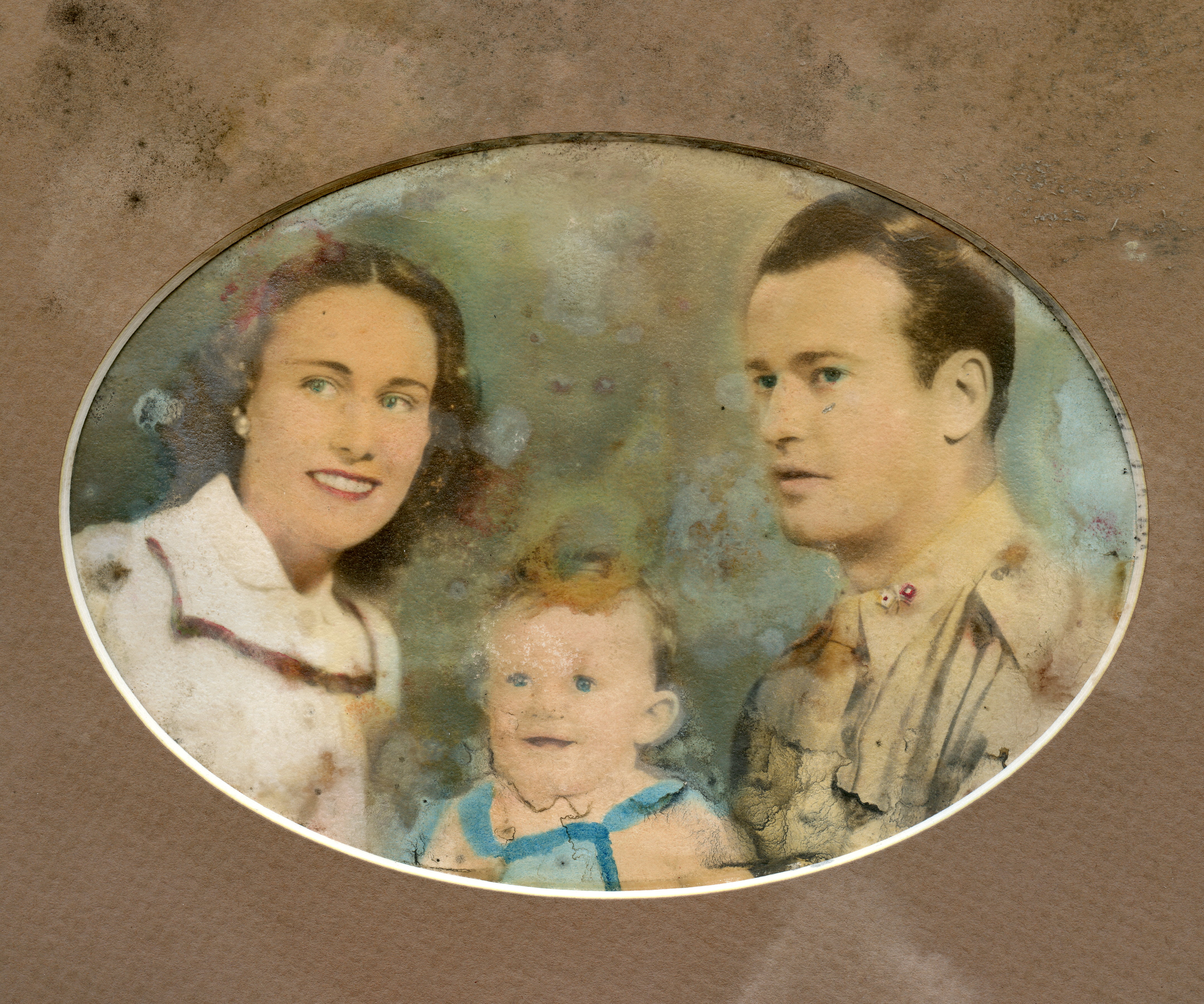
This guy in a uniform must be my father. Hey there, Dad.
This story becomes Chapter One (following the prologue)
of the childhood memoir:
THE LAST TIME I SAW JESUS
Surviving God and Elvis in the Time of ‘Duck and Cover’

My newlywed parents, along with my Aunt Alice and Uncle Tommy, at The Stork Club, a few weeks before my father left for The Pacific during World War II
As a child, I had two adult male role models, neither of whom, as far as I know, experienced a single responsible moment in their lives; which goes a long way toward explaining why money has always been a mystery to me. There was my father – a pathological liar, degenerate gambler, alcoholic, chain smoker, and raconteur to the uninformed; who seemed involved in an endless struggle between his income and the image of himself he had created, with clumsy sleight-of-hand, as a buffer to prevent being discovered as the fraud he must have known in his heart he undoubtedly was.
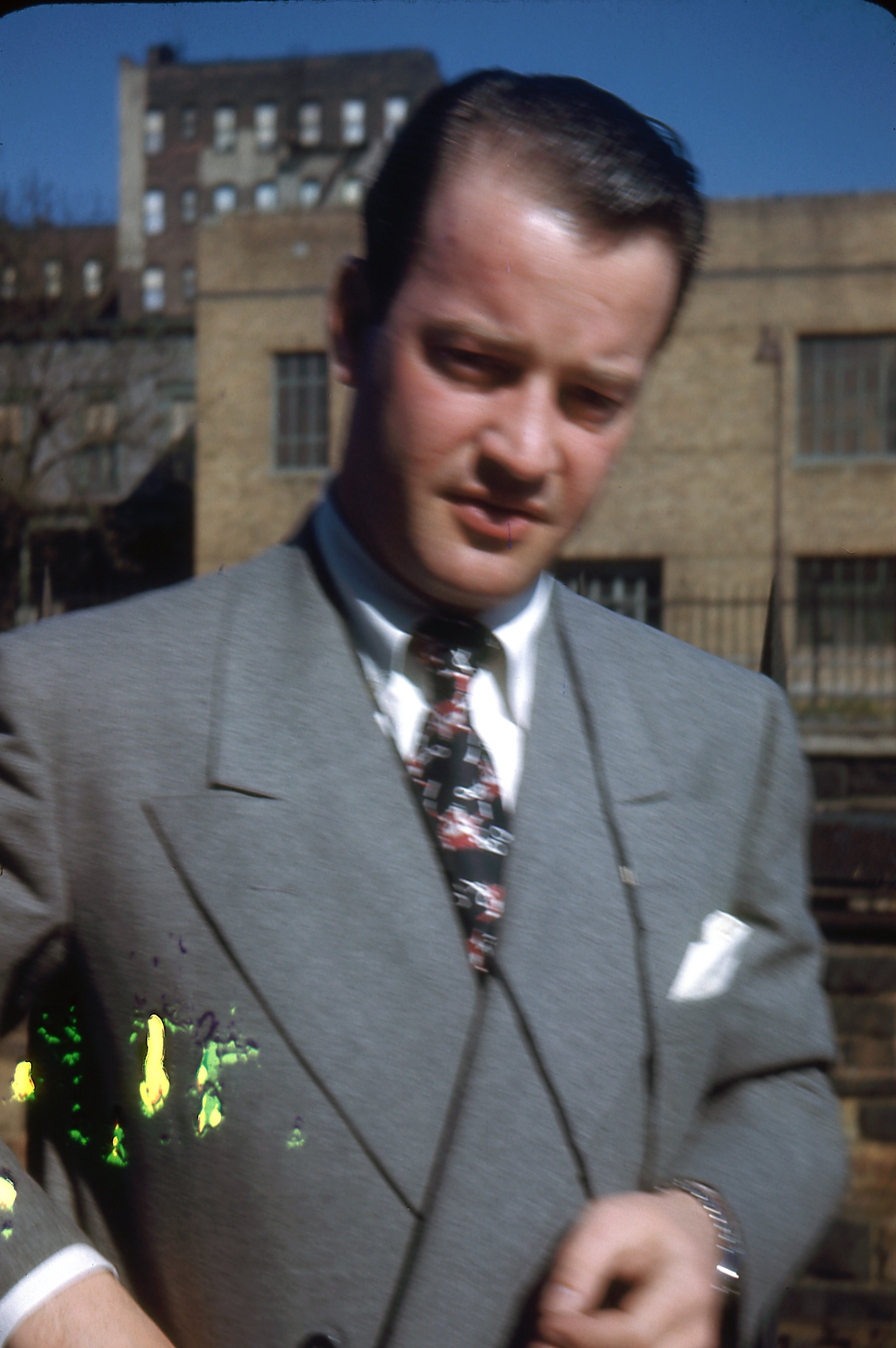
My father – a raconteur to the uninformed.
And then there was my Uncle Tommy, who staked his claim to my affections during the waning months of World War II, while my father was off serving in the Pacific, and then with the occupation forces after the Japanese surrender. Uncle Tommy was movie star handsome and a professional dancer, who parlayed this combination of useful traits, regardless of the fact that he was homosexual, into a lifetime of living off the gifts of generous and very wealthy women, whose ranks included Woolworth heiress Barbara Hutton.

Uncle Tommy was movie star handsome.
Quite understandably, my father resented my uncle, who lavished expensive gifts upon his favorite nephew, made his gift-laden visits to our family driving his Rolls Royce, and occasionally took us cruising on his yacht. My friends would gather outside our house as the trunk to Uncle Tommy’s Rolls would open like a cornucopia of generosity, the gifts flowing, while my father watched from our living room window, properly fortified with yet another VO Manhattan against the onslaught of familial competitiveness, a turf war he had no chance of winning. I thought Uncle Tommy was rich – the Rolls, the yacht, the custom tailored suits; but I’m willing to bet that, for all his lavish behavior, Uncle Tommy never had a bank account containing more than a hundred dollars. Neither my father nor my uncle spent any time planning for their futures. They couldn’t be bothered. They both lived in the smoke they had created around their respective ever-precious present. They had tricks up their sleeves. They did it with mirrors – an endless hocus-pocus. They both died broke.
On the surface, my family seemed to be living out the post war, Robert Moses version of the American Dream – Father, mother, brother, sister, dog and station wagon; all ensconced in the suburban subdivision of Green Acres, a delightfully park-like, child-friendly community, in Long Island’s Nassau County – about a forty minute car ride from midtown Manhattan.

Our house in Green Acres. I wanted to live there forever.
We lived in a two story brick house that was identical to every fourth house in the community, Green Acres offering four designs to choose from. This meant that on Elderberry Lane, which had a total of fourteen houses, our house was repeated three or four times, pretty typical in post World War II cookie-cutter subdivisions. Sounds a bit like Baltimore, but, despite architectural similarities, people seemed to find their way to their own houses unaided, with the exception of my philandering father, who was often accused by my mother of spending just a bit too much time offering domestic assistance to neighboring housewives, which was the cause of many interruptions in our familial tranquility. Virtually all of the streets in Green Acres were cul-de-sacs, which meant no through-traffic, or paradise to a kid on a Schwinn. Sections of the community were separated by small parks, so that you could walk from one end to the other without crossing a single street, allowing our extremely eccentric Dachshund ‘Ronzoni’ to wander freely about the neighborhood, sometimes for days at a time.
And then there was Montauk. In the late 1930’s, some members of my mother’s family, siblings of mygrandmother, bought property in Montauk, which was then a small fishing village at the very Eastern tip of Long Island, about a hundred miles East of Manhattan. These were the Stephensons, the children of my great grandmother Kitty Lane, who married Edward Stephenson, whose photograph, for decades after his early demise, sporting a straw skimmer and handlebar mustache, adorned the wall of their family’s Bronx apartment.

My Great Great Grandfather Edward Stephenson. Looks like a rakish dog, doesn’t he?
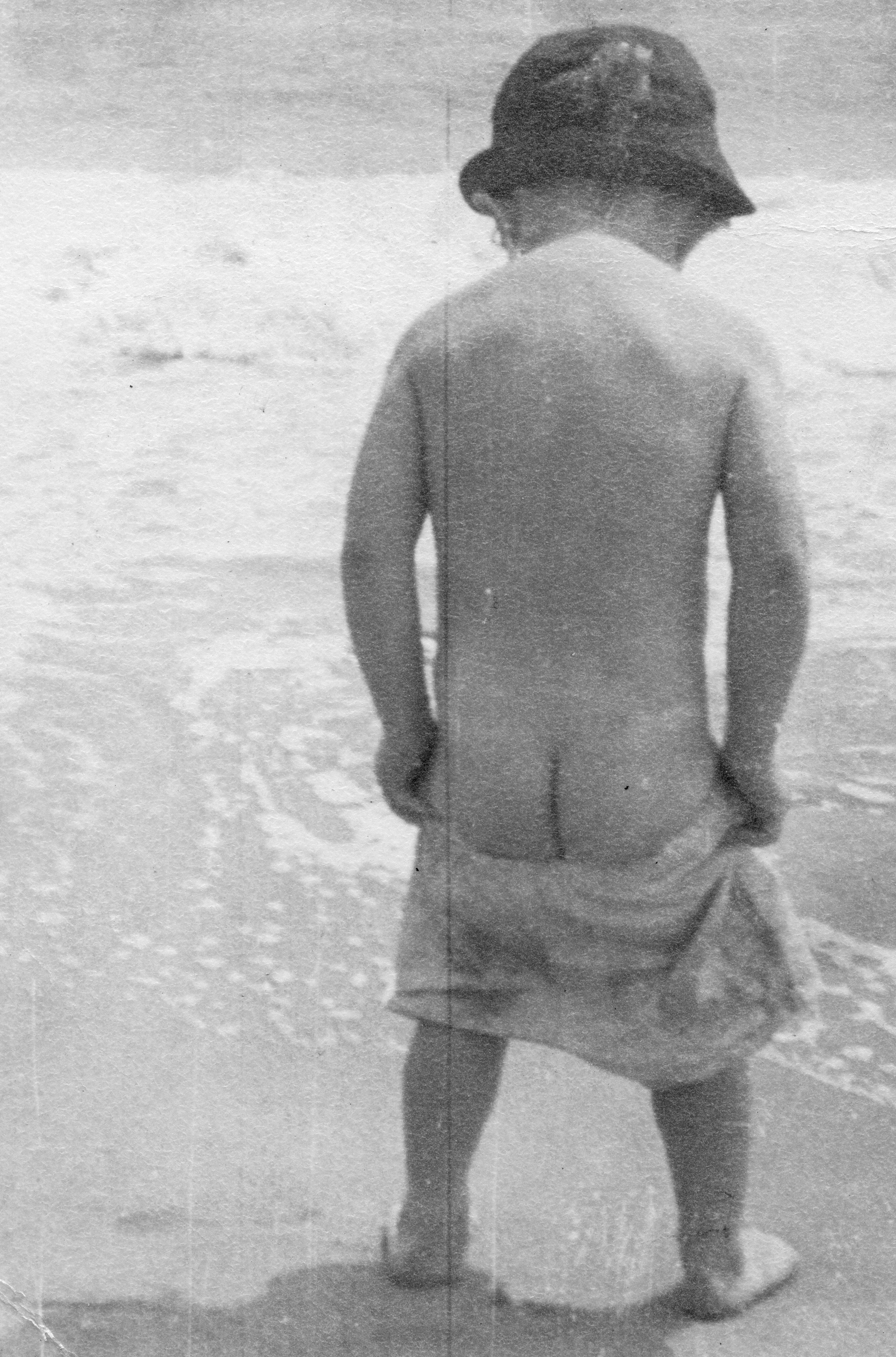
Little Shaun showing his penis to fish on the beach at Hither Hills, in Montauk

The Stephensons visit us in Green Acres. It was my Great Grandmother’s 85th birthday. She’s in the back next to little Shaun.
They were blue collar, working class, depression era Irish, bringing to the table all the good and the bad that that combination of unfortunate circumstances might suggest. With the exception of Aunt Catherine, I found them to be likeable and exotic. They seemed to speak another language, pronouncing words differently than I had ever heard before. Oil was earl, as in, “I’ve got to put some motor earl in the car”, or, “Pick up some olive earl for salad.” They called Chinese food chinks, and pizza was ahbeetz. Their apartment in the Bronx was filled with strange and bewildering religious oddities, each room with a crucifix on the wall and framed pictures of Jesus, the Virgin Mary, and various Saints. And there were glow-in-the-dark statues, mostly of Jesus that, if held next to a lamp for a minute or so, would glow a strange blue-green. On my Great Grandmother’s dresser was Statue of Jesus with little doors built into his chest which, when opened, revealed all his internal organs, like an illustration in a biology book. I had no idea why Jesus would want to share his internal organs with me, but examining the sacred innards was so wonderfully weird that it became my favorite source of amusement whenever we paid a visit.

My Aunt Catherine and Uncle Harold’s wedding portrait. They don’t make silver prints like this any more, It’s truly beautiful.
The oldest Stephenson was Edward Junior (Uncle Eddie) who, although his Montauk cottage sat directly across the .street from his younger sister Catherine, had, some time between the purchase of his building lot in the mid 1930’s, and the end of World War II, engaged in some dispute with his siblings, a result of which was eternal and mutual banishment. His sisters seldom spoke his name, and then only accompanied by a shaking head and mournful sigh – an Irish form of familial excommunication. As a small child I saw him once or twice, but was discouraged from crossing the dirt road that separated the warring parties.
The next in line was my Great Aunt Rose, a stout, determined woman, who lived far outside the code of conduct normally adhered to by her peers. Some time in the early 1920’s, Rose divorced her husband, and married Charlie Volk, a Jewish soda vendor with whom she had been carrying on a delightfully disgraceful affair for quite some time. Among depression era Irish, divorce was unthinkable. And marrying a Jew, well, the whole neighborhood probably grabbed their rosary beads and fell to their knees in a desperate attempt to prevent Bronx-bound lightening strikes. Rosie drank whiskey in bars, and enjoyed the company of men. Rosie got into bar fights that she usually finished. Rosie had some cojones.
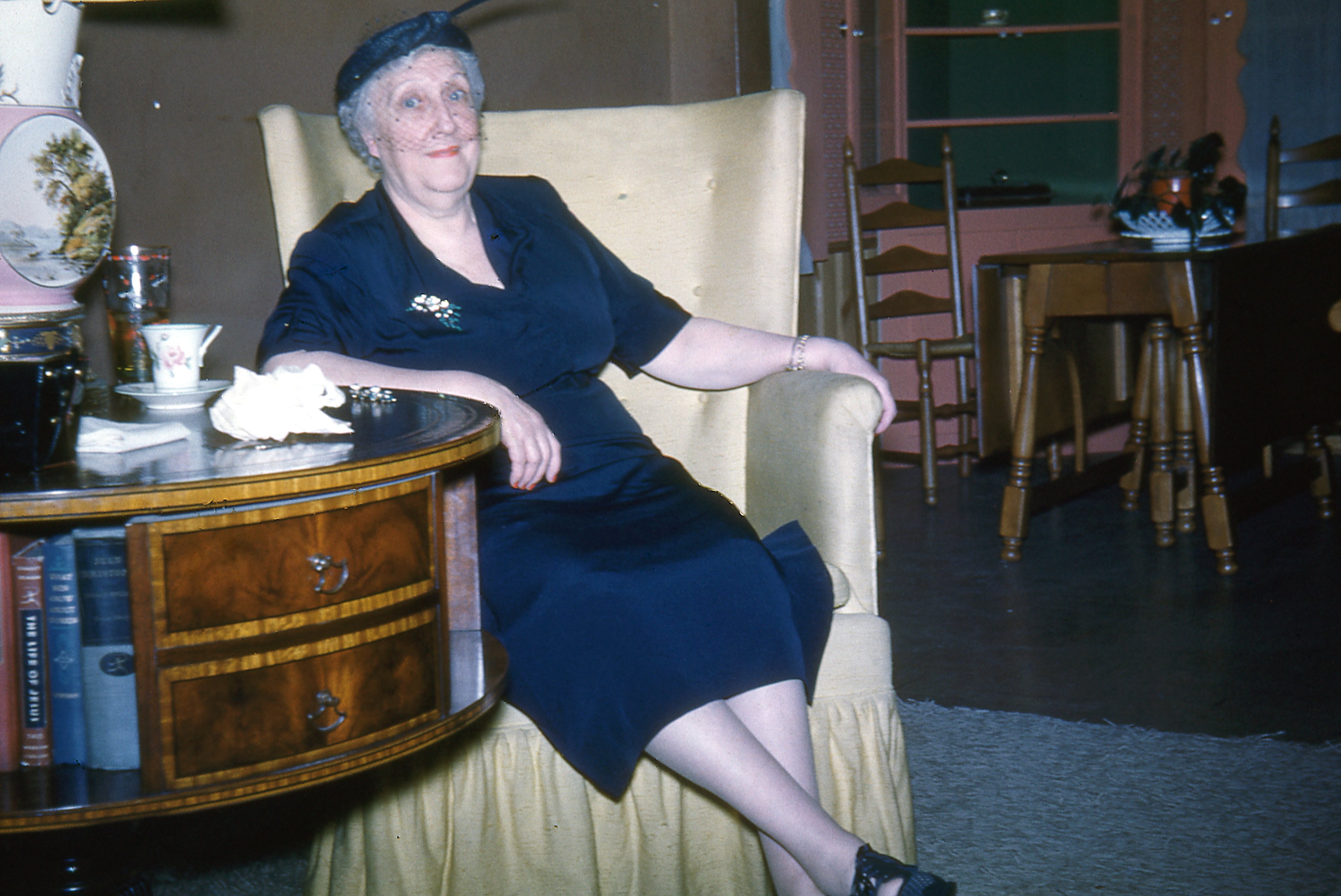
Aunt Rose had some cojones.
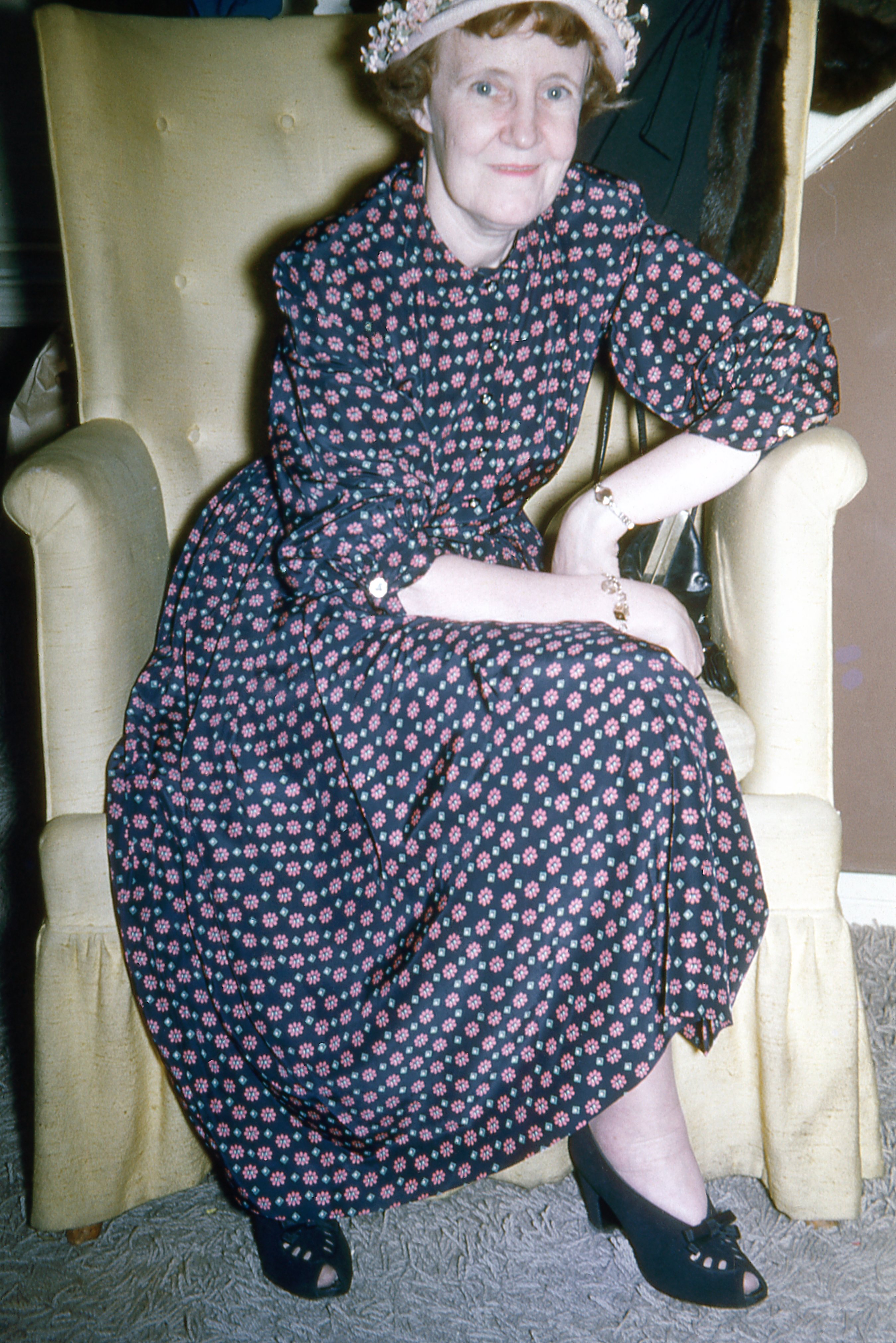
Aunt Della married Clem who ate clams and dropped dead.
Then came Aunt Della, a small, thin, mousy little woman, who, it was rumored, suffered a terrible bout of tuberculosis in her early twenties, which kept her chair-bound for most of her life, but didn’t seem to deter her chain smoking. Della married a man named Clem who, during prohibition, succumbed to a lethal combination of bad clams and bathtub gin. He walked out of the clam bar on City Island with a smile on his face, and was dead two hours later. There were whispers about Aunt Della that my young ears detected, but that my child’s brain could make little sense of. Something about a tubal pregnancy. A dead fetus inside Aunt Della. A shameful secret. Hair that kept growing. Different lengths were mentioned – three feet, five feet, ten feet – all inside Aunt Della. Until finally, she could hide her delicate dilemma no longer, and off to the hospital she went, to have her expanding Medusa surgically removed from her Catholic self. I assume it was the offspring of the deceased clam eater, but I guess we’ll never know.

My grandmother married notorious gambler and stage performer Black Jack Dowling.
Next was Anna (Nan), my Grandmother, who flew the coop at an early age, and married notorious gambler, and stage performer Black Jack Dowling. They started a Vaudeville act, had two kids (my Mother and Uncle Tommy), added them to the act, and called themselves the Dancing Dowlings. They played the Southern Vaudeville circuit for about ten years, before returning to New York City. Unlike the rest of her siblings, Nan lived in Manhattan for most of her adult life.

My Grandmother performing with her husband and my Grandfather Black Jack Dowling.
Last and probably least, was Aunt Catherine, the baby of the Stephenson clan. She bore a startling resemblance to Margaret Hamilton, who played the wicked witch in the Wizard of Oz. Catherine was married to Harold Hanley (Uncle Harold or sometimes Bootsiboo – don’t ask) who was a construction foreman, flounder fisherman, and pretty affable guy. How he put up with all those old biddies is anybody’s guess. Catherine was an unpleasant woman who couldn’t resist pinching my cheek, which really hurt. I hid from Aunt Catherine.

I hid from Aunt Catherine.
In the early days of World War II, Aunt Catherine and Uncle Harold built a tiny cottage on their Montauk property, and their presence seemed to draw other family members out to the end of Long Island. Uncle Tommy, who worked on the Tars and Spars Shows, out of the Brooklyn Coast Guard Barracks, began taking weekend passes, along with his Coast Guard pals, and heading out to Montauk, where he had befriended Otto and Mary Steinfeld, who owned the Montauket Hotel. After the war, Sonny Volk, Rosie’s son, who had lost a leg in the Battle of the Bulge, settled in Montauk, looking for business opportunities.
In January of 1946 my world, as I knew it, would change forever with the return of my father from Japan. Hail the conquering hero. He was resplendent in his army uniform, shiny Captain’s bars adorning the epaulets on his shoulders, and I’m sure a great fuss was made over him by everyone he knew, or was introduced to. This would be the first time I laid eyes on my father, who was on a troop ship sailing to New Guinea when I was born. Up until then, having a father, in my little world, meant being told stories by my mother of her hero, off somewhere far away, fighting for America.

Hail the conquering hero.
She would show me pictures and read me letters, and drag me to the record store where we would sit in a booth and record our voices on a disc that she would send off to somewhere in the far Pacific, to be listened to by her husband and his army pals. Personal recordings were extremely popular during the war, where many, like my father, could listen to the voices of their wives and sweethearts, and children they had yet to meet. I was two when I first met him, and I’m sure that his sudden presence in my life was bewildering, to say the least. He moved in to the small apartment I had shared with my mother, on Creston Avenue in the Bronx. My mother told me years later that she made my father wear his uniform after his return so she could show him off to everyone she knew. Take him down to the Club Fordham and flaunt her victorious soldier to the gang. He was a handsome guy, and I’m sure my mother’s pals were impressed by those shiny Captain’s bars on his shoulders.
A few years later, while snooping through his army trunk, which was one of my favorite forms of rainy day adventure, I came across his discharge papers. They were right there, along with his uniforms, and souvenirs of his years in the Pacific; a samurai sword, a blood-stained Japanese flag allegedly taken from the pockets of a dead enemy soldier, ivory Buddha statues, sea shells, photographs of naked women, and the various and sundry collected keepsakes of two years in a distant land. First Lieutenant Albert W. Costello was Honorably Discharged…………First Lieutenant. This would be my first brush with my father’s sleight-of-hand. He must have purchased Captain’s Bars at the PX, and somewhere between exiting the troop ship, and being enveloped into the welcoming arms of my mother, Lieutenant Costello became a Captain. I guess his army rank disappointed him, but more importantly, he thought it might disappoint others. I never mentioned my discovery, which I’m quite certain my mother was unaware of. The uniform finally went into mothballs, replaced by custom tailored suits, but the story of Al being a Captain in the war became his permanent legacy.

My sister’s fifth birthday party. Outside our house in Green Acres.
It wasn’t until my family moved to Green Acres that we began our visits to Montauk. After the birth of my sister, my father, looking for more space for his growing family, and greener pastures for his fragile self-esteem, moved us from our tiny Bronx apartment to the town of Katonah, in the wilds of northern Westchester County, a two and a half hour commute by train to his office in mid-town Manhattan. He had rented a house on a lovely estate called Blue Spruce Farm, overlooking the Croton Reservoir. The property, owned by a mysterious man named Korhulse, was extensive – fields, woods, ponds, streams, barns containing horses, empty buildings in which to do make-believe and exploring – what a place to be a kid. The literally thousands of family photographs I inherited tell a story of countless visits by many of my father’s friends from the city, who made the trek north to our house in the country, to witness, first hand, the kind of life style Al Costello now enjoyed. But, after two years, the length of the commute, and the lure of participation in the American Dream’s reward of home ownership, overwhelmed my father, who decided to buy a house on Long Island. I was told quite abruptly, half way through kindergarten, and was uprooted, and dragged kicking and screaming to the enclave of Green Acres, a short commute to my father’s office, and the first home my family actually owned.
We now lived less than a hundred miles from the hamlet of Montauk, where family members owned houses, and others like my Uncle Tommy were now visiting fairly often. It didn’t take long before we began stuffing ourselves and our baggage in our Nash Rambler station wagon to make weekend trips east.

My father took to Montauk like a prodigal son.
My father took to Montauk like the return of the prodigal son, although I’m not sure why. He wasn’t a fisherman, being a bit too squeamish to gut a freshly caught flounder. Boating made him sea sick. He was prone to sun burn. Yet, according to all who witnessed Al Costello’s Montauk epiphany, the man just loved the place. Early attempts at staying with Aunt Catherine, Uncle Harold and all the old biddies in their tiny cottage were quickly exchanged for rooms in local hotels. There was Bill’s Inn on Fort Pond, and The Montauk Chalet in a place called Shepherd’s Neck, and finally cottages in Hither Hills overlooking the ocean that were owned by a family named French. The Frenches were friends of my Uncle Tommy, who recommended we stay there.
The French family owned considerable property in an area of Montauk called Hither Hills, which sat directly above the ocean beaches and, many decades later, would become the most valuable real estate on the East Coast. Richard Nixon, who, while staying at Gurney’s Inn, an ocean front hotel in Hither Hills, wrote his acceptance speech for his nomination as the Republican candidate for President in 1968. Nixon was so taken with Hither Hills that, after his inauguration as President, he attempted to have the government purchase the property adjacent to Gurney’s Inn, with the intention of constructing the Nixon Summer White House. The Secret Service put the kibosh on Nixon’s plans because of security concerns, the property being too visibly accessible from the ocean.

My parents at one of the French’s cottages in Hither Hills.
The familial competition between my father and uncle rekindled when the Frenches persuaded my Uncle Tommy to purchase ocean front property adjacent to their own. Uncle Tommy’s always-prosperous appearance deceived the Frenches into thinking he could afford it. Unable to actually buy the property, and unwilling to be found out as a mountebank and charlatan, my uncle somehow wrangled an option to purchase the land with a small down payment, which could only have come from one of his many dowager patrons.

Uncle Tommy at Ditch Plains in Montauk.
No one but Uncle Tommy knew this, of course, everyone assuming that he was now the proud owner of some very expensive real estate. This was disturbing news to my father, who had recently purchased, on a G.I. mortgage, our house in Green Acres, and was almost certainly financially overextended. Not to outdone by his brother-in-law, and ignoring his financial reality, the ignoble Army Captain found himself a willing real estate agent, and began looking for a suitable site for the Costello family’s new summer house.
Within a year, Al Costello found himself making mortgage payments on our home in Green Acres, and our new summer house in Montauk. My father was now living way beyond his means, the two mortgages added to his ever-increasing gambling debts, and, unknown to the rest of us, was drowning in a whirlpool of fantasy-driven irresponsibility, robbing Peter to pay Paul, and struggling to somehow keep his head above water.
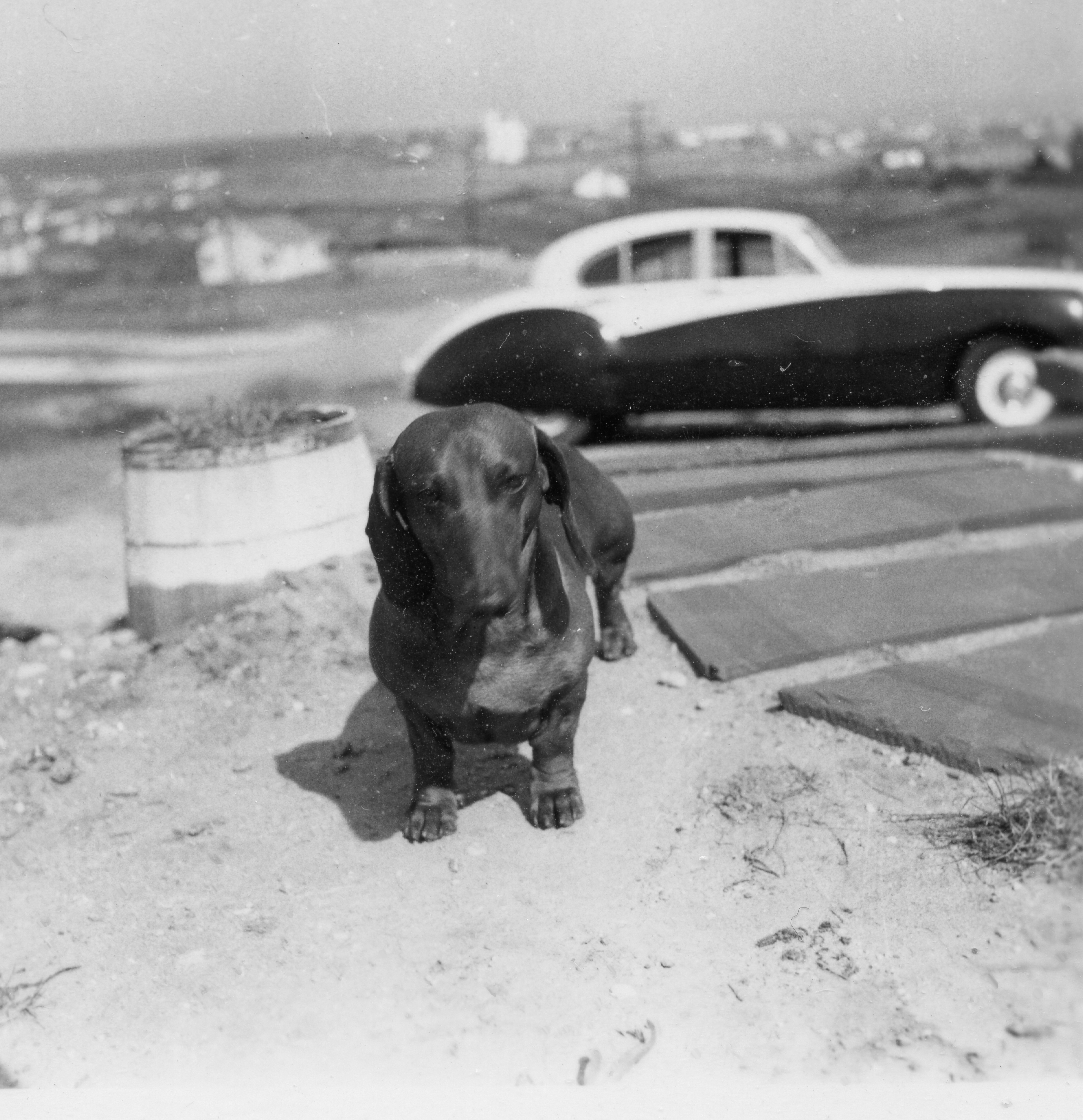
Our eccentric Daschound Ronzoni outside our house in Montauk. Uncle Tommy’s Jaguar Mark IX in background.
Meanwhile, Uncle Tommy, unable to make any additional payments on his ocean front fiasco, lost his option to purchase the property. Somehow, no one found out about this real estate calamity, and his friends and family went right on thinking, for many years, that Thomas Dowling Esquire owned that ocean front property, a myth he enthusiastically encouraged. After all, in his custom tailored suits, driving his Jaguar Mark IX sedan, gifts lavished upon him by generous women, he certainly looked the part.

Our house in Montauk with our Nash Rambler Station Wagon exiting the driveway.
My mother, now ensconced in her Green Acres dream house, spending weekends splashing about on the beaches near her newly acquired summer home, was unaware of her husband’s financial difficulties, at least in the beginning. But financial pressures quickly eat away at marital stability, and within a short time my parents’ marriage became out and out warfare, my sister and I hiding under our beds during bouts of shouting, name calling, and dish throwing; the argument usually started by my father, who was by then stopping off for a few quick ones on his way home to face the family he now blamed for his dilemma. I remember one horrific incident, when my father came home quite late and obviously drunk, ignoring the dinner set on the dining room table, and staggering to his room where he collapsed in bed. My mother was so enraged that, for reasons known to her alone, she took all of the dishes off the table and smashed them against the living room wall which, by the time she had thrown her last projectile, was completely covered by dripping food, and broken fragments of china, a violent and terrifying image I can still recall vividly.

My sister Debbie and I in our Montauk living room
Our family was in jeopardy. Revealed to me many years later, my father uncharacteristically confessed his situation, even the gambling debts, to my mother. A change had to be made, and it had to be made quickly. One of the houses had to be sold, and my parents decided to sell our home in Green Acres, and hold on to, at least temporarily, the Montauk beach house. Leaving Green Acres was probably the most traumatic moment of my childhood, and I never really forgave my parents. It had been decided, certainly without consulting me, that we would pack up our belongings and move to an apartment in Forest Hills, which I was told was in the borough of Queens, a part of New York City.

My mother and Uncle Tommy. They danced at the Forest Hills Inn way back when.
My mother had spent time there as a teen, dancing with my uncle at the Forest Hills Inn. She said it was a wonderful neighborhood. There was a famous tennis club, and a beautiful Catholic school, just a short walk from our apartment. I was told I would love it. Both my parents assured me that life in Forest Hills would not be that big of a change. After all, we still had the house in Montauk. They considered it a solution. I considered it a betrayal. But, like all children in situations like this, I had little say in the matter. We were moving to a place called the Forest Hills Gardens, and that was that.

We were moving to a place called The Forest Hills Gardens, and that was that.
*
© 2014 Shaun Costello
PORNOGRAPHER FOR HIRE
PORNOGRAPHER FOR HIRE
Toiling at day labor in the world of smut.
by Shaun Costello
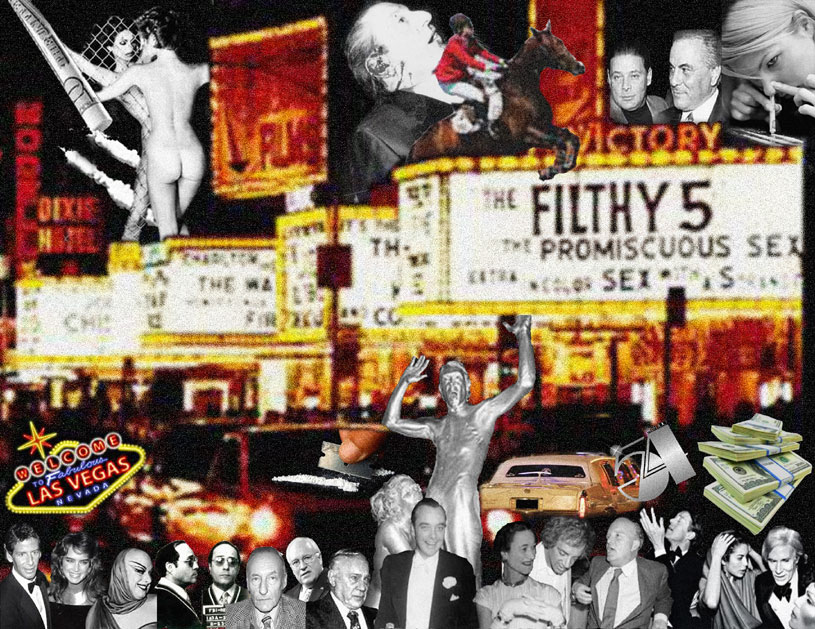 In 1978, the Reverend Jim Jones, a self-proclaimed Apostolic Socialist Preacher, increased the world-wide awareness of Kool Aid immeasurably, by moving his “People’s Temple” flock from the city of San Francisco to an obscure corner of Northwest Guyana, where he led them in a ritualistic
  mass suicide, leaving over nine hundred rotting, bloated corpses for the world’s Paparazzi to record for posterity. At Camp David, in rural Maryland, Egypt and Israel shook hands on a peace agreement while, in Lawrenceville Georgia, Larry Flynt, the publisher of Hustler Magazine, was paralyzed by gun shots from an
  unknown assailant. In England, the birth of the world’s first test tube baby was recorded – conceived through In Vitro Fertilization. Before the year would end, Atlantic City would legalize gambling, the Love Canal would be declared a federal disaster, and Garfield the Cat would enter syndication.
  In the Spring of 1978 I got a call from Roy Seretsky, who had an office in New York’s Film Center Building where I also had space for years. I knew Roy only slightly, and he knew me mostly by reputation. He also knew of my association with Dibi (Robert ‘Dibi’ DiBernardo) and the Gambino crime family. I was considered a protected guy, which meant I was untouchable, a status I reveled in. Dibi, in deference to my friendship with the late John Liggio, had kept the status of “connected” from our relationship. Instead I was considered a “friend” of the family, and friends were protected, without the reciprocity that would be demanded of a “connected” guy, or an “associate”. An ideal situation.

New York’s Film Center housed everyone from the makers of Deep Throat to many Oscar winners.
A year before, I had met Roy during the shooting of ‘Fiona on Fire’, a movie I was reluctant to direct. Fiona was written and produced by Ken Schwartz, who owned a film editing facility a few floors above my office in the Film Center. Schwartz was an affable man who I had gotten to know through renting his editing rooms to do post production on Waterpower, a movie I had produced a year earlier. Ken couldn’t get over Waterpower – how well he thought it turned out, and how absurdly kinky it was. He mentioned to me more that once that, if he ever got the opportunity to produce a film of his own, I would be the only director he would consider. I had been directing adult films for six years, and had always written and produced my own projects, a situation that I was not anxious to change. Working with long-time collaborator, cameraman Bill Markle, I had always written and produced everything myself. But Ken was relentless, and suddenly the opportunity presented itself. He had written a script based on Otto Preminger’s 1944 classic “Laura” and, through Roy Seretsky, had come up with the

Marlene Willoughby meets a sad end in FIONA ON FIRE, a movie I never wanted to direct.
money to produce it. The idea of working with someone else’s material was unappealing to me, and I declined Ken’s offer. But sometimes a situation can dictate a change in direction. A film I was planning had been cancelled by its backers, who were restructuring and temporarily out of business, and I found myself unemployed. This, combined with Ken’s relentless pursuit and offers of a hefty director’s fee, changed my position. So I took the job and hated every minute of it. Although I was allowed to hire Markle as the Director of Photography, that hire was my limit. Ken had written a complicated screenplay, with tricky dialogue that even experienced actors would have trouble with, and he expected porn performers, who had difficulty with the simplest scripts, to deal with it. It was impossible. Not only had Ken written the script, but he would also do the casting, so that actors I didn’t know, who had little experience, and even less talent would show up on the set to wrangle with dialogue they had no hope of delivering in any believable way. And, as the film’s director, I was supposed to sort all of this out – make it happen. It was hopeless. Bill Markle did a great job, as always, giving the movie a professional look, but the performance of most of the cast was laughable. At the end of every shooting day, after begging Ken to

After FIONA ON FIRE I swore I’d never hire myself out as a director again.
simplify the dialogue, I swore I’d never do anything like this again. Two or three times, during Fiona’s eight shooting days, Roy Seretsky would show up on the set, look around, and then quickly disappear. I had maybe one or two conversations with him, certainly nothing memorable. A year after we wrapped the set on Fiona, I was surprised to hear from him. Roy had one of the most unique jobs in show business. He scouted investment opportunities in theatrical and motion picture production for organized crime, particularly the Bonanno family. He had put together financial packages for many Broadway and Off-Broadway shows. “Joseph and the Amazing Technicolor Dreamcoat”, which had enjoyed a long and profitable Off-Broadway run, was wholly Bonanno funded, the arrangements made by Roy. Their biggest success was twenty percent ownership of “Cats”, which made them a fortune. On the film side, Roy was offered all or part of almost everything produced by Dino DeLaurentis. Roy had backers for a script that my old nemesis

The Broadway Musical CATS was mafia owned, and made the boys downtown a fortune.
Ken Schwartz had written and wanted to direct, a comedy/sex version of Dracula. The budget was huge, maybe $150,000, which was more money than had ever been spent on what would still have to be considered a porno movie. The script was hilarious, but the backers were nervous. Roy asked me to meet with him, along with some of the Colombo people. My part in this meeting would be to act as consultant in order to advise them on the profitability of the project. The meeting was held at Lanza’s Restaurant, on First Avenue and Twelfth Street. Roy, myself, and two of the Colombo people would participate. My good friend and sponsor John Liggio, a ranking member in the Colombo family, had died of lung cancer a few years before, and I recognized one of the Colombos from the funeral. He worked under John, and knew of our friendship, so the mood of the meeting was warm and friendly. They laid their cards on the table and I advised them as best I could. Ken Schwartz, who wrote the script and was lobbying to direct it, wanted to cast Jack Wrangler, a notoriously gay porno actor, famous for his live-in relationship with singer Margaret Whiting, as Dracula. Mafia members are born homophobes, and they were nervous about putting up the
Lanza’s Restaurant on First Avenue was kept open for meetings like this one.
biggest budget ever spent on a heterosexual porno movie (Dracula) starring a notoriously gay actor (Jack Wrangler). Wrangler had told Schwartz that if he got the part his good friend, famous Broadway wardrobe designer, William Ivey Long, would do the costumes. A stage-struck Schwartz was smitten with the idea of Long’s participation and, although I had no idea how that would add to the project’s profitability, I continued to listen. I heard them out and told them what I thought. Ken’s script was hilarious, and had real possibilities if correctly handled. I had met Wrangler a few times and liked him. I told them that Jack might make a very campy and funny Dracula. When asked if I would cast him I told them that, with a budget this big, it could be risky. I suggested that if the decision were mine I would cast Jamie Gillis as the moody vampire. On the Schwartz/directing issue I told them that he would probably be fine, but he should be closely watched. First time directors have a tendency to overshoot, and in 35MM that could lead to stock and lab overages that could be substantial. The meeting ended and we went our separate ways. I left the meeting hungry because the food at Lanza’s was awful. The place was kept open exclusively for meetings like this one, not for its cuisine.

Jack Wrangler, pictured here with his main squeeze singer Margaret Whiting, would have made a funny, campy Dracula, but the mob’s homophobia wouldn’t allow it.
A few days later Roy called. He asked me if, as a favor (a big word with these guys), I would take the job of assistant director on the picture in order to keep an eye on Schwartz. I declined. Having an obvious spy in the crew would only serve to make the first time director nervous. Roy had his back-up offer ready. He said that if I would direct the movie for a flat fee he would hire Gillis to play the lead, and I would have final say on all casting. This would mean a month in the city, and I had been training for a major dressage competition in Rhinebeck in a few weeks, so this was not an appealing idea. Also, it seemed like Fiona redux, which was an awful thought. But I knew that, if I said no, the Colombo’s would pressure the Gambinos, and I would get a call from Dibi suggesting I do this for the good of all concerned. So I caved. During pre-production it became obvious that the whole project was quickly becoming a mess, but there was one exception. Ken Schwartz, who had been kicked upstairs as Producer, and was becoming strangely
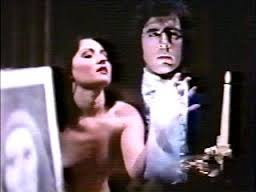
Jamie Gillis wound up playing the moody vampire. He was my first and only choice.
unstable, had hired a typist/PA on the production who caught my eye. He was a skinny, mousy guy with thick glasses, and a mid-western accent, who seemed to be an island of quietly assertive competence in the sea of chaos that this production was becoming. This was Mark Silverman, who would become my producer and friend for the duration of my tenure as a pornographer. The shooting of “Dracula Exotica” took over three weeks. I had a script supervisor and even an assistant. There was a production manager named Bill Milling, who I loathed on sight, and the biggest crew I had ever seen, much less worked with. Ken Schwartz spent most of his time going over sketches with William Ivey Long, the famous Broadway wardrobe designer, who took the job because he thought his friend Jack

Broadway costume designer William Ivey Long, who thought his friend Jack Wrangler was playing the lead, quit after the first week of shooting.
Wrangler was going to play the lead. Long quit after a week. The first night of pre-production, Milling and I got into it over something. As the shouting got louder, and the tension approached the red line, Mark Silverman, who was the lowest ranking production assistant in the crew and had the title “typist”, walked right over to the shouting parties and said, “Hey, do either of you two assholes want coffee?” I was in love. With one line Mark was able to diffuse the argument, and even get a few laughs. My kind of guy.
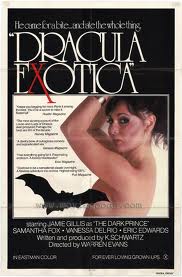
Dracula Exotic turned out to be a big disappointment.
I was happy with the look of the dailies. If only Ken Schwartz could handle post-production, he’d have a huge hit on his hands. By the end of the first week of shooting Schwartz, who had been growing more unstable with each production day, had a nervous breakdown. It seems that earlier in the day, William Ivey Long, the wardrobe designer, who was disappointed at the absence of Jack Wrangler, quit the project, and Ken flipped out. I was in a screening with Bill Markle and Robbie Lutrell, the special effects designer, when Mark Silverman burst in. “We have a big problem”, he said. “Ken has flipped out, and Bill Milling is running around like a lunatic, making phone calls and telling anyone who’ll listen that he’s taking over the picture”. I told Mark to get Roy Seretsky on the phone. I told him not to give details, but that he should get over here right away. Ken was sitting behind his desk mumbling something and had become completely dysfunctional. I guess that being responsible for this sized budget had gotten to him. Anyway, Roy showed up and straightened Milling out, and we kept shooting. Ken gradually recovered his ability to speak and by the end of shooting seemed normal, but wasn’t. The responsibility for the huge budget had gotten to him, and the loss of his famous wardrobe designer was the last straw. He never seemed to recover his original enthusiasm for the project. Ultimately, Dracula Exotica was a real disappointment. The cast, particularly Jamie Gillis, Vanessa Del Rio, and Bobby Astyr were terrific. The sets were elaborate. The locations were lush and inventive. Ken’s script was funny. But the picture just never worked. Schwartz, who seemed to have lost all faith in the production, and in order to save a few shekels, hired Robby Lutrell, the special effects designer on the project, who had never edited anything in his life, to cut the picture. The dailies had great potential, but the finished picture was flat. Robby couldn’t cut sex, and he couldn’t cut comedy, a bad combination. Dracula Exotica could have been a breakthrough picture for all concerned but, because Ken cheaped out in post production, all that expensive footage, that took us all so many long shooting days to achieve, was wasted. If asked, I probably would have cut the film for nothing, and the result might have been quite different. But I wasn’t, and this time I swore, and stuck to it, never to work as a hired gun again.

In the 1970’s, New York’s Pussycat Theater, owned by the Bonanno crime family, was the number one venue in the country.
I’m going to take a moment here to explain why adult movies with big budgets like Dracula Exotica were, from an investor’s point of view, pure folly. During the Seventies there were a finite number of first run adult movie houses in major cities, just as there were a finite number of second and third run (where the real profit was made) houses in the suburbs and rural areas. In 1978, the year I made Dracula Exotica, a Porn Feature made its reputation playing the big houses in NY and LA. This assured that picture of major play in the rest of the big cities. The biggest play date

Mickey Zaffarano, a Bonanno family Capo, operated the Pussycat Theater for the mob, He died of a heart attack during an FBI raid on the theater.
was the Pussycat Theater in NYC. The Pussycat played the biggest pictures, not because of their quality, but because of the familial connection of the backers. Since the Pussycat was owned and operated by New York’s Bonanno crime family, it stood to reason that a Bonanno funded picture would be first choice, guaranteeing a nice profit for its investors. A full page rave review, written by Al Goldstein, would appear in Screw the week of the opening, with quotes galore, available for the print ads and one-sheets. Goldstein was on the Bonanno’s payroll, and did what he was told. If no Bonanno funded picture was available then a Gambino funded picture would play the house, followed by a Colombo funded picture, etc. The rule of thumb was that the first run houses in major cities made back the picture’s negative cost, and the second and third run houses in the hinterland made the profit. The same is true in television, where the network run makes back the production cost, and syndication makes the real profit.
The formula was: Dollar one of profit was reached at 2.5 X negative cost.
So a Movie like Dracula Exotica, which had a production cost of $150,000 and additional lab costs (internegative, and release prints) of $30,000 had a total negative cost of $180,000. This meant that it would not make dollar one of profit until it grossed $450,000. That’s a number that might take years to reach. The only reason that the budget was so big was to make Ken Schwartz feel good about himself. He convinced Roy Seretsky, who arranged the financing, that he could produce a “Breakthrough” movie that would make them all rich and Roy bought into Ken’s fantasy, a bad decision, from a purely business point of view.
When I was approached by Cal Young, that same year, to make a picture with Dom Cataldo’s money, I was careful about how I approached it. This was Cal’s first attempt at a “better” movie, and I liked both of these guys, and wanted them to do well. Also I had a piece of it. So I designed the production to maximize profitability. I came up with a great title (Afternoon Delights), wrote a screenplay that revealed itself in vignettes (more bang for the buck), shot the movie in 16MM, specifically designed to be blown-up to a 35MM internegative, and limited the 35MM release print run to ten (you rarely needed more). Dom Cataldo was a highly ranked sub-boss in the Colombo family with gambling operations in Brooklyn and Queens, so opening Afternoon Delights at the Pussycat was assured. That would mean that the two pictures would have pretty much the same play dates throughout their runs.
Let’s compare them: THE TALE OF THE TAKE:
Dracula was ultimately a disappointment to its backers.
DRACULA EXOTICA: “The Heavyweight Champ and disappointment to its backers”
Negative cost $180,000
Dollar one of profit reached at $450,000.
Gross revenues (as of ‘83) $550,000. (I know this number because Seretsky, who was pissed at Ken Schwartz, told me)
Profit: $100,000. or 56% of its negative cost.
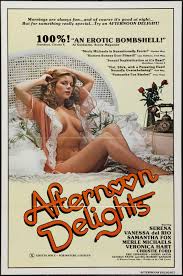
Afternoon Delights turned out to be a cash cow for its investors.
AFTERNOON DELIGHTS: “The Lightweight Challenger, and little known cash cow”
Negative cost $60,000 (production cost $40,000…blow up and print run $20,000)
Dollar one of profit reached at $150,000.
Gross revenues (as of ‘83) $500,000.
Profit $350,000. or 580% of its negative cost.
Which investment would you rather have made? The moral to this story is that, back in 1978, as long as you were connected, spending more than $60,000 on an adult movie was pure folly. Other than freakishly profitable blockbusters like, Deep Throat, Behind the Green Door, and some others, most adult movies made the same money, provided they were ‘Family’ financed, and looked good. The pictures I made for Reuben Sturman a few years later were made with video in mind somewhere down the road, so they had to appeal to a wider audience, namely couples. Sturman wanted a “Look”, was willing to pay for it, and it was money well spent. He had the foresight to understand where the business was going. At this point the ‘Families’ were coming to the conclusion that there was more money in heroin and cocaine than in porn, which was basically the end of them.
 *
*
© 2014 Shaun Costello
REVISIONIST HISTORIANS CAN BE HAZARDOUS TO HISTORY
REVISIONIST HISTORIANS CAN BE HAZARDOUS TO HISTORY
By Shaun Costello

Historians sometimes become so involved in the events they are chronicling, that they begin to feel they were participants in, rather than chroniclers of those events.

Mr. Bowen will endlessly insist that his version of events is correct, regardless of challenges from people who actually experienced the era he’s revising.
Revisionism is a dangerous commodity. I speak from experience, having had my life turned into fiction by numerous writers whose motives and sources were questionable at best. Those who call themselves historians are a dangerous breed, who often become so involved in chronicling an era that they begin to think they were actually part of it. Busy attempting to reassemble the characters and events of the Adult Film Industry in the 1960’s and 1970″s, I can think of two so-called historians who fit this category. One is Michael Bowen, and the other is Ashley Spicer. The former, who has some oblique connection to NYU, will endlessly insist that his version of history is correct, regardless of challenges from people who actually experienced the era he’s revising.

Ashley Spicer behaves like he’s filed for patent rights on his revelations.
The latter, who, in addition to his day job as an investment banker, operates, along with his wife April, a web site called The Rialto Report, which offers articles about, and interviews with adult film stars from the Sixties and Seventies, the decades that are often called porn’s “Golden Age’. Mr. Spicer seems to have filed for patent rights to the chronicle of these decades, suggesting his ownership of the whole story, and woe be unto those who dare to challenge the authenticity of his revelations. Like Evangelical Christians, who believe the Bible is the word of God and should be taken literally, Mr. Spicer seems to suggest that, not only should his version of history be taken as Verbum Dei, but that he owns the book and film rights as well.
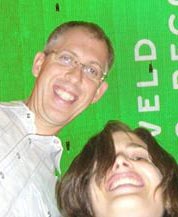
Ashley and April Spicer would have you believe that, not only should their version of history be taken as Verbum Dei. but that they own the book and film rights as well.
*
© 2014 Shaun Costello
SANTA’S RACIAL DILEMMA
SANTA’S RACIAL DILEMMA
The Morality Police busy themselves saving children from reality.
By Shaun Costello



Members of the Liberal press, people I listen to, and read daily, had a communal nosebleed when a Fox News bimbo-clone and a few Republican idiots recently proclaimed that Santa Claus was their favorite color – WHITE. I’m as liberal as liberal gets short of anarchy, but I find no fault in Santa’s being white. Santa Claus, AKA Saint Nicholas, Kris Kringle, Father Chrismas, etc, is a product of Northern European folklore, and his inclusion in the celebration of Christmas is a product of Northern European culture and tradition. As Europeans immigrated to the New World, they brought their traditions with them, and an Americanized version of the Santa character evolved on our shores. America, unlike Northern Europe, became a multi-cultural nation, and as different nationalities and races assimilated into American society they were exposed to each other’s religious beliefs, celebrations, and traditions. America’s diversity is our greatest strength, and tolerance of our differences, while long in coming, is an American phenomenon well worth the wait.

The celebration of our individual ethnic traditions by Christians, Jews, Moslems, Hindus, etc, does not make us any less American. I hope that Christmas and Chanukkah are never, at some future date, molded together into a celebration of the ultimate amalgam of political correctness – Christukkah. The Jewish God, with his flowing white hair and beard, and lightening bolts in each hand, ready to toss at some unfortunate offender, would never allow it. Nor should he. Chanukkah, the festival of lights, is a

wonderful holiday that should remain forever Jewish. As Christmas, a celebration, for those who are keeping score, of the birth of Christ is, and should always remain Christian. That Santa should have no color is preposterous. That the spirit of Christmas should have no color is something to strive for. I can only hope that one day, children will honor and celebrate the spirit of each other’s ethnic holidays and appreciate the wonder of their differences.

The commercialization of Christmas in America has turned a once charming tradition into a frenzy of gift giving that borders on the ridiculous. The spike in the suicide rate at Christmas time has a direct correlation to the obligation Americans seem to feel to give the right gift, and the disappointment and shame they feel when they fail to do so. Bargain sale days like black Friday, which allegedly exist to help shoppers fulfill their obligatory purchases for the upcoming gift swapping conflagration that Christmas has become, have become so competitive that gift-hungry buyers line up sometimes several days in advance to assure their purchases at the right price. This holiday season has so far seen three deaths at shopping venues, two by gun shot wounds, as frantic shoppers compete, sometimes violently, for the discounted price.
Traditional icons of the Christmas celebration, like Santa Claus, have lost their luster, and their connection to the idea of Christmas. As commercialization overtakes ritual,

Christmas loses the charm of its identity, and morphs into the struggle of buying, and giving, and returning, and the never-ending obligation to succeed in the frenzy of finding the perfect gift. Americans have long ago lost touch with the origins of this Holiday and the traditional characterizations that have always accompanied the
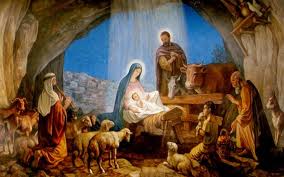
celebration. So, Santa Claus, a product of centuries of folklore, becomes a plastic, red and white, bearded face on a front door. We no longer think of him as flesh and blood – the jolly white-bearded, bearer of Yultide gifts, driving his reindeer and sleigh through the skies to bring joy and gifts to the children of the world. He’s been lost in the amalgamation of the idea into the commercialization of the moment.
So just why, exactly, do Liberals think Santa has no color? Are they so guilt-ridden that they busy themselves creating an antidote to offending absolutely anyone? Do they really think that Black children can’t relate to a Santa who is white? Do they

really think that black children see the world as grey? Do they really think that black children are oblivious to the fact that there are black people, and white people, and yellow people, and brown people? Are they so lost in the androgyny of their morality that they’ve gone on the permanent defensive against the celebration of anything unique or individual? Do they really feel that playing the role of the morality police compensates for a lifetime of questionable decisions and behavior? Do they really think they can throw us all in the blender, obliterate our differences, and turn us into them? Just what exactly are they afraid of? Why can’t Santa be white – the guy is from Poland.

*
© 2013 Shaun Costello
THE FIRST REVIEW OF “WILD ABOUT HARRY”


From The Erotic Film Society in London
The first review of:
WILD ABOUT HARRY
by Shaun Costello
For such a prolific director – at least 66 films between 1973 and 1984 – Shaun Costello remained one of the New York XXX scene’s best kept secrets for many years. One reason is the number of noms-de-porn he worked under.
He made more than his fair share of films that are now recognised as classics but not always under the same name – he was ‘Kenneth Schwartz’ for FIONA ON FIRE but ‘Warren Evans’ for DRACULA EXOTICA, for example – and this prevented him from getting due recognition until relatively recently.
For notorious roughies FORCED ENTRY and WATERPOWER, he was ‘Helmuth Richler’ but ‘Amanda Barton’ made the sensitive PASSIONS OF CAROL. At Avon Productions he was ‘Russ Carlson’ and for a while he was even ‘Oscar Tripe’; plus there were numerous uncredited one-day-wonders.
In ONLY THE BEST, published at the dawn of the video era, critic Jim Holliday indicated that one person was behind some of these pseudonyms; but pre-internet it was pretty much impossible for even dedicated pornologists to crack the Costello code.
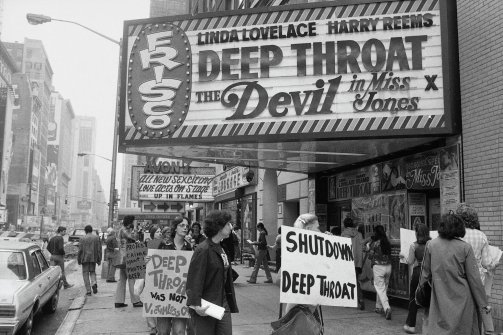
Public outrage at Deep Throat’s popularity
With the advent of the web, the IMDb and IAFD and dedicated discussion forums where smut-hounds could compare what they’d discovered, facts began to surface.
Then something occurred that every film historian dreams about; Shaun Costello himself joined the forums. He posted on IMDb. He corrected. He clarified… And suddenly his incredible career came into sharp focus.
Not just those 66 films that he helmed but around the same number of appearances from 1971 to ’89 – and that doesn’t include loops – plus at least 50 films he produced and a similar number of writing credits. It’s a wonder he ever found time to sleep.
On the evidence of WILD ABOUT HARRY, his by turns hilarious and moving memoir about his friendship with Harry Reems, during the pre-DEEP THROAT days of Big Apple hard-core, sleep was often the last thing on his mind.
Whether he was editing into the early hours – the only way he could afford post-production facilities – or heroically carousing with his buddies – ‘the Three Musketeers of 42nd Street’ – those years in the late 60s and early 70s seem to have been one madcap adventure, where anything was possible.

Harry and Linda Lovelace in DEEP THROAT
A voracious film fan, from art-house masters to grindhouse smut, Shaun absorbed everything. He fell into the pornographic loops business by happy accident, just as they were on the borderline of becoming legal, or at least tolerated, in the adult bookstores of the Deuce.
And he was there when a handsome, young, legit actor – still known by his birth name, Herb Streicher – made his debut in an explicit 8mm film destined for ‘under the counter’ sales.
(Assumed names were cast aside faster than underwear: Herb wouldn’t settle on Harry Reems for a couple of years, after he’d tried on ‘Tim Long’ among other aliases.)
It wasn’t just the start of a professional relationship – Shaun cast Herb/Harry as a disturbed Vietnam Vet in FORCED ENTRY, his first feature as director – it was the beginning of a deep friendship.
And now Shaun has published this memoir of those heady days – and that double entendre is very much intended – as a tribute to his buddy, who passed away in March of this year.
Anyone who knows the recipe for Automat Soup (a container of ketchup and hot water, if you’re asking – gourmets break some gratis crackers on top to simulate croutons) will probably already have a copy.

The United States of America v Harry Reems
But what if you’re not a dedicated devotee of the Deuce and are wondering whether to purchase? Or what if you – horror – have to ask, ‘What’s the Deuce’? Well, let Mr Costello explain…
‘The Times Square subway station, my portal to the neighborhood, was an intense assault on the senses. A sudden, almost overwhelming surge of smells and filth hit you as the train doors slid open to the rush of urine, and cotton candy, and damp humanity, and hot dogs on their revolving spits, and vomit, and baked goods like crumb cakes and bran muffins and pretzels, and the garlicky pungent scent of Gyros slowly rotating, and everything suddenly interrupted by someone chasing a pick-pocket through outstretched hands asking for dimes, and a tidal swarm of the disenfranchised huddled in groups, trying to stay warm. And this entire sensory phantasmagoria was musically scored by the overmodulated sound of Kool and the Gang wailing “Jungle Boogie” from the cheap speakers over the door to the subterranean record store. And then the cold again as you climbed the stairs to the street, and there it was, “The Deuce”.’ (from WILD ABOUT HARRY © 2013 Shaun Costello)
From this vivid evocation of arriving at 42nd Street, you should immediately have discerned that our guide to all this decadence has a very neat turn of phrase indeed, which he puts to fine effect throughout the book.
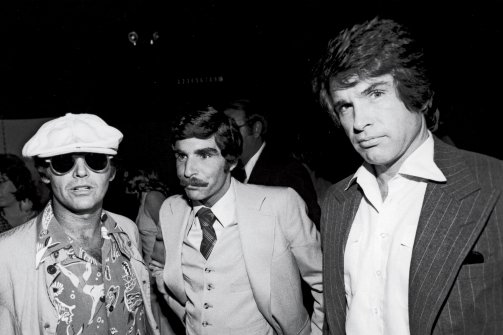
Jack Nicholson and Warren Beatty come to Harry’s rescue
It’s prose that encapsulates the sights, the sounds, the smells, the animal excitement of the city – and the only reason not to enjoy it is that it makes you break down and cry, lamenting the passing of such delightful debauchery.

Herb being Harry, and enjoying himself
‘Delightful debauchery’? Well, yes. Shaun Costello is aware of the oxymoron. On the one hand, he’s a cultured chap, dating a wealthy heiress. On the other, he’s working his way up the porn ladder.
And he’s having fun all the way, along with his lifelong friend Jimmy and – of course – Harry, who is seemingly ever ready for an adventure. Such as one hallucinogen-fuelled romp which takes them from Times Square to the East Side via various apartments whose inhabitants are woken at unearthly hours, before disgorging them on a pitch-and-putt golf course by the beach… all described with a panache that matches Hunter S Thompson’s knack for conveying altered reality.
When DEEP THROAT made Harry a porno chic superstar, his world suddenly became a round of press and promotion and personal appearances, followed equally swiftly by the traumas of the authorities’ attempts to prosecute him for merely appearing in the film.
During this period, Shaun lost contact with his buddy, so he has to rely on the interviews that Harry made when he reappeared from anonymity (he’d become a real estate salesman in Colorado) in the wake of the documentary INSIDE DEEP THROAT, to describe what happened.
Initially I was worried that this could turn into a cut and paste job, but Costello has chosen and edited the quotes with great sensitivity.

Fanny was a Puerto Rican stripper who taught young Herb everything he knew about sex
It’s rather like that moment in a jazz number, when the star soloist comes forward. We’ve enjoyed Shaun talking about his friend and now we get hear Harry’s own voice.
And what a lovely voice it is, especially talking about his conversion to Christianity and the spiritual belief that saved him from alcoholism (with the aid of a 12 step programme).
This sort of tale could so easily be preachy. And how often have former porners turned on the business, their former friends, their whole past life, when they found God?
But Harry – or Herb – was clearly such a sweet guy – and his story of salvation comes over as so genuine – that even if you don’t believe yourself, you can’t help but feel glad that he found that faith because it saved his life.
And then there’s a coda: a meeting years later; a final phone call. It’s deeply touching and heartfelt. Shaun Costello has written as beautiful a tribute as anyone could imagine. Any quibbles? Just one. I was left ravenous for more of Shaun’s own autobiography. From his contributions to various forums, I know he has great tales to tell and that he tells them in an exceptionally entertaining manner.

Herb/Harry found love, God and happiness in the mountains of Utah
WILD ABOUT HARRY
is available as an eBook
http://store.blurb.co.uk/ebooks/384584-wild-about-harry
WHY I’M NOT SURPRISED THAT MARK JACKSON BECAME A SUCCESSFUL NBA COACH – AFTER ALL, ONCE UPON A TIME, HE SAVED MY ASS AND MADE ME A HERO
by Shaun Costello
I was born and raised in New York City, commuted to High School by subway – a real city kid, and dedicated gym rat. When it came to basketball, I rooted for the New York Knickerbockers. After all, they were the city’s team, my team. Over the years I rode the roller coaster of highs and lows that the sometimes magnificent, sometimes dreadful New York Knicks provided for their loyal and befuddled fans. I remembered the names of all of the players and their many coaches – even some of the assistants. This is the plight of kids who grow up as gym rats, and who, once upon a time, thrilled to the peerless ballet performed on the floor of Madison Square Garden by the likes of Willis Reed, Dave Debuscher, Frazier,
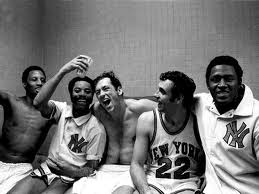
Monroe, Lucas, and the rest. You become a hopeless case, who dreams the impossible dream, of your team, the city’s team, returning to its former glory, even though, with passing years, those days of glory had long since faded into the distant past.
During the Eighties, I made a very good living directing television commercials for New York advertising agencies. In early September of 1989 I was handed a story board from Grey Advertising containing their concept for an ambitious television commercial for none other than my beloved New York Knicks. I was beyond thrilled. If my production company was awarded this project, the entire team would be turned over to me for one whole day.

OK, long story short; the agency creatives liked my input, the suits gave the go-ahead, and the job was mine.
Now, this was the 89/90 Knicks – the Patrick Ewing/Charles Oakley/Mark Jackson/Trent Tucker/Kiki Vandeweghe/Gerald Wilkins Knicks. The team that came between the Rick Pitino trap and gun blur of the mid Eighties, and the Pat Riley-led NBA Finalists of the mid Nineties. A good, but not great team, filled with journeyman role players. Of course, how good they were was meaningless to me. All I could think about was that the New York Knickerbockers were going to be mine for a day.
The commercial would be a complicated combination of live action (Knicks players) interacting with recognizable pieces of New York City’s skyline
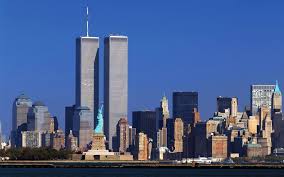
(Empire State Building, Pan Am, World Trade Center, etc). The players, who would appear to be hundreds of feet tall, would dribble, pass, and dunk their way through Manhattan’s caverns, using the famous buildings as props. I spent seven shooting days carefully photographing the buildings, so that they would match the intended interaction of the players. We would need the largest soundstage in the city, to accommodate the players, who were taller than I ever imagined, and the building cut-outs with which they would interact. Locked-down cameras were set up in position to photograph the cut-outs, which were carefully constructed to exactly match the buildings I had already photographed, and the Knicks personnel, who would appear as giants, doing their thing. The cut-outs would be painted a color that the computer animation system would recognize, hopefully allowing the intended magic to happen. On the studio floor, the action would appear to be basketball players weaving between huge green set pieces, but on the monitors that were set up all over the building, my original footage of the skyscrapers would be sandwiched with the new shots that included the players at work. Patrick Ewing, and his giant

shadow, would appear to be three quarters the size of the World Trade Center. To do this right, the camera set ups had to be absolutely exact, and this would take several days. In order to simulate the action during the complicated set-up, crew members and agency personnel stood in for the players. The problem was, that none of our crew people or art directors was seven feet tall, but this didn’t seem to matter at the time. Once we were convinced that the set-ups were correct, we were ready for the players. The team was in training, preparing for the upcoming season, and we would only have them all together for one long shooting day.
I arrived early the morning of the shoot. Everything had been set up by the time we left the studio the night before so, other than turning on all the lighting, and technical gadgetry that covered the studio floor, not much had to be done. I had assigned a production assistant the important task of taking still production photographs of the director, and former gym rat, interacting with his heroes throughout the day. In addition, I handed him my very own personal basketball, with instructions to get every player to sign it – reasonable perks for a lifetime fan.
Whenever celebrities were involved in a production like this, an unusually large number of hangers-on were sure to show up. Between Grey Advertising, the Madison Square Garden handlers and publicity staff, the production company, and all of the personal management people who represented the individual players, there must have been well over a hundred gawkers, who were there for a free lunch and a glimpse of Charles Oakley’s sneer.

This was in addition to the twenty five crew members who were already busy warming up the production machinery. And, of the approximately 125 people now waiting for their arrival, I was sure that I would be the only one in the building who knew each and every player by name. A lifetime Knicks fan was about to get his due.
Other than Trent Tucker, who lived in Manhattan, and was already sipping a coffee on the studio floor, the team would be bussed down from their training facility in Westchester. After a pleasant Chat with Trent, I was

informed that the team had arrived, and were all upstairs in the dressing rooms. My heroes, here at last. The first player I noticed was Kiki Vandeweghe, who was sitting in a chair in the make-up room, having some pancake applied to his face. I introduced myself, and he cheerfully engulfed my outstretched hand in his own, the largest hand I had ever seen. I felt like a three year-old, shaking hands with an affable gorilla. One by one, I met the players, who seemed happy to get a day off from the rigors of training camp and, this early in the day, were in a playful mood.
Down on the studio floor, the players mingled with crew people, asking questions about the technology involved in this endeavor, looking in camera viewfinders, seemingly happy to be there. The two players who took particular interest were Mark Jackson, and Gerald Wilkins, who asked intelligent questions, and seemed genuinely fascinated by the technology involved in the production.

Jackson, who addressed me as “Chief”, which almost made me swoon, was relentlessly curious about everything we did. He seemed amazed by the artistry, and wanted to know all about the technology we used to achieve it. I introduced him to our chief video engineer, and walked over to the edge of the studio floor, where Patrick Ewing was sitting all by himself. Now, I’m just not used to being in the presence of anyone seven feet tall, and have to admit to being intimidated by his knee being level with my waist. I asked him if he needed anything, and he shrugged and said he was fine. A few minutes later, I noticed my assistant director, a woman considerably more sensitive that I, approach Patrick, who still seemed aloof.
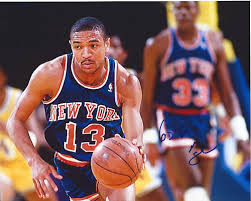
She slid her arm around his sitting shoulder and gave him a half hug, and his face lit up like a Christmas tree. Patrick wasn’t aloof – he was just shy.
At some point Stu Jackson, the newly hired Knick’s coach made a brief appearance. He asked me if everyone was behaving, and left after a few minutes. Actually the players, with the possible exception of Charles Oakley who had on his snarly game face, were a cooperative bunch. As we began the first set-up, it became obvious that something was wrong. When Oakley or Patrick Ewing stood next to our precious cut-outs, the scale was off by a mile. A common practice in prepping a production, we had used crew people as stand-ins when we constructed the sets. The problem, which was now obvious, was that crew people are not seven feet tall, and that none of our carefully constructed building cut-outs would work with the actual players. I had a very expensive disaster on my hands. We told the team to take a break, and had a crash meeting. Everything would have to be at least two feet taller. All the set-ups, that had taken so many long days to achieve, would have to be redone, and in a hurry. The construction crew attacked the task at hand, and we would have to go through the day shooting one set-up while constructing the next; a noisy, distracting process.
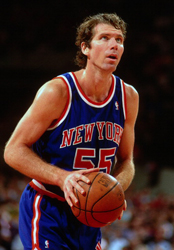
Somehow we managed slowly shooting set-up after set-up, the crew becoming exhausted and cranky, but the players, again with the possible exception of Oakley, were real troopers and none of them complained about the time all of this was taking. After ten hours of shooting, and well into overtime, we were ready for the final shot, which would be the whole team, forming a semi-circle, standing along the edge of Madison Square Garden’s cylindrical roof-line, high-fiving each other, and exuding the energy and confidence of a sports franchise ready to kick some butt. The enormous cylinder shaped platform that the players would stand on had been raised a good five feet by the construction crew, while we were shooting the other set-ups. This would be the big shot. The players climbed up on the platform, and I arranged them in an order that made sense in the camera. The choreography of this shot took at least another hour and, by the time everyone was in position, they hardly looked like the high-energy butt kickers I has envisioned, but instead just a bunch of tired guys who wanted to go home. We began shooting and, take after take, the team seemed more and more exhausted. Payroll wise, we were now into ‘Golden Time’, the client was grumpy and becoming nervous, the crew was sleep-walking, my heroes appeared very unheroic, and my ‘big shot’ was just not working. Just about the time I considered killing myself, I heard a familiar voice from up on the platform. “Hey Chief, wait a second”.

It was Mark Jackson, who jumped down from the platform, took me by the arm, and led me off somewhere beyond the earshot of the huge crowd of gawkers who had been watching this disaster in the making. “Look”, he said, “There’s no energy here. It’s late. These guys are beat. You’ve got to wake them up”. I could only nod, grateful for his interest, but almost too tired to respond. “Look Chief, these are performers you’re dealing with here. They need something to respond to. They need a crowd to cheer them on like it’s the last minute of overtime and they’re one point down. They need their fans to get behind them and make some noise”. Of course, he was absolutely right. He saw the situation, found the problem, and came up with the appropriate solution. Mark took his place back up on the platform, and I rallied the troops. I had to turn every crew person, gawker, and corporate freeloader on that studio floor into frenzied, screaming sports fans, rallying their heroes on to victory. I told the exhausted, yet somehow still cooperative players that we would try one more take, while Mark Jackson poked and prodded them into laughing and trash talking. The camera began rolling, and I began screaming at the people on the floor to get behind their team. As the noise level grew louder, the energy level of the players grew as well, until the crowd, who had now gathered close around the platform, was a delirious cacophony of deafening encouragement to twelve tall men who had totally bought into their enthusiasm. Trash was talked, high fives were swapped, someone threw a basketball up to the players and they did mad tricks with it. It was exactly the high energy madness I had envisioned, but was unable to achieve, until Mark Jackson wisely intervened with exactly the right solution. This very expensive disaster, was transformed into an enormous success thanks to a guy who saw a problem, and knew how to fix it.
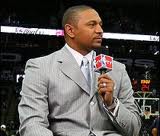
I can remember thinking at the time, that one day, after his point guard days were over, Mark Jackson would have a long and successful career coaching NBA basketball. He was a natural. A leader of men. A fixer of problems. He walks with a swagger that’s been earned. He would be a brilliant coach. But, although he interviewed well, he was turned down by a series of teams because of his lack of coaching experience. After retiring as a player, Jackson chose the broadcast booth over an Assistant Coach’s seat on the end of the bench, and most teams chose from the pool of Assistant Coach’s to fill their Head Coaching vacancies. I knew Jackson’s manager, Steve Kauffman, and sent him a version of this humble scribbling, which he used in his campaign to find a Head Coaching job for his client. I’m sure that my literary plea on Jackson’s behalf had little to do with the San Francisco Warriors final decision to give Mark Jackson his chance as their Head Coach, but I’m thrilled to have helped.

After his extraordinarily successful first season, there’s little doubt that Mark Jackson is a coach to be watched, something I knew all along. After all, if Mark Jackson could turn my miserable self into a hero, winning an NBA championship is really not so much of a stretch.
*
© 2012 Shaun Costello
I’M STILL HERE
I’M STILL HERE
My flirtation with mortality was obviously unsuccessful. After 12 days in the hospital, I’m still weak and not at all sure about anything. One thing is certain, my situation remains unchanged. I still can not meet my monthly financial obligations. Ridiculous as it might seem, homelessness remains a possibility. But I’m still here, and attempting to remain here.
WILD ABOUT HARRY
WILD ABOUT HARRY
A friend who knew him well
remembers HARRY REEMS
by Shaun Costello
AVAILABLE NOW
AVAILABLE NOW
On March 19th, just three weeks ago, HARRY REEMS, the star of Deep Throat and many other adult films of the 1970’s, died of pancreatic cancer, at a VA Hospice in Salt Lake City, Utah. Before the media circus that surrounded Deep Throat created the fast talking, Burleaque-comedic actor know as HARRY REEMS, he was just a young man, trying like so many before him, to make it in show business. He was born Herbert Streicher to a Jewish family in Brooklyn, and was a close friend of mine. When I read the news of his death I was devestated. So many rich memories. Such an important friend. I knew I had to do something, so I put everything else aside, and sat down to write a personal reminiscence of my friendship with Herb. I have worked almost around the clock, since the day after his death, and finished the text yesterday. I’m very pleased with how it came out. I think Herb would be too.
Herb and Harry – a dichotomy he leaves behind for the rest of us to puzzle over. As Herb he was a son, a brother, a Bar Mitzvah boy, a High School track star, a student, a Marine, an aspiring actor, and a loyal and generous friend. As Harry he was a porn icon, an international celebrity, a darling of the TV Talk Show circuit, a victim of judicial overreach, a convicted felon, a finally-absolved and victorious defendent, a drunk, a drug addict, a Twelve Step Champion, a converted Christian, a successful real estate executive, a scratch golfer, a semi-pro skier, a loving husband, and, at long last, a happy man.
WILD ABOUT HARRY is a hard cover, eight by ten, four color book – text driven, and including over a hundred four color and black and white, fun images of HARRY’S life. It’s being printed on an on-demand basis and is available now at the link below:
http://www.blurb.com/b/4214470-wild-about-harry
I’m quite pleased at how this story came out, and, for those of you who have a fascination with the Seventies, the birth of the adult film industry, the First Amendment trial and media circus that surrounded the prosecution of Deep Throat, and the complex character that was HARRY REEMS, you will be too.
AVAILABLE NOW – CLICK ON LINK BELOW
http://www.blurb.com/b/4214470-wild-about-harry
****************
SWINGERS
SWINGERS
Rick was narrating my sexual experience with my screaming blonde friend, like Howard Cosell calling the Thrilla in Manilla
By Shaun Costello

Excerpted from the “Seventies” manuscript:
RISKY BEHAVIOR
Sex, Gangsters, and Deception in the time of ‘Groovy’
My girlfriend Ann had taken a job working for an aging literary agent named Kurt Hellmer who, because of his advancing age, had let his business slip, and had lost many of his authors. Ann, who was the best-read person I knew, was a quick reader with amazing retention, and she seemed to have a knack for spotting publishable manuscripts from the huge slush pile that came across her desk daily. My continuing porn involvement was not spoken about, and my plan to sell the golf film that Bill and I had made the previous summer to a television network seemed enough for Ann to tell her parents about, in order to justify her continued involvement with me.

She had been talking for a while about the two of us trolling a “Swingers” bar, looking for some erotic adventure. Ann considered herself to be on the vanguard of the sexual revolution – a master player in the game of erotica. But none of this was true. She was just a smart, manipulative “Five Towns” girl who had read too much Anais Nin, and derived considerable pleasure from creating embarrassing scenarios for her malleable and impressionable roommates from Long Island to play out. Ann herself however, seldom took risks, being uncomfortable in situations she did not control. Not wanting to be involved in one of her ridiculous sociological experiments, I made a series of excuses for not participating, but Ann was relentless. The more I resisted, the more she demanded my involvement, until finally, I gave in from sheer exhaustion. But I knew it was a mistake. Ann in a party full of Swingers? This had disaster written all over it.

She searched through the alternative classifieds, and came up with an ad that seemed perfect. There was a restaurant down in the financial district called “Smitty’s” that served lunch to stock brokers and, because there was no night-time business in that area, they leased the place out after-hours to groups who hosted private parties. The ad in the Village Voice suggested that these parties were attended by open-minded couples, and that no single men were allowed.

We arrived about nine on a Friday night. The price was ten dollars a couple, which seemed reasonable enough, and there were maybe a hundred people already milling about. Ann was a very attractive 23 year-old cutie, so most eyes in the room followed our every move. About half the crowd was out on the dance floor gyrating to Elton John’s Bennie and the Jets, and one by one, we were approached by couples looking to hook up. The MO seemed to be that couples met here at Smitty’s, and then gathered later on at private parties for
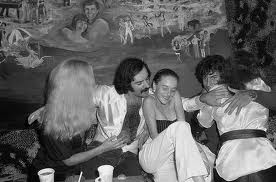
some intimate activities. As we met more people I became aware of an odd phenomenon. The men made all the arrangements. Women took no initiative and seemed satisfied to be included in the coupling negotiated by their male partners. Women’s lib did not seem to have affected the Swingers set. After several private-party offers we were approached by a couple named Rick and Ione. They were a bit older, and of course Rick did all the talking. They were having a few couples over to their apartment later, and maybe we might like to join them. “And Shaun, maybe you would like to dance with Ione”. Ann and I exchanged looks, and Ione led me out

to the dance floor where we slow-danced to Barbra Steisand singing “The Way We Were”. Ione made sure that our crotches were seriously grinding against each other and told me that this song always made her cry, which she proceeded to do. As we slowly did our turn on the dance floor Ione looked up at me, Streisand-induced tears running down her cheeks and said, “I saw you when you came in. I want you in my mouth. I want you in my mouth now”.
Their apartment was on West 54th Street, between Broadway and Seventh Avenue, and about ten couples had been invited. Ann, who seemed extremely nervous, was off somewhere doing god-knows-what with Rick, while Ione led me into her bedroom. Along the way she had taken a female friend in tow, and proceeded to slowly undress us both. She had closed the door, assuring our privacy, which I thought was a nice touch. Ione’s idea was to choreograph a sexual encounter between myself and her girlfriend, and participate as she saw fit during carefully chosen moments. I have to confess here that it was exciting, within limits, and that Ione, although several years older, was imaginative, and resourceful. I also have to admit to thinking, at the time, that I was living out a scene from one of my own movies. She spread me across her bed, placing her girlfriend over me but facing away. Ione was extraordinarily proficient at oral sex on both men and women, or at least she professed herself to be, and proceeded to slowly lick and suck each of her co-conspirators in this frolic, as she drew us closer together in the process, until we were joined.
Ione was at the bottom of the bed, her noisy mouth glued to our genitals, and as the motion grew faster and mutual orgasm seemed approaching on the near horizon, Ione suddenly, but assuredly,

like she had done this many times before, knelt up, reached into her mouth, and removed her teeth. Well, this was certainly a startling development. “There”, she said, “This will make it better”, and she leaned over and put them on the night table right next to my face, and resumed her oral endeavors with a new fervor. I guess it probably did feel better, but the sensation of the joined male and female genitalia, enthusiastically licked and slurped by Ione’s tongue, not to mention Ione’s gums, was just not as fulfilling when, right next to my head, were Ione’s dentures; a full set, uppers and lowers, a whole mouth full of teeth, like something you saw in a gag store that wound-up and chattered. At this point comedy overtook erotica and, although we somehow took this cumbersome adventure to completion, my heart was just no longer in it. Post-coital Marlboros were passed around, and Ione didn’t seem to need her teeth to smoke.
I wandered out into the common area of the living room, where mixed groups seemed huddled in twos and fours, touching, and munching on each other’s body parts, while others were sitting naked on the couch watching Johnny Carson. Ann was nowhere in sight, which relieved me of the responsibility of making sure she was enjoying herself, a burden she seemed to relish delegating to others, usually me, which never really worked, but that fact never kept her from trying. Ann’s happiness was my responsibility, in the world according to Ann.
A young, cute blonde girl, maybe twenty, came out of the kitchen, grabbed my hand, and led me to the other side of the room. ‘Where have you been?”, she asked, “I’ve been looking for you”. I had noticed her dancing back at Smitty’s, and thought she was pretty cute, but hadn’t seen her at Rick and Ione’s until this moment. As she started swallowing my face I realized that my intermission was over. I ate her for a long time. She was sweet, and responsive, and came at least twice before I removed my mouth from her clitoris. We seemed to have become the main attraction, as most of the party guests gathered around us in a circle. She turned over on her stomach and spread her cheeks apart. “Shove it in my ass, go ahead, give it to me, give it to me.” Well I didn’t have to be asked twice. I could sense the crowd drawing closer around us as I started fucking her harder. “Hurt me. C’mon, hurt me”. And I was fucking her much harder now, and we were soaked with sweat, and she was screaming, and all of a sudden I became aware of someone’s mouth very close to my ear softly saying, “They met in a swingers bar. When she saw him across the room she knew she had to have him. She knew he would do her bidding, no matter what she asked. Anal
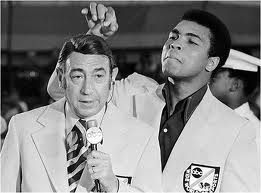
sex was what she needed and she was going to get from him no matter what”. I looked to my left, and it was Rick, who was narrating my sexual experience with my screaming blonde friend, like Howard Cosell calling a Mohammad Ali fight. “She wanted to experience the shame of anal penetration. To be subjugated by his masculine will. By his strength. By the pounding of his cock”. And my partner, who seemed to not hear a word of this narrative blow by blow, was still screaming for me to hurt her, over and over again. Rick softly, but audibly continued his narration to the delight of the crowd of sweaty party goers who seemed caught up in the whole rhythmic, slamming, screaming, narrated event, until she came, and I came, and we melted into a puddle of two sweaty swingers, and all I could hear was the sound of our breathing; and of course Rick, whose relentless narration continued. “She felt the intrusion of his manhood deep within her willing rectum, burning her, scalding her into a submissive jelly. Tonight she got exactly what she needed”. Well, nothing like a good narration to put things in perspective.

In the cab on the way home I asked Ann why she was being so quiet. “Don’t even talk to me”, she responded. Evidently I was guilty of something. Crimes against Ann, no doubt. “How could you?” she asked. I remained silent because it seemed like the best course to take. “You went down on her”, she scowled at me. ‘You never go down on me. Never. And you went down on that waitress, or dental assistant, or whatever that stupid slut was”. A bit judgmental on Ann’s part. The girl might have been an astronaut. “Ann, this whole thing was your idea, remember?” An attempt at making sense got me nowhere. Ann was insistent, “A stranger. You ate out the cunt of a stranger. What about me? What about my cunt? What about me?”
We remained silent for the rest of the cab ride, and I let Ann out at her building on East 48th Street, then headed home. Why did she ever leave her husband, the Doctor? Why did I let her talk me in to doing this? Probably because I knew that something amusing would happen, and it did. I thought about Ione’s teeth all the way home.

*
© 2013 Shaun Costello
BEST OF THE WEST
BEST OF THE WEST
Hollywood’s All-Time Ten Best Westerns (the movies – not the motels)
By Shaun Costello
The Western, being Hollywood’s favorite entertainment genre, was produced in such numbers that the sheer volume of titles makes the job of narrowing the field to only ten just about impossible. Maybe, the first task is to define the genre – just what exactly is a Western Movie? The stranger, who shows up in the nick of time to save a town from corrupt land owners – SHANE? The town Marshall who single-handedly takes responsibility for the safety of his town, even though the very people he’s protecting run for cover, and refuse to stand behind him – HIGH NOON? A noirish cavalcade of over-the-hill characters trying to make a buck on aging reputations – UNFORGIVEN? Cowpokes, banding together, against all odds, to make the impossible journey – RED RIVER? A tale of vengeance, and the collecting of odd souls, as a man seeks out the men who murdered his family, only to find salvation in something more important – THE OUTLAW JOSEY WALES? The saga of men who had outlived their era, and couldn’t seem to adapt to reality – BUTCH CASSIDY AND THE SUNDANCE KID? The answer, of course, is yes to all of these, as well as the other titles on this list.
But what must we eliminate? Here’s where I begin to make enemies. First, the Seven Samurai clones: THE WILD BUNCH, THE MAGNIFICENT SEVEN, and THE PROFESSIONALS – three of my all time favorite movies, but not true Westerns, not really. Next, anything with singing – sorry, Gene and Roy. And how about all those dark, cerebral, recently made Westerns, starring country western singers with long hair, and giant hats, wearing those ankle-length duster-coats, that seem to make Nascar fans swoon – Nah! Let’s stick to the best of the genre. And let’s also remember that we’re doing the subjectivity shuttle, here. Everyone has their favorites, and I know there are die-hard Peckinpah fans out there, who would rather go down in a hail of squibs, than turn their back on THE WILD BUNCH, but this is MY list, and it’s tough to whittle it down to just ten. For purpose of full disclosure, I have to admit to breaking one of my rules here, which is to never list a movie that’s been on one of my previous lists, but RED RIVER is one of the greatest films ever produced by Hollywood, and it’s a Western, so it’s here. Get over it.
So, in alphabetical order:
BUTCH CASSIDY AND THE SUNDANCE KID
1969 George Roy Hill
(Four Oscars)
Hey, it was the Sixties, and if ever there was a Sixties western, it’s this memorable saga of Butch and Sundance. William Goldman’s tasty screenplay is loosely based on real events, so here is some background:

Robert LeRoy Parker (April 13, 1866 – November 6, 1908/1936?), better known as Butch Cassidy, was a notorious American train robber, and leader of the Wild Bunch Gang in the American Old West, doing most of his mischief in Wyoming and Montana from the 1880’s through the turn of the century. After pursuing a career in crime for several years in the United States, the pressures of being pursued, notably by the Pinkerton Detective Agency,

forced him to flee with an accomplice, Harry Alonzo Longabaugh, known as the Sundance Kid, and Longabaugh’s girlfriend, Etta Place, first to Argentina and then to Bolivia, where he and Longabaugh were allegedly killed in a shootout in November 1908.
OK, back to Hollywood. This movie is many things on many levels, and all of them good, which almost never works, but in this case, worked to perfection. Enough beautifully staged action to qualify as

a solid action film, Goldman’s brilliant and hilarious screenplay, which makes it an engaging comedy, and the inevitable, tragic ending, which you knew somehow was coming, but that happens so quickly that it doesn’t sour the film’s success as the ultimate, happy go lucky Buddy Movie. From the trick opening, to Butch and Sundance’s demise in a hail of Bolivian bullets, the movie never loses its focus, probably due in equal parts to Newman and Redford’s chemistry, Goldman’s script, and George
Roy Hill’s adroit direction. Katherine Ross, as the Kid’s gal pal, is lovely to look at, and nice ensemble work by a game cast. Solid lensing by Conrad Hall, who moved in with Ms Ross during the shooting, and a lovely score by Burt Bacharach. The huge worldwide Box Office would encourage producers to come up with an appropriate vehicle to repackage the Newman/Redford magic, which would happen five years later in another George Roy Hill blockbuster, The Sting.
http://www.youtube.com/watch?v=X41Ylp02NRs
THE GUNFIGHTER 1950 Henry King
The problem with being a gunfighter, it seems, is that everybody wants a piece of your street cred.
Notorious but aging gunfighter Jimmy Ringo (Gregory Peck) tries to avoid the trouble that goes with his reputation as the fastest draw in the west. However, when a cocksure cowpoke named Eddie (Richard Jaeckel) deliberately provokes an argument and draws on him, Ringo has no choice but to kill him. Ringo is warned to leave the area because the deceased has three brothers who are certain to seek revenge. Sure enough, the brothers pursue him, but he takes them by surprise, disarming them and driving off their horses.
Ringo then stops to wait in the nearby town of Cayenne, where he occupies a corner of the largely empty saloon for most of the remaining film. It is only revealed later that he is hoping for a chance to see his wife and young son, whom he has not seen in
eight years. The local barkeep, Mac (Karl Malden), remembers him from the past in another town and alerts Sheriff Mark Strett (Millard Mitchell), who turns out to be an old friend of Ringo’s. Strett also knows Ringo’s wife Peggy (Helen Westcott), and tells Ringo she has changed her surname to hide their past life together. Urging Ringo to leave town as quickly as possible, Strett nevertheless agrees to go and ask Peggy to come and see him. She declines, still fearing the notorious and hotheaded nature of Ringo’s younger days that drove them apart.
While waiting, Ringo also has to deal with Hunt Bromley (Skip Homeier), the young local would-be gunslinger who is keen to make a name for himself, and Jerry Marlowe (an uncredited Cliff Clark), a semi-retired man who mistakenly believes Ringo killed his son some years before. Ringo also meets another friend from the

past, a bar-girl named Molly (Jean Parker), who eventually persuades Peggy to come and talk to her husband. Meeting at last, Ringo tells his wife that he has changed, that he wants to settle down somewhere where people do not know him, possibly out in California, and asks her to leave with him. She refuses, but agrees to reconsider in a year’s time if he will remain true to his word. Ringo also gets acquainted with his son at last, although he does not tell him of their relationship.
However, by this time Ringo has spent too long in town. The three brothers are still trailing him and arrive, but are captured by Strett and his deputies before they can ambush Ringo. As Ringo makes final preparations to leave, Bromley seizes his chance. Eager to get himself a reputation as a gunfighter, Bromley shoots Ringo in the back, fatally wounding him. Word quickly spreads through the

town that Bromley has shot Ringo. As Ringo lies dying he tells Sheriff Strett to say that he, rather than Bromley, drew first. When Bromley starts to say that he doesn’t want Ringo’s help, Ringo rejects Bromley’s words, informing his killer that he will soon know how it feels to have every hotshot and two-bit gunfighter out to get him in turn. An angry Strett tells Bromley to leave town immediately, punctuating his order with a severe beating which he warns is “just the beginning” of what Bromley’s got coming to him for killing Ringo. It is clear that Bromley has become a magnet for trouble: he will soon discover (just as Ringo did) that notoriety as a gunfighter is in reality a curse which will follow him wherever he goes, making him both an outcast and a target for the rest of his life.
The film closes with Peggy Walsh attending Jimmy Ringo’s funeral, making her way through the crowd around the church door with her son to reveal, quietly but with pride, what the townsfolk have never known – that she is Mrs Jimmy Ringo. Thus, despite his death, the gunfighter finally achieves what he sought in coming to the town – his wife’s forgiveness and reconciliation.
Nice work by a peak Peck, Malden, and a game ensemble of mostly “B” players. Solid direction here by Henry King, and dark lensing by Arthur C Miller. The screenplay is credited to William Bowers, but word has it that a major rewrite was done by Nunnally Johnson, who also Produced. Good score by Alfred Newman. This is a small, dark, unpretentious Western that never tries to over-reach, and stays on-target throughout.
http://www.youtube.com/watch?v=3z6Obp0rcuo
HIGH NOON 1952 Fred Zinnemann
(Four Oscars)

Now considered one of the great American Westerns, High Noon received some frosty reactions when it opened in 1952.
Upon its release, the film was criticized by audiences, as it did not contain such expected Western archetypes as chases, violence, action, and picture postcard scenery. Rather, it presented emotional and moralistic dialogue throughout most of the film. Only in the last few minutes were there any action scenes.
In the Soviet Union the film was criticized as “a glorification of the individual.” The American Left appreciated the film for what they believed was an allegory of people (Hollywood people, in particular) who were afraid to stand up to HUAC. However, the film eventually gained the respect of people with conservative/anti-communist views. Ronald Reagan, a conservative and fervent anti-Communist, said he appreciated the film because the main character had a
strong dedication to duty, law, and the well-being of the town despite the refusal of the townspeople to help. Dwight Eisenhower loved the film and frequently screened it in the White House, as did many other American presidents. Bill Clinton cited High Noon as his favorite film and screened it a record 17 times at the White House.
Actor John Wayne disliked the film because he felt it was an allegory for blacklisting, which he actively supported. In his Playboy interview from May 1971, Wayne stated he considered High Noon “the most un-American thing I’ve ever seen in my whole life” and went on to say he would never regret having helped blacklist liberal screenwriter Carl Foreman from Hollywood.

Ironically, Gary Cooper himself had conservative political views and was a “friendly witness” before HUAC several years earlier, although he did not name names and later strongly opposed blacklisting. Wayne accepted Cooper’s Academy Award for the role as Cooper was unable to attend the presentation.
In 1959, Wayne teamed up with director Howard Hawks to make Rio Bravo, as a conservative response. Hawks explained, “I made Rio Bravo because I didn’t like High Noon. Neither did Duke. I didn’t think a good town marshal was going to run around town like a

chicken with his head cut off asking everyone to help. And who saves him? His Quaker wife. That isn’t my idea of a good Western.”
Irritated by Hawks’s criticisms, director Fred Zinnemann responded, “I admire Hawks very much. I only wish he’d leave my films alone!” Zinnemann later said in a 1973 interview, “I’m told that Howard Hawks has said on various occasions that he made Rio Bravo as a kind of answer to High Noon, because he didn’t believe that a good sheriff would go running around town asking for other people’s help to do his job. I’m rather surprised at this kind of thinking. Sheriffs are people and no two people are alike. The story of High Noon takes place in the Old West but it is really a story about a man’s conflict of conscience. In this sense it is a cousin to A Man for All Seasons. In any event, respect for the Western Hero has not been diminished by High Noon.”

I included so much background because it’s so surprising. Back to the movie. It’s said the there’s no such thing as an honest man. Will Kane (Gary Cooper) proves otherwise. Kane, the longtime marshal of Hadleyville, New Mexico Territory, has just married pacifist Quaker Amy Fowler (Grace Kelly) and turned in his badge. He intends to become a storekeeper elsewhere. Suddenly, the town learns that Frank Miller (Ian MacDonald)—a criminal Kane brought to justice—is due to arrive on the noon train.
Miller had been sentenced to hang but was pardoned on an unspecified legal technicality. In court, he had vowed to get revenge on Kane and anyone else who got in the way. Miller’s three gang members – his younger brother Ben (Sheb Wooley), Jack Colby (Lee Van Cleef) and Pierce (Robert J. Wilke) wait for him at the station.
Kane and his wife leave town, but fearing that the gang will hunt him down and be a danger to the townspeople, Kane turns back. He reclaims his badge and scours the town for help, even interrupting Sunday church services, with little success. His deputy, Harvey Pell (Lloyd Bridges), resigns because Kane did not recommend him as the new marshal.
Kane goes to warn old flame Helen Ramírez (Katy Jurado), first Frank Miller’s lover, then Kane’s, and now Harvey’s. This girl gets around. Aware of what Miller will do to her if he finds her, she quickly sells her business and prepares to leave town.
Amy gives her husband an ultimatum: she is leaving on the noon train, with or without him.
The worried townspeople encourage Kane to leave, hoping that would defuse the situation. Even Kane’s good friends the Fullers are at odds about how to deal with the situation. Mildred Fuller (Eve McVeagh) wants her husband, Sam (Harry Morgan) to speak with Kane when he comes to their home, but he makes her claim he is not home.
In the end, Kane faces the Miller Gang alone. Kane guns down two of the gang, though he himself is wounded in the process. Helen Ramírez and Amy both board the train, but Amy gets off when she hears the sound of gunfire. Amy chooses her husband’s life over her religious beliefs, shooting Pierce from behind. Frank then takes her hostage to force Kane into the open. However, Amy suddenly attacks Frank, giving Kane a clear shot, and Kane shoots Frank Miller dead. As the townspeople emerge, Kane contemptuously throws his marshal’s star in the dirt and leaves town with his wife.

No Western had ever come close to this kind of gripping drama, and the term “Adult Western” was coined to describe it. Brilliantly piloted by Zinnemann’s steady hand, the tension builds relentlessly until the Quaker bride shoots the last bad guy. Cooper is steadfast and perfect, Kelly is trim and convincing, and Katy Jurado shines as the busiest girl in town. Crisp black and white lensing by Floyd Crosby, and brilliant editing by Elmo Williams and Harry Gerstad, relentlessly keeping the clock ticking as the whole town waits for the Noon Train. A memorable music score by Dimitri Tiomkin. One of the real champs.
http://www.youtube.com/watch?v=SkNu4-sSglY
THE OUTLAW JOSEY WALES 1976 Clint Eastwood
I know I’ll take some flak for including this, but I love this movie, and every ridiculous character in it.
Josey Wales, a Missouri farmer, is driven to revenge by the murder of his wife and son by a band of pro-Union Jayhawkers—Senator James H. Lane’s Redlegs from Kansas.
Wales joins a group of pro-Confederate Missouri Bushwhackers led by William T. Anderson. At the conclusion of the war, Captain Fletcher persuades the guerrillas to surrender, saying they have been granted amnesty. Wales refuses to surrender. As a result, he and one young man are the only survivors when Captain Terrill’s Redlegs massacre the surrendering men. Wales intervenes and guns down several Redlegs with a Gatling gun.

Senator Lane puts a $5,000 bounty on Wales, who is now on the run from Union militia and bounty hunters. Along the way, despite wishing to be left alone, he accumulates a diverse group of companions. They include an old Cherokee named Lone Watie, a young Navajo woman, and an elderly woman from Kansas and her granddaughter whom Wales rescued from Comancheros. And a mangy hound who Wales spits his tobacco on.
In Texas, Wales and his companions are cornered in a ranch house which is fortified to withstand Indian raids. The Redlegs attack but are gunned down by the defenders. Wales, despite being out of ammunition, pursues the fleeing Captain Terrill on horseback. When he catches him, Wales dry fires his pistols through all twenty–four empty chambers before stabbing Terrill with his own cavalry sword.
At the bar in nearby Santa Rio, a wounded Wales finds Fletcher with two Texas Rangers. The locals at the bar, who refer to Wales as “Mr. Wilson,” tell the Rangers that Wales was killed in a shoot-out in Monterrey, Mexico. The Rangers accept this story and move on. Fletcher refuses to believe that Wales is dead. He says that he will go to Mexico and look for Wales himself. Seeing the blood dripping on Wales’s boot, Fletcher says that he will give Wales the first move, because he “owes him that.” Wales rides off, hopefully to rejoin his odd collection of companions who have set up housekeeping at the old lady’s late son’s Rancho.
This is typical, sentimental story telling from Eastwood, who, along with John Ford, gets two titles on this list. Without his knowledge or consent, and gradually throughout his journey, Josey’s murdered family is replaced the odd collection of characters who he saves from calamity along the way, and feels responsible for. Chief Dan George plays the old Cherokee, and delivers too many hilarious, dead-pan lines to count.
Nice work by director Eastwood, with solid cinematography by Bruce Surtees, and editing by Ferris Webster. Nice job by all.

http://www.youtube.com/watch?v=en9rfsUGDkc
RED RIVER 1948 Howard Hawks

As American as it gets. Hawks’ memorable tapestry of the blazing of the Chisholm Trail. The cattle were in Texas, but the Rail Head was in Abilene Kansas. And driving a huge and ornery herd of cattle, for the very first time, across the Red River, over mountain ranges, through hostile Indian territory, risking misadventure with nature and bands of rustlers, was no easy business.

Hawks, probably Hollywood’s best dialogue director, made John Wayne almost believable. Lots of crusty, spicy cowpoke dialogue that might be corny in the hands of another director, but Hawks pulls it off.
One memorable scene has John Ireland and Montgomery Clift admiring each other’s six shooters in great detail. Say’s Ireland, “The only thing as beautiful as a good gun is a Swiss Watch, or a

woman from anywhere. You ever have a Swiss watch?” Of course, Hawks was having some fun with guns as penis parody material, which gets funnier with each viewing.
It’s dawn on the range, and the men and the cattle are ready. Hawks’ camera does a slow, minute-long, 360 pan across the faces of cowboy after cowboy, beginning and ending on Wayne, who looks to Montgomery Clift and finally say’s, “Take ‘em to Missouri, Matt”. Clift raises his hat and whoops the first of many,

And the next cowboy does the same, and in quick cuts now, face after face, whoop after whoop, until, finally driven by the drama of the moment, the music swells, and the herd begins to move. It’s one of the great moments in movie history and, if you haven’t experienced it – shame on you.

http://www.tcm.com/mediaroom/index.jsp?cid=12520
http://movieclips.com/S47B-red-river-movie-showdown/
THE SEARCHERS 1956 John Ford
Directed by John Ford, based on the 1954 novel by Alan Le May, and set during the Texas–Indian Wars, the film stars John Wayne (who else) as a middle-aged Civil War veteran who spends years looking for his abducted (by Comanches no less) niece played by Natalie Wood, along with Jeffrey Hunter as his adoptive nephew, who accompanies him on the search.

In 1868, Ethan Edwards (Wayne) returns from the American Civil War, in which he fought for the Confederacy, to the home of his brother Aaron (Walter Coy) in the wilderness of west Texas. Wrongdoing or legal trouble in Ethan’s past is suggested by his three-year absence, a large quantity of gold coins in his possession, a Mexican revolutionary war medal that he gives to his young niece Debbie (played as a child by Natalie Wood’s sister Lana Wood), and his refusal to take an oath of allegiance to the Texas Rangers, as well as Rev. Samuel Clayton mentioning that Ethan “fits a lot of descriptions”.

Shortly after Ethan’s arrival, cattle belonging to his neighbor Lars Jorgensen (John Qualen) are stolen, and when Captain Samuel Clayton (Ward Bond) leads Ethan and a group of Rangers to follow the trail, they discover that the theft was a ploy by Comanche to draw the men away from their families. When they return home, they find the Edwards homestead in flames; Aaron, his wife Martha (Dorothy Jordan), and their son Ben (Robert Lyden) dead; and Debbie and her older sister Lucy (Pippa Scott) abducted.
After a brief funeral, the men return to pursuing the Comanches. When they find their camp, Ethan recommends an open attack, in which the girls would be killed, but Clayton insists on sneaking in. The Rangers find the camp deserted, and when they continue their pursuit, the Indians almost catch them in a trap. The Rangers fend off the Indian attack, but with too few men to ensure victory, Clayton and the posse return home, leaving Ethan to continue his search for the girls with Lucy’s fiancé Brad Jorgensen (Harry Carey) and Debbie’s adopted brother Martin Pawley (Jeffrey Hunter). However, after Ethan finds Lucy brutally murdered and presumably raped in a canyon near the Comanche camp, Brad becomes enraged, rides wildly into the camp, and is killed.
Ethan and Martin search until winter, when they lose the trail. When they return to the Jorgensen ranch, Martin is enthusiastically welcomed by the Jorgensens’ daughter Laurie (Vera Miles), and Ethan finds a letter waiting for him from a man named Futterman, who has information about Debbie. Ethan, who would rather travel alone, leaves without Martin the next morning, but Laurie provides Martin with a horse to catch up. At Futterman’s (Peter Mamakos) trading post, Ethan and Martin learn that Debbie has been taken by Scar (Henry Brandon), the chief of the Nawyecka band of Comanches. A year or more later, Laurie receives a letter from Martin describing the ongoing search. In reading the letter aloud, Laurie narrates the next few scenes, in which Ethan kills Futterman for trying to steal his money, Martin accidentally buys a Comanche wife, and the two men find part of Scar’s tribe killed by soldiers.

After looking for Debbie at a military fort, Ethan and Martin go to New Mexico, where a Mexican man leads them to Scar. They find Debbie, now an adolescent (Natalie Wood), living as one of Scar’s wives. When she meets with the men outside the camp, she says she has become a Comanche and asks them to leave without her. However, Ethan would rather see her dead than living as an Indian. He tries to shoot her, but Martin shields her with his body and a Comanche shoots Ethan with an arrow. Ethan and Martin escape to safety, where Martin saves Ethan by tending to his wound. Martin is furious at Ethan for attempting to kill Debbie and wishes him dead. “That’ll be the day,” Ethan replies. The men then return home.

Meanwhile, Charlie McCorry (Ken Curtis) has been courting Laurie in Martin’s absence. Ethan and Martin arrive home just as Charlie and Laurie’s wedding is about to begin. After a fistfight between Martin and Charlie, a nervous “Yankee” soldier, Lt. Greenhill (Patrick Wayne), arrives with news that Ethan’s half-crazy friend Mose Harper (Hank Worden) knows where Scar is. Clayton leads his men to the Comanche camp, this time for a direct attack, but Martin is allowed to sneak in and rescue Debbie, who welcomes him. During the attack, Martin kills Scar and Ethan scalps him.
When Ethan sees Debbie, Martin is unable to stop him from chasing her, but instead of killing her, Ethan carries her home. Once Debbie is safely with her family, and Martin is reunited with Laurie, Ethan walks away, alone, the cabin door closing on his receding image in one of the most famous and iconic closing scenes in film history.
Quite a yarn, nicely piloted by Ford, with beautiful cinematography by Winton Hoch. Ford’s Favorite location, Monument Valley, never looked better. Wayne seems comfortable with this kind of suds, and obviously works well with Ford. Jeffrey Hunter, Vera Miles, Ward Bond, and Natalie Wood round out the cast.
A busy Western about guilt and vengeance. Very nice indeed.
http://www.youtube.com/watch?v=Yr7KzwRV2qM
SHANE 1953 George Stevens

I saw this as a child, in the Edwards Theater in East Hampton, which was the venue that provided so many of my early movie experiences. I can still remember young Brandon deWilde’s voice echoing across the valley, calling to Shane to come back, as Alan Ladd rides off into a perfect movie ending. Great stuff. Great movie.
Two themes here that reoccur in movie westerns, over and over; you just can’t escape who you are, and sometimes a man just stands up. And more often than not, both cost you what you want most. This is a simple story about good and evil, and right and wrong, and doing what’s needed, no matter the cost. A simple story delicately handled by director George Stevens, with a game cast of heroes and villains. It’s the old story of the hard working homesteaders, trying to make a go of it against all odds, and against the will of the greedy land barons, who want to keep the range open and free of the fences these pesky farmers keep putting up everywhere. Just how far will the land Barons go to squeeze the homesteaders off their land? Assault? Arson? Murder? There’s no end to it. These are simple farmers, unable or unwilling to fight back. They need help. They need a hero. Into this sordid atmosphere, a quiet man appears, riding into town wearing buckskin, looking for work. His name is Shane.
The location is an isolated valley in the sparsely settled territory of Wyoming. Whatever his past, Shane soon finds himself drawn into a conflict between homesteader Joe Starrett (Van Heflin) and ruthless cattle baron Rufus Ryker (Emile Meyer), who wants to force Starrett and the others off the land.
Shane stays for supper and the night at the invitation of Joe’s wife, Marian (Jean Arthur), and starts working as a farmhand. Young Joey (Brandon deWilde) is drawn to him and the gun, and wants to learn how to shoot. Shane tries to teach him and his mother that a gun is a tool like any other, except it’s designed to shoot people. Whether it’s used for good or not depends on the person using it.

There is an obvious attraction, and perhaps a history, between Shane and Marian. She tells Shane that they would be better off if there weren’t any guns in the valley, including his. She is emphatic that guns are not going to be a part of her son’s life.
When Shane goes into town with Starrett and the rest of the homesteaders, he gets into a fistfight with Ryker’s men after being ridiculed for backing down before. With Joe’s help, they win, and the shopkeeper orders them out. Ryker declares that the next time Shane or Joe go to town the “air will be filled with gunsmoke.”

As tensions mount, Ryker hires Jack Wilson (Jack Palance), an unscrupulous, psychopathic gunslinger, who laughs at the thought of murder. Wilson goads ex-Confederate Frank ‘Stonewall’ Torrey (Elisha Cook, Jr.), a hot-tempered Alabama homesteader, into a fight, and shoots him down in the street.
After the funeral, many plan to leave. But a fire set by Ryker’s men spurs them into pulling together to put it out, rather than driving them out.
Ryker decides to have Wilson kill Starrett in an ambush at the saloon, under the pretense of negotiating. One of Ryker’s men loses his stomach for this, and warns Shane that Starrett’s “up against a stacked deck.”
Joe is resolved to go anyway. He knows that Shane will look after Marian and Joey if he doesn’t survive. But Shane tells Joe he’s no match for Wilson, although he might be a match for Ryker. They fight and Shane has to knock him unconscious. Joey yells at Shane for pistol whipping his father with the butt of his gun.
Marian begs Shane not to go and asks if he is doing it for her. He admits that he is, and for Joey, and all the decent people who want a chance to live and grow up there.
In town, Shane walks into the saloon. Shane tells Ryker that they’re both relics of the Old West, but Ryker hasn’t realized it yet. Wilson draws, but is shot and keeps reflexively shooting, even after he’s dead – only Jack Palance can get away with stuff like this. Ryker pulls a hidden gun and Shane returns fire. He’s turned to leave when Ryker’s brother fires a Winchester rifle from the balcony overhead. Joey, who ran after Shane, calls out and Shane fires back.
Shane walks out of the saloon, where Joey is waiting for him. He says that he has to move on and tells him to take care of his family. Shane also says to tell Joey’s mother that there “aren’t any more guns in the valley.”
Shane’s blood runs onto Joey’s hands when he reaches up to him. Joey’s worried, but Shane tells him that’s fine. Wounded, Shane sits up, with his arm hanging uselessly at his side as he rides past the grave markers on Cemetery Hill, and out of town, into the sunrise, over the mountains.
Whether Shane has been mortally wounded, as is often speculated, is apparent in neither the film nor in Schaefer’s novel.
Best scene: Stevens needed a gimmick, a piece of stagecraft to set up the entrance of Wilson, the gunfighter hired by Ryker to harass the homesteaders. Wilson is played by Jack Palance, billed in the credits as Walter Palance, in his first important role. Stevens wanted the audience to understand that the man who was about to come through the swinging doors of the Saloon, was evil incarnate, before they ever saw him. In the background is the
doorway to the saloon, not yet open, with a man’s legs and boots visible behind the swinging doors. Stevens sticks a sleeping dog in the foreground. As the saloon door opens, the dog awakens, whimpers, and crawls out of frame. One of the best evil entrances ever staged.
A simple story – beautifully told.

http://www.youtube.com/watch?v=zdd07SDHv5Q
SILVERADO 1985 Lawrence Kasdan
Something you need to know. Two years before Silverado, Larry Kasdan made The Big Chill, which did impressive box office, and was loved by just about everyone I knew. And I hated it. I thought it was an endless, pretentious, post mortem gab fest, although I loved
the house, and the music, and fell totally in love with a delicious young Glenn Close. Anyway, The Big Chill was supposed to be a great opportunity for a young unknown actor named Kevin Costner to show his stuff. Unfortunately for Costner, the picture was re-edited leaving his entire performance on the editing room floor.

He’s the dead guy in the coffin, who everyone’s talking about. Kasdan liked Costner, and felt badly about what had happened, so he kept an eye out for a likely vehicle to put Costner’s talents to good use. While working, two years later, on the script for Siverado, Kasdan expanded the role he wrote for Costner, to make up for poor Kevin getting stuck in that coffin. Just so you know.
Emmett (Scott Glenn) is ambushed by three men while he sleeps in a deserted shack. In a brief gunfight, he kills all of the assailants. As he travels to Silverado, Emmett finds a man, Paden (Kevin Kline), lying in the desert, having been robbed and left to die.

Emmett and Paden ride to the town of Turley to meet Emmett’s brother, Jake (Kevin Costner), who is locked up and awaiting hanging for killing a man in self-defense. Paden is later jailed when he encounters and kills one of the men who robbed him. Emmett aids Jake and Paden in a breakout with the help of Mal (Danny Glover), a black cowboy who was run out of town by sheriff John Langston (John Cleese).
After helping a wagon train of settlers recover their stolen money from thieves, and leading them to Silverado, the group disbands to find their relatives and settle into the town. Emmett and Jake learn from their sister’s husband, the land agent for the area, that rancher Ethan McKendrick (Ray Baker) is attempting to maintain the open range, which he will dominate with his enormous herds of cattle, by driving all lawful claimants off the land. Emmett had
killed McKendrick’s father years earlier in a gunfight, and McKendrick had hired the men who attempted to kill Emmett upon his release from prison. Mal finds his father Ezra (Joe Seneca), left destitute after his home had been burned down and his land overrun by cattle.
It is soon revealed that the sheriff Cobb (Brian Dennehy), an old friend of Paden’s, is on McKendrick’s payroll. After McKendrick’s men murder Ezra, burn the land office, and kidnap Emmett’s nephew Augie (Thomas Wilson Brown); Paden, Mal, Emmett, and Jake determine to defy

Cobb. The four stampede McKendrick’s cattle to provide cover for a raid on his ranch, in which most of the bandits are killed and the kidnapped boy is rescued. They then return to town, where in a series of encounters, each defeats his own personal enemy. In the last of these, Paden kills Cobb in a duel. Emmett and Jake leave for California, their long stated goal, while Mal and his sister reunite and decide to rebuild their father’s homestead. Paden stays in Silverado as the new sheriff.
This is rollicking, knee slapping good fun from beginning to end. Nicely piloted by Kasdan, who also wrote the screenplay with his brother Mark. Tasty tangy dialogue delivered by a game cast, but it’s little Linda Hunt who steels the show as the tidy little saloon keeper who rather fancies Kevin Kline. A robust musical score from Bruce Broughton, whose work I’m unfamiliar with. Good work by all. Great fun.
http://www.youtube.com/watch?v=VACFLuni49c
STAGECOACH 1939 John Ford

In 1939, John Ford (who else) would finally make a Western for grown ups, and movies would never be the same again. Rumor has it that Orson Welles screened Stagecoach over twenty times with DP Greg Toland, during pre production for Citizen Kane. Room Ceilings had been included in Stagecoach by Ford and DP Bert Glennon, and Welles was so impressed that he reworked the cinematic design for Citizen Kane.
John Ford’s first talking Western – and talk they do, starring Claire Trevor and John Wayne in his break-through role. The screenplay, written by Dudley Nichols and Ben Hecht, is an adaptation of “The Stage to Lordsburg”, a 1937 short story by Ernest Haycox. The film follows a group of strangers riding on a stagecoach through dangerous Apache territory.
Although Ford had made many Westerns in the silent film era, he had never previously directed a sound Western. Between 1929 and 1939, he directed films in almost every other genre, including Wee Willie Winkie , starring Shirley Temple, and The Informer, starring Victor McLaghlen. Stagecoach was the first of many Westerns that Ford shot using Monument Valley, in the American south-west on the Arizona–Utah border, as a location, many of which also starred John Wayne. In Stagecoach the director skillfully blended shots of Monument Valley with shots filmed at Iverson Movie Ranch in Chatsworth, California, and other locations.
In 1880, a motley group of strangers boards the east-bound stagecoach from Tonto, Arizona Territory to Lordsburg, New Mexico Territory. Among them are Dallas (Claire Trevor), a prostitute who is being driven out of town by the members of the “Law and Order League”; an alcoholic doctor, Doc Boone (Thomas Mitchell); pregnant Lucy Mallory (Louise Platt), who is traveling to see her cavalry officer husband; and whiskey salesman Samuel Peacock (Donald Meek).

When the stage driver, Buck (Andy Devine), looks for his normal shotgun guard, Marshal Curly Wilcox (George Bancroft) tells him that the guard has gone searching for fugitive the Ringo Kid (John Wayne). Buck tells Marshal Wilcox that Luke Plummer (Tom Tyler) is in Lordsburg. Knowing that Kid has vowed to avenge the deaths of his father and brother at Plummer’s hands, the marshal decides to ride along as guard.
As they set out, U.S. cavalry Lieutenant Blanchard (Tim Holt) informs the group that Geronimo and his Apaches are on the warpath and his small troop will provide an escort until they reach Dry Fork. Gambler and Southern gentleman Hatfield (John Carradine) joins them and at the edge of town, the stage is flagged down by banker Henry Gatewood, (Berton Churchill), who is absconding with $50,000 embezzled from his bank.
Along the way, they come across the Ringo Kid, whose horse became lame and left him afoot. Even though they are friends, Curly has no choice but to take Ringo into custody. As the trip progresses, Ringo takes a strong liking to Dallas.
When Doc Boone tells Peacock that he served as a doctor in the Union Army during the “War of the Rebellion,” Hatfield quickly uses a Southern term, the “War for Southern Independence.” Later, Mrs. Mallory asks Hatfield whether he was ever in Virginia; he tells her he served in the Confederate Army under her father’s command.

When the stage reaches Dry Fork, the group is informed that the expected cavalry detachment has gone to Apache Wells. Buck wants to turn back, but Curly demands that the group vote. With only Buck and Peacock objecting, they proceed to Apache Wells. There, Mrs. Mallory faints and goes into labor when she hears that her husband had been wounded in battle. Doc Boone is called upon to assist the delivery, and later Dallas emerges holding a healthy baby. Later that night, Ringo asks Dallas to marry him. She does not give him an immediate answer, afraid to reveal her checkered past, but the next morning, she agrees if he promises to give up his plan to fight the Plummers. Encouraged by Dallas, Ringo escapes but returns when he sees signs of a possible Indian attack.
When the stage reaches Lee’s Ferry, the passengers find the station and ferry burned, and those who were not killed have fled. They tie large logs to the sides of the stagecoach and float it across the river. Just when they think that danger has passed, they are set upon by a band of Apaches. Curly releases Ringo from his handcuffs to help repel the attack. During a long chase, when things look bleak, Hatfield is about to use his last bullet to save Mrs. Mallory from being taken alive when he is fatally wounded. Just then, the 6th U.S. cavalry arrives to the rescue of the group.
When the stage finally arrives in Lordsburg, Gatewood is arrested by the local sheriff, and Mrs. Mallory is told that her husband’s wound is not serious. Dallas begs Ringo not to seek vengeance against the Plummers, but he is determined to settle matters. Curly grants him leave and his gun. In the ensuing shootout, Ringo dispatches Luke and his two brothers, then returns to Curly, expecting to return to jail. He asks the lawman to take Dallas to his ranch. However, when Ringo boards a wagon and says goodbye, Curly invites Dallas to ride to the edge of town. As she climbs aboard, and Curly and Doc laugh and start the horses moving, letting Ringo “escape” with Dallas.

Stagecoach is the granddaddy of the modern Western Film genre. The yardstick by which all others are measured. After Stagecoach, movies would never look the same. Ford had invented a whole new kind of movie, which would be endlessly imitated throughout the post-Stagecoach era of modern motion pictures.
http://www.youtube.com/watch?v=NBuPI4m4pO8
UNFORGIVEN 1992 Clint Eastwood
(Four Oscars)
If you’re looking for a good guy to root for, you’ve come to the wrong movie. Unforgiven has none.
Produced and directed by Clint Eastwood with a screenplay written by David Webb Peoples, the film tells the story of William Munny, an aging outlaw and killer who takes on one more job years after he had hung up his guns and turned to farming. A dark, dark Western that deals frankly with the uglier aspects of violence and the myth of the Old West, it stars Eastwood in the lead role, with Gene Hackman, Morgan Freeman, and Richard Harris.
Eastwood dedicated the movie to deceased directors and mentors Don Siegel and Sergio Leone. The film won four Academy Awards, including Best Picture, Best Director, Best Actor in a Supporting Role (Hackman), and Best Film Editing. Eastwood himself was nominated for the Academy Award for Best Actor for his performance, but he lost to Al Pacino for Scent of a Woman. In 2004, Unforgiven was added to the United States National Film Registry as being deemed “culturally, historically, or aesthetically significant”.
The film was only the third western to win the Oscar for Best Picture following Cimarron (1931) and Dances With Wolves (1990).

A group of prostitutes in Big Whiskey, Wyoming, led by Strawberry Alice (Fisher), offers a $1,000 reward to whomever can kill Quick Mike (Mucci) and “Davey-Boy” Bunting (Campbell), two cowboys who disfigured Delilah Fitzgerald (Levine), one of their own. This upsets the local sheriff, Little Bill Daggett (Hackman), a former gunfighter and now an obsessive keeper of the peace who does not allow guns or criminals in his town. Little Bill had given the two men leniency, despite their crime.
Miles away in Kansas, the Schofield Kid (Woolvett), a boastful young man, visits the pig farm of William Munny (Eastwood), seeking to recruit him to kill the cowboys. In his youth, Munny was a bandit who was notorious for being a vicious, cold-blooded murderer, but he is now a repentant widower raising two children and has sworn off alcohol. Though Munny initially refuses to help with the
assassination, his farm is failing, putting his children’s future in jeopardy. Munny reconsiders a few days later and sets off to catch up with the Kid. On his way, Munny recruits Ned Logan (Freeman), another retired gunfighter who reluctantly leaves his wife (Cardinal) to go along.

Back in Wyoming, gunfighter English Bob (Harris) and his biographer, W. W. Beauchamp (Rubinek), arrive in Big Whiskey, also seeking the reward. Little Bill and his deputies disarm Bob, and Bill beats him savagely, hoping to set an example for other would-be assassins. The next morning Bob is ejected from town, but Beauchamp decides to stay and write about Bill, who has impressed him with his tales of old gunfights and seeming knowledge of the inner workings of a gunfighter’s psyche.
Munny, Logan and the Kid arrive later amid a rain storm and go to the saloon/whorehouse to discover the cowboys’ location. Munny has a bad fever after riding in the rain, and is sitting alone in the saloon when Little Bill and his deputies arrive to confront him. Little Bill has no idea who Munny is, and after finding a pistol on him he beats him brutally and kicks him out onto the street. Logan and the Kid, upstairs getting “advances” on their payment from the prostitutes, escape out a back window. The three regroup at a barn outside of town, where they nurse Munny back to health.

Three days later, they ambush a group of cowboys and kill Bunting – although it becomes apparent that Logan and Munny no longer have much stomach for murder. Logan decides to return home while Munny and the Kid head to the cowboys’ ranch, where the Kid ambushes Quick Mike in an outhouse and kills him. After they escape, a very distraught Kid confesses he had never killed anyone before, and renounces the gunfighter lifestyle. When Little Sue (Frederick) meets the two men to give them the reward, they learn that Logan was captured by Little Bill’s men and tortured to death, but not before giving up the identities of his two accomplices. The Kid heads back to Kansas to deliver the reward money to Munny and Logan’s families, while Munny drinks half a bottle of whisky and heads into town to take revenge on Bill.
That night, Logan’s corpse is displayed in a coffin outside the saloon. Inside, Little Bill has assembled a posse to pursue Munny and the Kid. Munny walks in alone and promptly demands to know whom is the owner of the establishment brandishing a double-barrel shotgun. Skinny Dubois (James), the saloon owner and pimp steps forward in an attempt to dissuade Munny, who in response guns him down, stating in response to a comment from Bill “Well he shoulda armed himself if he was gonna decorate his saloon with my friend”. After some tense dialogue, a gunfight ensues, leaving Bill wounded and apparently dead and several of his deputies dead. Munny orders everyone out before a moment later stopping Little Bill from trying to shoot him in the back with his drawn pistol. Bill complains about not deserving to die and curses Munny saying he’ll see him in hell. Munny says “Deserves got nothing to do with it…” and with a simple Yea’ Munny finishes him with a final rifle-shot to the head. Munny then threatens the townsfolk in the rain before finally leaving town, warning that he will return if Logan is not buried properly or if any prostitutes are further harmed. If he finds out that someone has, he will return and kill them, their entire family and friends. Then rides off into the rain to go back home to his children.

Eastwood attempts here to make his character more appealing by having him ride a mangy old horse that repeatedly dumps him. It almost works. This is a dark, almost sacrilegious descent into the sleazy underbelly of Western Movie culture, and it’s delicious. Steady direction by Eastwood and a cast that seems to be swapping
bad guy one-upsmanship throughout the film. The tired old killers, game for a comeback (Eastwood and Freeman). English Bob, the sadistic British gunslinger (Harris). The corrupt Sheriff, Little Bill (Hackman). English Bob’s biographer W. W. Beauchamp (Rubinek). The insecure Kid, out to get that first notch on his gun (Woolvett). Quick Mike and Davey Boy, two nasty drunken cowpokes who disfigure a Hooker with a knife when Quick Mike can’t get it up (Muuci and Campbell). Bad guys all, in the town of Big Whiskey. The only let up from nastiness is the Madam of the local Brothel, Strawberry Alice, and the disfigured prostitute with a heart of gold, Delilah, who offers “free ones” to cowboys she likes.
Darkly and beautifully shot by Jack Green, a nice musical score by Lenny Niehaus, and crisp pacing by editor Joel Cox. Dark and unseemly doings in the town of Big Whiskey.

http://www.youtube.com/watch?v=bhWNbBzzOK0
*
© 2013 Shaun Costello
2012 in review
The WordPress.com stats helper monkeys prepared a 2012 annual report for this blog.

Here’s an excerpt:
600 people reached the top of Mt. Everest in 2012. This blog got about 10,000 views in 2012. If every person who reached the top of Mt. Everest viewed this blog, it would have taken 17 years to get that many views.
HOW THE NRA HOODWINKED AMERICA
By Shaun Costello

Somewhere along the way, the National Rifle Association, which is nothing more than a lobbying entity representing the firearms industry, has positioned itself as an organization dedicated to preserving the freedoms of each and every American citizen. This extraordinary advertising coup was achieved by enlisting Hollywood actors like Ronald Reagan and Charlton Heston to espouse
the importance of the firearm as an integral element in America’s history, and in every American’s heritage. America’s freedom from the tyranny of British rule was achieved by means of the gun, claims the NRA, therefore freedom itself, the birthright of every American, can only be maintained by the gun. Early on, the NRA ingratiated itself with alleged patriotic organizations like the DAR (Daughters of the American Revolution), the American Legion, the Veterans of Foreign Wars, and any and every right wing political entity they could penetrate. Over the years, with careful image control, and effective

advertising, the NRA has positioned itself as the protector of America’s Freedom, and an integral element in the maintenance of democratic rule, as created by America’s founding fathers. The objective of this image campaign was to equate the NRA with all things patriotic, so that the average American would think of the NRA, right up there with the Bill of Rights, The Declaration of Independence, The Boston Tea Party, George Washington, the flag, and Mom’s apple pie.
And it worked. Now that the NRA, which in reality was simply a lobby group for a multi-billion dollar industry, had woven its way into the fabric of patriotic America’s tapestry, its next move was to begin donating to key political campaigns, creating a network of obligated politicians across the country who would vote pro-gun, regardless of their prior, or actual beliefs.

The word was out now for every elected official, regardless of political affiliation. Want to keep your job? Vote pro-gun.
With political power in their grasp, the NRA would control all legislation that might effect or regulate the firearms industry, which has annual revenues exceeding eleven billion dollars. Through fear tactics, and the patriotic bully pulpit, the NRA’s base expanded, and their power became unchallengeable. But suddenly, America woke up. The recent tragic events in Newtown Connecticut have changed everything. A deranged kid with his mother’s legally bought, .223 Caliber military assault rifle, slaughtered 20 little children in their classrooms, 6 teachers who died protecting their kids, his mother, and finally himself. A catastrophe of such

magnitude that America has been shocked into a reality that might finally put a stop to unregulated manufacture and sale of assault weapons, and the NRA’s strangle hold on the political machinery that allowed those weapons to find their way into the hands of killers.
After a week’s silence, Wayne LaPierre, the President of the NRA, called a news conference this afternoon, finally expressing the NRA’s response to the tragedy in Newtown. His words were shocking, but not surprising. In keeping with the NRA’s policy of ever-expanding gun sales, LaPierre suggested arming teachers and school administrators. Mr. LaPierre stood there at the microphone and said, “The only way to stop a bad guy with a gun is with a good guy with a gun.” So, the NRA-supported firearms industry will supply both the good guys and the bad guys with more guns, and they can shoot it out.

Not this time. America seems finally to have awakened to the NRA’s charade of patriotic hyperbole and congressional manipulation. Twenty kids are dead. Enough. The President seems to have awakened as well, and even some Republican Congressmen are beginning to understand the need for more stringent gun regulation. Will it happen? I hope so. Will Americans finally understand that the Second Amendment, which the NRA successfully tattooed on the American psyche as giving anyone the right to unlimited and unregulated gun ownership, is an archaic instrument, used by the paranoid to assuage their fears and insecurities? I can only hope.
The NRA is not what it claims to be. They’re the playground bully, threatening the weaker kids and stealing their lunch money. Once America begins to understand this simple fact, and politicians stop cowering in fear that their re-election funding will dry up, maybe we’ll stop shooting each other. After all, no playground bully is anywhere near as tough as he thinks. He’s only what you believe he is. Nothing more.
*
© 2012 Shaun Costello
JACK’S CHRISTMAS BLAST
“Mommy, Santa’s asleep on the kitchen floor”
By Shaun Costello
Christmas in the Forest Hills Gardens was my favorite time of year. A great deal of attention was paid by Gardens residents to make sure that the little hamlet was as adorable as was intended by the designers who created it. The

Gardens Corporation spent a hefty portion of its annual budget making sure that every lamp post, every pine and spruce, even the stop signs were appropriately adorned and decorated to say “Merry Christmas” to each and every passer by. There was a full scale Nativity Scene with a stable, and life size statues of the participants, as well as enormous stuffed sheep and goats. Sometimes, in the middle of the night, the older kids would rearrange the juxtaposition of the scene’s characters to suggest that the Magi were doing something unnatural

with the sheep, but the following morning the Gardens Corporation’s handyman would put things right, and Yuletide spirit would resume, uninterrupted.
The houses were elaborately decorated with lights, and wreaths, and holly, with candles in the windows, and Santa’s sleds on the rooftops. There was a team of judges who traveled about the community, making notes on the quality of decorations, and a prize was awarded to the best dressed home on Christmas night right in the middle of Station Square, the epicenter of the community. There was a rumor, that the judges could be bribed with martinis, so the validity of the prize was in always in question.
On Christmas Eve the grown ups had lots of parties, and the Gardens Corporation kept track of where they were so that a list of addresses could be given to the Gardens Carolers, who would sing their versions of “Silent Night”, and “We Three Kings of Orient Are”, at each and every gathering, after which they would be rewarded with drams of eggnog and cognac and thus fortified, move on to the next venue. The streets in the little hamlet were crowded with revelers, drinks in hand, arm in arm, singing and laughing, as they staggered from party to party, hell bent on the proper celebration of the birth of the Christ child. Enormous consumption of alcohol seemed to be an integral element in the festivities.
Each Christmas Eve the Gardens Corporation “conscripted” a group of Santa’s from among the Gardens’ teenage population. They were dressed in Santa outfits, given a list of addresses complete with the names of the children in residence, and a bag of gifts, one for each child on the list. This event was enormously popular with the children of the community, who got a visit from their very own Santa, who handed them a gift with their very own name on it. On this particular Christmas, my friend Bill Beggs’ older brother Jack was to take his first tour as Santa, and Bill’s friends, me included, went over to the Beggs’

house to give Jack pointers on his Santa performance, and tease him as much as he would allow. Jack Beggs was an unassuming, engaging, friendly kid and Bill’s friends all liked him. He was the only teenager in the community who treated us like humans.
There was a tradition at the Gardens Corporation office on every Christmas Eve, that involved giving each Santa a shot of brandy to ward off the cold, along with a Merry Christmas toast before the eager team of teenage Santa’s began their rounds of gift giving. Jack was fourteen, and had never had a shot of brandy before, but the fiery liquid was a welcome fortification against the cold, not to mention his nervousness at the possibility of giving the wrong presents to children whose names he might forget. Properly imbibed, Jack began his rounds.

Mr. and Mrs. Beggs were out doing the party circuit, so Bill answered the phone when it rang about two hours later. “Look Beggs, this is Al Relyea down at the Gardens office. I just got an angry phone call from Doctor Fallon. I guess you know that your son Jack is a Santa this year. Anyway, he evidently got his hands on a bottle of hooch, and got himself plastered. He passed out on Fallon’s kitchen floor and threw up all over the place. The Doc’s kids are hysterical, and he’s threatening to sue the Gardens Corporation for something called “loss of innocence”, unless we get young Jack out of his house right away. Say, how old is Jack now, fourteen? I guess he got an early start. Hair of the dog, eh John? Look Beggs, you’ve got to help me here. Go over and get your son out of there”. A stunned Bill Beggs, lowering his voice as far as it would go said, “Right away’, and hung up.

Not knowing what to do, and realizing that if his parents found out, Jack would be on house arrest until his 65th birthday, Bill called me. Jack was simply too big for the two of us to handle, so we enlisted the help of the Bullock twins, and Chipps Page, who were delighted to be able to witness the sight of Jack in his Santa suit, unconscious on the Fallon’s kitchen floor, and they met us outside the Doctor’s house.
When we knocked on the Front door we were confronted with an angry Doctor Fallon, who challenged Bill with, ‘Where’s your father, mister?” We explained to the Doctor that Mr. and Mrs. Beggs were out, so the five of us would get Jack out of his house and take him home. Santa was still out cold on the kitchen floor, his beard all askew, and Mrs. Fallon was busy cleaning up the remains of the dinner that Mrs. Claus must had made for him before he began his trip from the North Pole, and that he had thrown up all over the Fallon’s floor. Jack was dead weight and it took all the strength we could muster to get him out of there and back home.

Here’s what had happened. It seems that there’s one more tradition in the local Christmas lore that Jack was unaware of. Each time Santa makes a visit he is rewarded by the grateful family on which he has bestowed his gifts, usually in the form of what local grown ups referred to as a “blast”. This consisted of a strong eggnog, or a shot of Cognac. The Fallon’s were Jack’s tenth and last family, which meant that fourteen year old Jack Beggs, whose first taste of alcohol was the Christmas Toast earlier that evening at the Gardens office, had consumed five eggnogs and four Cognacs before he knocked, with great difficulty, on the Doctor’s door. He had somehow lost his

hat, and was wearing his beard sideways as he staggered into the Fallon’s living room. Poor Jack was sick for a few days, and his parents actually did find out about his mischief, but drunkenness in the Forest Hills Gardens was a forgivable sin, not only condoned, but encouraged, even in children. Young Jack became a folk hero in the eyes of the local grown ups, who were sometimes referred to by their children as, the “unquenchables”. His father was greeted by friends with, “Chip off the old block, huh John?” His heroic performance had added stature to Jack’s reputation in the community, and I wondered how long it would be before his dad greeted him one evening with, “Hey son, how about a blast?”
*
© 2010 Shaun Costello
KING OF THE ELEVATOR – AND DAVE BRUBECK’S BITCH
KING OF THE ELEVATOR – AND DAVE BRUBECK’S BITCH
by Shaun Costello
In the dead of Winter, in either 1990 or 1991, I was returning from a long shooting day, along with my assistant and sound recordist. I don’t remember which project it was because those were halcyon days for me, and I was booked solid. We were tired and cranky. It was cold. Snow was on the ground. It was late –must have been after 10PM, and we had been working since early that morning. I was using the off-line
 editing system in a friend’s apartment in Manhattan’s West Eighties,
to cut the project, and we were returning our equipment to his
editing room. We were standing on the lobby floor, waiting for the

elevator. The door opened, and we lugged our equipment cases into the small cubicle and turned to face the front. My camera was visible because I seldom put it in its case. Before the door closed, an old man, bundled up with too many clothes against the cold, got in with us. He looked like a kid whose mother had dressed him for a snowball fight – his arms, covered with too many layers to quite fall to his sides, stuck out a bit. He wore one of those winter hats that people in places like Minnesota put on their heads, the kind with ear flaps that tie under your chin. The flaps were untied and stuck straight out at right angles from his ears. His thick, black-framed glasses were still frosted over from the heat inside the building. This was about as dorky a guy as you’re going to run into, and considering the late hour, and state of exhaustion, I was not ready for conversation.
The elevator door closed, but instead of turning to face the front of the car, the old man in the snow suit just stood there looking at us. He was grinning. ”You guys out shooting in the cold? Must have been an important gig to keep you out until this hour, in this kind of cold. Something big, huh?” On the streets of Manhattan, a film crew is often approached by gawkers and passers bye, looking to make a negative assertion, saying something stupid, going for the cheap shot, something you get used to and try to ignore. But we were trapped
inside the elevator with Mr. Dorky, who was just about impossible to avoid. I could probably attempt to excuse my behavior that night by reminding you, dear reader, of how tired I was – but there’s no excuse for being that big a jerk. “We’ll shoot anything”, I answered, “Weddings, Bar Mitzvahs, no job’s too small, and as you can see, weather’s no object.” Was it my intention to belittle the man in the snow suit, to treat him with condescension and one-upsmanship? To show him just who he was dealing with here, late at night in the confines of that elevator? I’m a film director, you dork. How dare you speak to me.
His expression never changed. He just kept grinning, impervious to the pompous condescension I had dumped all over him. I can still remember his grin, framed by those those ear flaps. As the elevator came to a stop at his floor, still grinning he said, “It’s Tuesday. There are no Bar Mitvahs on Tuesdays. Night, boys.” And off he went, having won the bout with my surly personage by knockout.
As the elevator ascended to our floor, I couldn’t get the “Mr. Dorky” image out of my head. There was something about this guy – something strangely familiar. The door opened on the eighth floor and it fell on me like a ton of bricks, as I realized who the guy was. I turned to my assistant. “Do you know who that was?”, I asked. He just said, “Yeah”, and kept moving our equipment cases out of the elevator. “Do you know what kind of an asshole I was?”, I asked him. “Yeah”, he said again, grinning like Mr. Dorky, and turning the key in the apartment door. “Why didn’t you poke me, or something?” I was feeling deflated, like I had just behaved about as badly as a person can, regardless of my exhaustion, and pathetic need to exert my superiority over my fellow man. “You were too busy being a jerk”, my assistant told me, stacking cases in the editing room.
He was right. I was too busy being a jerk to notice that I had just treated one of this world’s true geniuses, and a personal hero of mine throughout my school years, one of this planet’s giants, with a combination of condescension and dismissal. The man had asked an honest question, and I, in my delusional need for one-upsmanship, tried to play King of the Elevator with a perfect stranger, whose only sin had been an engaging grin, and his refusal to take the bait. I felt such a fool. Such a guy. Such an asshole. A victim of my gender’s need to feel superior, even in an elevator.
And superior to whom? An old dorky guy in a snowsuit, who had the audacity to cross the line. To ask an honest question. To risk a moment of familiarity with a perfect stranger, with no motive other than simple curiosity. I’d like to say that I learned a lesson that night. That I woke up the next morning a better person, ready to take on the world. Able to slay the dragon. But none of that is true. I’m sure I awoke the next morning as big a jerk as I was the night before. Feeling impossibly crippled my own insecurity, and in awe of an old man in a snow suit, whose simple honesty had been so elegant. The old man, you see, was Dave Brubeck, who knew from personal experience that Bar Mitzvah’s were never held on Tuesdays. Rest in peace, Big Guy.
*
© 2012 Shaun Costello
ALEXANDER’S – THE STORE AND THE RAGTIME BAND

ALEXANDER’S – THE STORE AND THE RAGTIME BAND
by Shaun Costello
I am now pretty old, and have had certain dreams that have repeated themselves, sometimes identically, and sometimes in varying forms, throughout my life. Though my memory is nowhere near perfect, I can recollect events in detail going back to early childhood. My earliest memory is of being bathed by my mother in what seemed like a large kitchen sink,

probably at the age of one, give or take. I have several visual recollections from that time, but one is quite puzzling, and I thought I would share it with you, along with a startling discovery about that memory, and the possibilities of cognitive recollections from a sensory amalgam of sources, as my brain developed. The first dream, that I remember, was at approximately the age of between eight and ten. (1952 – 1954) The visual images and music would repeat, in varying forms, on a regular basis, until a discovery in the winter of 2001. I can only be vague about the frequency and number of repetitions, but it seemed often, and in the hundreds. Over the years, I have tried to discern the reasons behind the repeated recollection, but could come to no conclusion that made sense – until 2001.
It seems like winter. I am bundled. I am low to the ground. I am not walking. I am being propelled somehow. Above me are two faces. They are women, wearing hats. The top half of their faces are covered by nets, the kind that were attached to women’s hats in the 1930’s and 1940’s. They are talking to each other, and sometimes to me, although I can not hear their voices. But I do hear music. I hear the song Alexander’s Ragtime Band, with lyrics clear and loud.

That’s it. Over the years I came to some obvious conclusions:
That the two women were my mother and her best friend.
That I was being pushed along, low to the ground, in a child’s stroller.
That I was less than a year old. (I began walking at the age of ten months)
The mystery was the music. It was always recognizable as Alexander’s Ragtime Band. At some point along the way I simply stopped attempting to discover why this combination of images and music repeated itself so often, and accepted it as a fated event, and a pleasant one at that.

For a reason I can’t possibly explain, in the winter of 2001, I decided to take a look, and I returned to the physical location that I had concluded must have been where this took place.
I was born in the Bronx NY, in 1944. We lived not far from Fordham University. My father was in the Army, serving in the Pacific. The main shopping thoroughfare in our neighborhood was a boulevard called the Grand Concourse. To reach this  venue from where we lived, you would have to walk up Fordham Road, about ten blocks or so up a gradual incline. My guess was, that my mother probably spent more time pushing me in a stroller along Fordham Road than any other street. I must have had some time on my hands that day in 2001, so off I went, searching for my early childhood.
Oddly enough, other than demographically, the neighborhood had not changed that much. The buildings that stood, back in the 1940’s, were still there, but of course housed different tenants and businesses. I walked East past Fordham University, and began the slight climb, up toward the Concourse, which was ten blocks away, at the top of the hill. The physicality of the street seemed correct, in terms of possibly being the location of my recollections. After walking about three blocks, I stopped to get my bearings, and see the bigger picture. It was here that I saw it.

At the very top of the hill, some six or seven blocks away, was a large brick building, distinguished from the surrounding architecture only by its larger size. Along the top of the building were five letters, ALEXA, very faded, probably painted many years ago. As I got closer, I realized that these letters were not a word, but part of a word. After the second A, the building had been painted another color, covering the last letters in the name. Then suddenly, I understood. The building at the top of the hill had been the original ALEXANDERS DEPARTMENT STORE, a popular neighborhood shopping venue in 1945, but only the first five letters of the name were still there, albeit just barely.

I guess you can see where this is headed, and it’s a fascinating possibility. Could the curious eyes of a child, less that a year old, have absorbed everything around him, storing different bits of data in separate parts of the brain, and have recollections of that data appear as memory, as the brain was able to decipher the information according to that brain’s cognitive evolution? That day, in that stroller, pushed along by those two women, could I have seen the ALEXANDERS sign as an image that could not possibly have any meaning until I learned to read? The sign would have been background to the closer, more vivid images of the two women, so the meaning of the letters would have no significance, until the brain was able to process the data and make the connection. The song Alexander’s Ragtime Band was popular at the time the images were imprinted. Could my brain have connected the song with stored image of the sign after I learned to spell, and scored the reoccurring dream with the song? The dreams began just after I learned to read. This was a genuine moment of discovery for me, and after that afternoon in 2001, I never had the dream again. A delicious conundrum.

http://www.youtube.com/watch?v=qPTbgvzgMZU
*
© 2012 Shaun Costello
A DVD TWIN BILL FROM ENGLAND’S GOLDEN AGE OF AUTEUR-DRIVEN FILM MAKING


A few months ago I saw a documentary on TCM called CAMERAMAN – THE LIFE AND WORK OF JACK CARDIFF. After an astounding seventy years in the motion picture business, and with an astonishing portfolio of ground-breaking films to his credit, Cardiff’s interview in the film was both whimsical and revealing.
Having established himself as England’s leading Technicolor cinematographer, Cardiff talks about being approached by the great Michael Powell to shoot his next film, A MATTER OF LIFE AND DEATH – retitled STAIRWAY TO HEAVEN in the US. This would become an historic creative partnership between Cardiff and co-directors Michael Powell and Emeric Pressburger, that would yield A MATTER OF LIFE AND DEATH, THE RED SHOES, and BLACK NARCISSUS – three films that became the crowning achievement of England’s 1940’s/1950’s era of auteur-driven film making.
Having a behind the scenes look at the making of these classic films made me hungry to see them all again, and this double bill was my first purchase. Anyone who has not experienced the mesmerizing directorial skills of the Powell/Pressburger tandem, and who appreciates inventive, daring, and surprisingly challenging film making, will be thrilled with these unique motion pictures. There’s never been anything quite like them.
OK, these two titles on one DVD:

A MATTER OF LIFE AND DEATH (STAIRWAY TO HEAVEN) 1948 – Jack Cardiff’s first film with the Powell/Pressburger team – with David Niven, Kim Hunter, Robert Livesey, Raymond Massey, Marius Goring.
During the waning days of World War II, Niven, an RAF bomber pilot returning from a bombing raid, his plane in flames somewhere over the English Channel, radios his position only to discover a surprisingly delightful voice (Kim Hunter) on the other end. Niven had given his parachute to his navigator, and rather than burn to death in a plane crash, he tells the voice on the other
end of the radio that he’s going to jump. Something clicks (hey, it’s a movie) between Niven and Hunter, and he say’s a wistful farewell before jumping to his certain death. But something goes wrong somehow in Heaven’s Welcome to Eternity department, and we discover Niven, washed up on a beach somewhere in England. He awakens, thinking he’s dead, only to find he has somehow survived. YES, IT’S A DEAD GUY MOVIE! But the best ever made. Heaven goes into damage control over its mistake, and a great trial for Niven’s mortality begins. Of course, because this is a Dead Guy Movie, he meets the girl who stole his heart over the radio in his last moments in the burning bomber (Kim Hunter) and falls head over heels. I know this sounds ridiculous, and of course it is, but Powell and Pressburger’s nimble direction and Cardiff’s extraordinary visuals turn suds into cinema, and make it all work. During pre-production, Cardiff asks Powell if Heaven will be in color, and Earth in black and white, a safe assumption.
“No”, say’s Powell, “that’s just what everyone will expect”. So they flip the Heaven/Earth – Color/ B&W transition, that worked so well in The Wizard of Oz, in Earth’s colorful favor. It’s all fabulous fantasy from Powell, Pressburger, and Cardiff, who delivers ground breaking visual effects seamlessly. One of the real champs.
Special Features: Martin Scorsese on A MATTER OF LIFE AND DEATH – Commentary by historian Ian Christie
http://cinemajaguar.com/38733/A-Matter-of-Life-and-Death-1946-Trailer
And now for something completely different:
AGE OF CONSENT – 1969 – Directed by Michael Powell, and his last film. With James Mason, a very young and astonishingly beautiful and mostly naked Helen Mirren, and Jack MacGowran.
A middle aged painter (Mason) and an under aged girl (Mirren) on an almost-deserted Australian island. His mid-life crisis. His Tempest. He wants to paint her naked, and she gladly agrees. Do they? Could They? Should they? Not in today’s ridiculously politically correct moralistic cinema, but this is 1969,
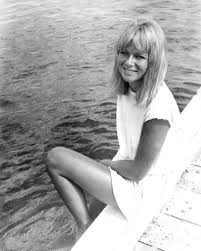
and Michael Powell tells this taboo tale without a hint of judgment. Fluff, certainly, but fascinating fluff, with a compelling Mason, as the middle aged painter with an obsession, and Mirren, as the woman/child, without a care, and without regret. A sexual taboo, dealt with by Powell, without judging its outcome. A simple film of lyrical beauty (about twenty minutes of startlingly gorgeous cinematography with a totally naked Helen Mirren swimming underwater while Mason paints away in his little boat), and well handled by all involved.

Special Features: Martin Scorsese on AGE OF CONSENT – Commentary by historian Kent Jones – Making of Age Of Consent – Helen Mirren: A conversation with Cora – Down under with Ron and Valerie Taylor
http://www.youtube.com/watch?v=UHrEmY2RqyU
*
© 2012 Shaun Costello
9/11 CONNECTION WIDELY IGNORED IN PRESS COVERAGE OF EMBASSY ATTACKS
9/11 CONNECTION WIDELY IGNORED
IN U.S. EMBASSY ATTACKS
Yesterday, September 11, 2012, the eleventh anniversary of the Al Qaida attacks on the World trade center, the US Embassy in Cairo, and our Consulate in Benghazi, Libya came under attack. The American Ambassador to Libya, J. Christopher Stevens, and three

Embassy staffers were killed while attempting to evacuate the Consulate in Benghazi. Both attacks were allegedly attributed to the release of the trailer for a film made by an Israeli Jew, living in California, which depicts Islam and the Prophet Muhammad in a negative light.
Muslims find it offensive to depict Muhammad in any fashion, much less in an insulting way. The 2005 publication of 12 caricatures of the Prophet Muhammad in a Danish newspaper triggered death threats in Denmark and riots in many Muslim countries.

In the late 1990’s, after the publication of Salmon Rushdie’s Satanic Verses, the mad Mullahs of Iran sentenced Rushdie to death for his literary efforts, encouraging assassination squads to hunt the author down and take their lethal Islamic vengeance. Of course, none of the Mullahs who were after Rushdie’s blood, had read Rushdie’s book. Soon after the death sentence was handed down, I sat next to Rushdie in an East Hampton restaurant, and must admit to being a bit apprehensive during dinner.

A 14-minute trailer of the movie that sparked yesterday’s protests, posted on the website YouTube in an original English version and another dubbed into Egyptian Arabic, depicts Muhammad as a fraud, a womanizer and a madman in an overtly ridiculing way, showing him having sex and calling for massacres.

The website’s guidelines call for removing videos that include a threat of violence, but not those that only express opinions. YouTube’s practice is not to comment on specific videos.
Sam Bacile, a 56-year-old California real estate developer who identifies himself as an Israeli Jew and who said he produced, directed and wrote the two-hour film, “Innocence of Muslims,” said he had not anticipated such a furious reaction.
Speaking by phone from an undisclosed location, Bacile, who went into hiding Tuesday, remained defiant, saying Islam is a cancer and that he intended his film to be a provocative political statement condemning the religion.

Bacile said he believes the movie will help his native land by exposing Islam’s flaws to the world. “Islam is a cancer, period,” he repeatedly said in a solemn, accented tone.
It should surprise no one that Sam Bacile is an alias. The film’s director turns out to be neither an Israeli nor a Jew. His name is Nakoula Basseley Nakoula, and he is a Coptic Christian. Nakoula remains in hiding, and has assigned the job of promoting the bizarre project to a Mr. Steve Klein, a failed California real estate developer and Vietnam Veteran, whose name has been connected to several organizations that could be described as hate groups. Mr. Klein’s hate-focus seems centered on Islam.
These attacks happened on 9/11, folks. Does anyone really think it was a coincidence? And why weren’t our embassies in the Middle East on heightened alert? Isn’t the CIA supposed to alert the NSA before events like this take place? Was someone asleep at the

switch? If we can’t protect our embassies, we can’t justify having them. The Islamists become more intolerable with every passing day. And it’s not just Islam against the USA, it’s Islam against the world. This would not have happened if Ghadafi and Mubarak were still in power. What does that tell us? It’s horrible to contemplate, but maybe these countries are better off with dictators, who keep the insanity of the Islamists in check. The Arab Spring might just wind up being the beginning of a whole new era of Islamist Madness. Oh, and Iran is building a bomb. Iran the greatest exporter of terrorism on the planet will soon be able to distribute nuclear devices to its world-wide terror cells. Maybe Israel is right. This is all heading in a really bad direction.

Oddly, the press coverage of the Cairo and Benghazi attacks is making no connection to the date on which they occurred. The anti-Semites are claiming that it’s all the fault of the Jews. The extreme pacifists are claiming that retribution for American drone strikes justifies the killing of the Americans, even though those drone attacks are taking place thousands of miles away. The Arab Street is out chanting away, clamoring for death to those who insult Islam. But few, if any, journalists are connecting the date of these attacks to the infamous World Trade Center attacks of eleven years ago. I wonder why.

http://www.youtube.com/watch?v=iC6yGzpSvjU
© 2012 Shaun Costello
WGCU A DISGRACE TO PUBLIC RADIO
WGCU, a mismanaged National Public Radio affiliate, broadcasting in the Southwest Florida area, is attempting to extort surcharges from its listeners for programming carried for free by other affiliates.

Some background, according to Wikipedia:
WGCU-FM (90.1 FM) is an NPR-member radio station. Licensed to Fort Myers, Florida, USA, the station is owned by Florida Gulf Coast University.
WGCU’s schedule consists of jazz and NPR news and talk. WGCU-FM’s programming is simulcast on ‘WMKO FM 91.7, a full-time station licensed to Marco Island to serve the Naples area.
WGCU-FM first signed on in 1983 as WSFP-FM, a station owned by the University of South Florida in Tampa, owners of public broadcasting stations WUSF FM and TV. At the time, Fort Myers / Naples was the only media market in Florida without any public broadcasting stations. WSFP-FM was largely a rebroadcast of WUSF-FM.
The broadcast license was transferred to the new Florida Gulf Coast University in 1996, while the finishing touches were being put on Florida’s newest university. WSFP-FM changed its calls to WGCU-FM on June 13, 1997, two months before FGCU opened.
Broadcasting from its transmitter site in southern Charlotte County, WGCU-FM’s signal is barely listenable in Naples, though its grade-B signal reaches much of northern Collier County. Soon after FGCU opened, it requested funding for a second station to serve the Naples area. WMKO signed on for the first time in 1999.
In 2009, WGCU moved its classical music programming to a 24/7 feed on its digital sub-channel.
WGCU is also referenced for hurricane information on signs across southwest Florida.
 Long notorious for not making projected quotas on fund raising pledge drives, and short of funds because of consistent mismanagement, WGCU announced several weeks ago that it would drop the weekly broadcast of NPR’s long-running, hit show A Prairie Home Companion. This announcement came as a

shock to the thousands of local fans of one of NPR’s most popular shows. The reason given by WGCU’s management was that the station could no longer afford the program that the rest of America enjoys on a weekly basis. Shortly after WGCU announced this cancellation, a series of WGCU-produced promos began, suggesting that WGCU would bring back A Prairie Home Companion if listeners, many of whom are already contributing members of the station, pay a surcharge for the program. When the Mafia does this kind of thing it’s called extortion. Asking listeners to pay additional money, something no other NPR affiliate has ever done, because of consistently bungled mismanagement of the station is outrageous. Since WGCU is owned by Florida Gulf Coast University, it becomes the responsibility of that University to investigate the mismanagement of its broadcast entity.

WGCU’s General Manager Rick Johnson, whose attitude toward anyone who questions his policies might best be described as arrogant and smug, claimed to be shocked that Florida Governor Rick Scott vetoed more than four million dollars in funding for Public Broadcasting. But Scott’s veto, devastating as it might be, does not explain WGCU’s mishandling of its budgetary responsibilities. Nor does it explain the boondoggle surrounding the attempt by the station to extort additional funding from its listening members to bring back programming that WGCU management has cancelled because they claim it is not affordable by the station. Just where has all the money from all the pledge drives gone? I, for one, would like to know. If Rick Johnson’s management team is responsible for mismanagement of the station, they should be replaced by a staff more answerable to their listeners and supporters. The number of experienced broadcast personnel now unemployed by a shrinking economy should easily provide replacements.
*
NEW EVIDENCE PROVES CARTER STEVENS IS AN ALIEN
FINALLY – PROOF THAT CARTER STEVENS IS AN ALIEN
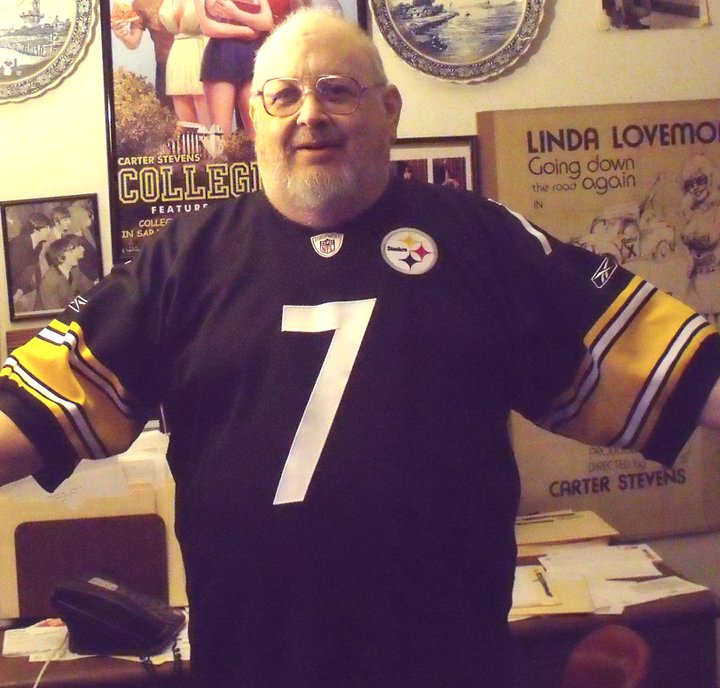
Associated Press January 24, 2012 In a startling news conference today that rocked rural Pennsylvania, Barnaby McNabb, the Mayor of the Township of Pocahontas, stated for the record that he had proof that one of Pocahontas’s residents, a Mr. Carter Stevens was, in fact, an alien being. Long suspected of unusual behavior, Mr. Stevens posted a suspicious photograph of himself on a social networking web site. “The minute I saw that picture, Stevens’ goose was cooked”, claimed Mayor McNabb. “That pink helmet was a sure-fire giveaway.  With those two antennae on his head, Stevens was obviously able to communicate with others of his ilk, and we’ve been listening, believe me”. McNabb claimed that local and State authorities have intercepted encrypted radio messages transmitted from the area of Stevens’ home. “He’s talking with some guy named Klaatu something-or-other. It’s all in some Nikto-Shmikto alien mumbo jumbo, but our boys are getting to the bottom of it, you can bet on that”. Stevens first came under suspicion when local livestock began to disappear. “Cows, chickens, goats – you name it. And those farm boys all claimed the same thing – a strange, bright light in the sky, and some kind of light beam that hit their barns, and faster than you can say Jack Robinson, there goes Ole Bossie”

Mayor McNabb further asserted that the disappearance of livestock began shortly after the arrival of Mr.  Stevens in the Pocahontas community. “We had a real peaceful little town before that creature showed up. Then everything went all kerfluey, and critters began to disappear. First the farm animals, then the girls”. The Mayor seemed reluctant to explain details, but said that within a month of the first kidnapped cow, the young women of Pocahontas began to disappear, one after another. “I
  guess Stevens and his alien cohorts experimented with the livestock, before moving on to the town’s young women. God only knows what he did with them. I shudder to think what those poor girls went through”. Each of the abducted women reappeared after a period of three days, but according to friends and family members, their behavior had become quite different. “They were all from good Christian families. God fearing folks. Church-goers, every
  one. But you’d never guess it from the way they acted, once they escaped from the clutches of that alien maniac”. The clue that broke the case wide open, according to Mayor McNabb, was a photograph that Mr. Stevens posted on his Facebook page. “The first thing I noticed was that pink helmet, a dead giveaway if there ever was one. But then I saw the vest. He was wearing a black leather vest. Some kind of space-garb,
  I guess. But when I had a look-see at what was painted on the back, I near to had a heart attack. It was the spitting image of Elsie Bronkowski, a girl I’ve know since she was in diapers, and the first young woman to disappear”. The Mayor claimed that the Bronkowski girl, like all the rest, reappeared three days after her abduction, but had gone through some kind of alien makeover. “Elsie was a devout Seventh Day Adventist.
  Baked seed cakes for the church socials. Did you see that drawing of her on Stevens’ vest? Naked as a Jaybird. Some kind of restraint devices on her wrists and ankles. God only knows what they put her through. And now, well let’s just say she’s become a daughter of Satan. Works at the Peek-a-Boo Lounge, over in Stroudsburg, dancing naked for the truck drivers. A good Christian girl, abducted by Stevens and his alien cronies, and now look at her – all sweaty and naked. Shaking her booty for those perverts”.
Although he would not go on record as saying so, Mayor McNabb suggested that law enforcement personnel had made a covert visit inside Stevens’

Pocono retreat. “Let’s just say we came up with the clincher, evidence wise. These aliens are crafty, I’ll tell you that. We found, what looked like some kind of toy. You know, like a top, that a child would spin. And it had some kind of writing on it – foreign writing. Like nothing from this earth. Here it was – the language from another world. Some kind of intergalactic gibberish. And then it hit me. This is how they learned about space travel. How they

invented the flying saucer. As young mutants, they would spin these toys, probably on some kind of alien Holiday, and watch them spinning, and out of the minds of these space kids came the flying saucer. And now, everyone in Pocahontas is hiding behind locked doors. No one is safe. And young girls I’ve known since they were kids, are flagging down sixteen wheelers at truck stops. And  it’s all because of Stevens. First it was Roswell, now it’s Pocahontas. And next? It looks to me like world conquest. And how did they do it? It all started with that little top. The one with the funny writing all over it. And now, the world as we know it, looks like it’s coming to an untimely end. Goodbye, my friends”.
A tearful Mayor McNabb left the press conference, an obviously shattered man. Phone calls, made in an attempt to confirm the Mayor’s remarks, to the Pennsylvania Governor in Harrisburg, and to NASA, went unanswered.

*
© 2012 Shaun Costello
GINGRICH “SPONGEBOB” RANT ANGERS PARENTS
GINGRICH “SPONGE BOB” RANT ANGERS PARENTS. MIGHT COST HIM NOMINATION.

ASSOCIATED PRESS December 4th During a news conference today, Republican Presidential hopeful Newt Gingrich stunned reporters with an angry outburst aimed at the hugely popular children’s animated TV program, SpongeBob Square Pants. Taking questions, after making a speech before the Florida Businessmen’s Alliance in Tampa Florida today, the former Speaker of the House was asked whether he was aware of recent tweets  suggesting his physical similarity to the beloved animated character, SpongeBob Square Pants. An angered Gingrich rebuked his questioner, “I know of no such suggestions, and if I did know any such suggestions, this is hardly the time or place to address them. This is just another example of the liberal press attempting to smear a Presidential candidate by comparing him to a ridiculous, and I might add, dangerous animated character in what is alleged to be a children’s TV series.” When asked what he meant by dangerous, Mr.
  Gingrich replied, “SpongeBob Square Pants is a subversive, and suggestive piece of socialist propaganda, aimed at convincing innocent children that sea sponges, and other creatures live harmoniously beneath the world’s oceans, in a world of happiness and tranquility, far removed from the contentious realities of everyday life. A child growing up being fed that kind of hogwash will have no chance whatsoever of successfully dealing with the harsh realities that confront today’s adults”. Asked what he meant by the show being suggestive, the former Speaker said, “The Square Pants family, and all of the other silly anthropomorphic anomalies in this show live in the fictional undersea town of Bikini Bottom. Need I say more? I think we all know what’s in a bikini bottom gentlemen, and that’s not the kind of place where the innocent minds of children need to dwell.”

Mr. Gingrich, who in recent weeks has spoken out about fixing school budgets by firing the janitorial staff and giving mops and brooms to the kids themselves, and institutionalizing the children of welfare families by placing them in orphanages, did not waver in his tough-love approach to education. “You can bet that the funding for socialist propaganda like SpongeBob, is deeply rooted in the National Endowment for the Arts, which has, as studies have shown, a Marxist/Leninist agenda.” Mr. Gingrich refused to take any further questions, and left the podium. Calls to the Gingrich for President campaign headquarters, attempting to confirm today’s comments, have gone unanswered.
*
© 2011 Shaun Costello
A BRONX TALE
A BRONX TALE
A couple of kids from the Bronx dance their way through the depression.
by Shaun Costello

My mother and Uncle Tommy were born in the Jewish/Irish Tremont section of the Bronx – Tommy in 1917, and his younger sister Catherine, two years later. Their parents, Nan, and Black Jack Dowling made a living of sorts on the Vaudeville stage as  a dance act. But New York was where you played once you had made a name for yourself, and the Dancing Dowlings were far from being headliners. So, once my mother was old enough to walk, they picked up stakes and headed for Norfolk Virginia, a hub in the Southern Vaudeville circuit, where, shamelessly billing themselves as New York’s dancing sensations, it would be easier to get bookings. Norfolk was the venue of choice for another reason as well – it was home port to one of the United States Navy’s largest installations, employing over seventy five thousand Naval personnel, many of whom, when pay day rolled around, wasted no time losing

their hard-earned pay in the myriad of floating crap games and poker sessions that so often seemed to find men in uniform, whenever they had money in their pockets. My grandfather, Black Jack Dowling, when not booked to entertain Vaudeville audiences with his dancing feet, was more than happy to swindle recently paid sailors out of their cash with his practiced slight of hand. Wearing a stolen sailor suit, my grandfather, a predator with portfolio, armed with marked cards and loaded dice, rode the trains into and out of Norfolk, systematically separating the sailors from their pay, often just one step ahead of the local Sherriff, and occasionally that Sherriff’s guest in the local jail house.

Trained by their parents in the art of stage craft, Tom and Sis, now incorporated into The Dancing Dowlings, dazzled all who saw them with their high stepping and showmanship – they were naturals. With the kids carrying the show, the family act seemed to stay booked, and performed throughout the Southern Vaudeville Circuit on playbills with Fanny Brice, Buck and Bubbles, Jack Benny, Burns and Allen, Eddie Cantor, Al Jolson, and just about everyone who toured back then. But success couldn’t keep a card sharp like my grandfather out of regular incarceration for his nefarious railroad hijinks, and his absences became more frequent, until finally, he disappeared altogether. The act, unbookable without its patriarch, made the journey back to the Bronx, in search of employment for my grandmother, and education for her kids.
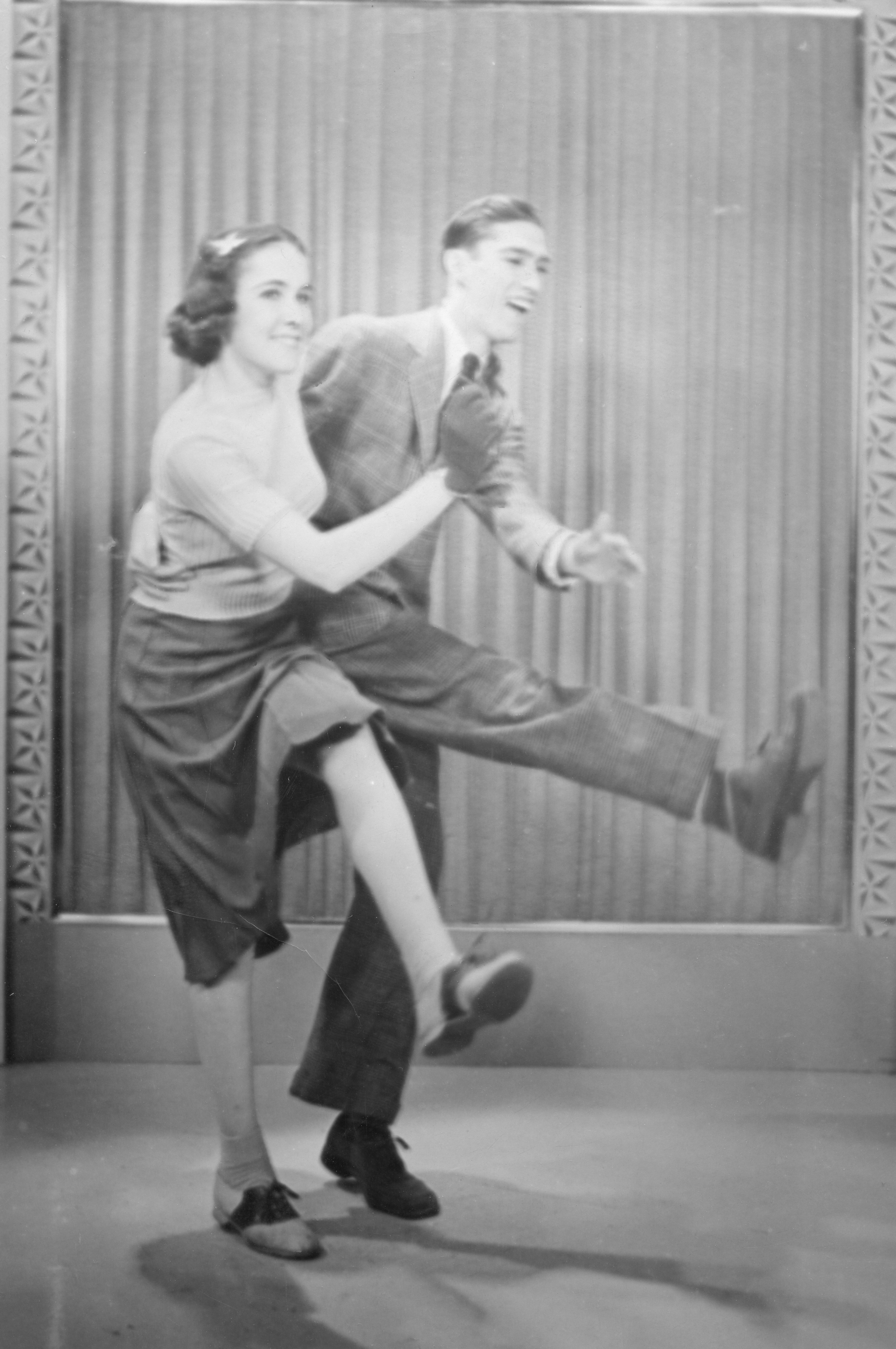 While still in High School, Tom and Sis continued to do what they did best, and they danced and danced, until people began to take notice. They starred in school productions, and spent all their spare time at a famous Bronx jazz club called the Club Fordham, where they entertained the musicians by improvising dance routines to any kind of music. Though not employed by The Club Fordham, they were encouraged by the
 club’s owner Maurice Reidy, and performed their dance routines until they became crowd favorites. There was a buzz about them now – who were these kids? Reporters began to make the trek up to the Bronx, to watch, and to write about those kids at the Club Fordham. Photo shoots for magazines followed – ‘how to’
 spreads with Tom and Sis demonstrating the latest dance craze for a dance-crazy generation of readers. Using the photographs from one of these sessions, the editorial staff at Ladies Home Journal hired an illustrator to create a likeness of ‘the kids’ for the cover of the August 1938 edition. So there they were, Tom and Sis Dowling, a couple of depression era Bronx kids, right there on the cover of a national magazine, doing their thing.
Within a year they had made the seamless transition from The Club Fordham, to Manhattan’s Stork Club, where they became favorites
of the owner, Walter Winchell, who both promoted and protected them. Now, this was the era of the ‘Big Bands’, and band leaders often hired dancers to demonstrate the latest dance trends to their music, for an ever-eager public. Winchell had mentioned Tom and Sis to his friend Horace Heidt, one of the era’s biggest band leaders, and, after seeing them dance up a storm at the Stork Club, Heidt offered them a contract to perform with his band, “Horace Heidt’s Musical Knights”, one of the

biggest bands of that decade. The gig with Heidt was followed by
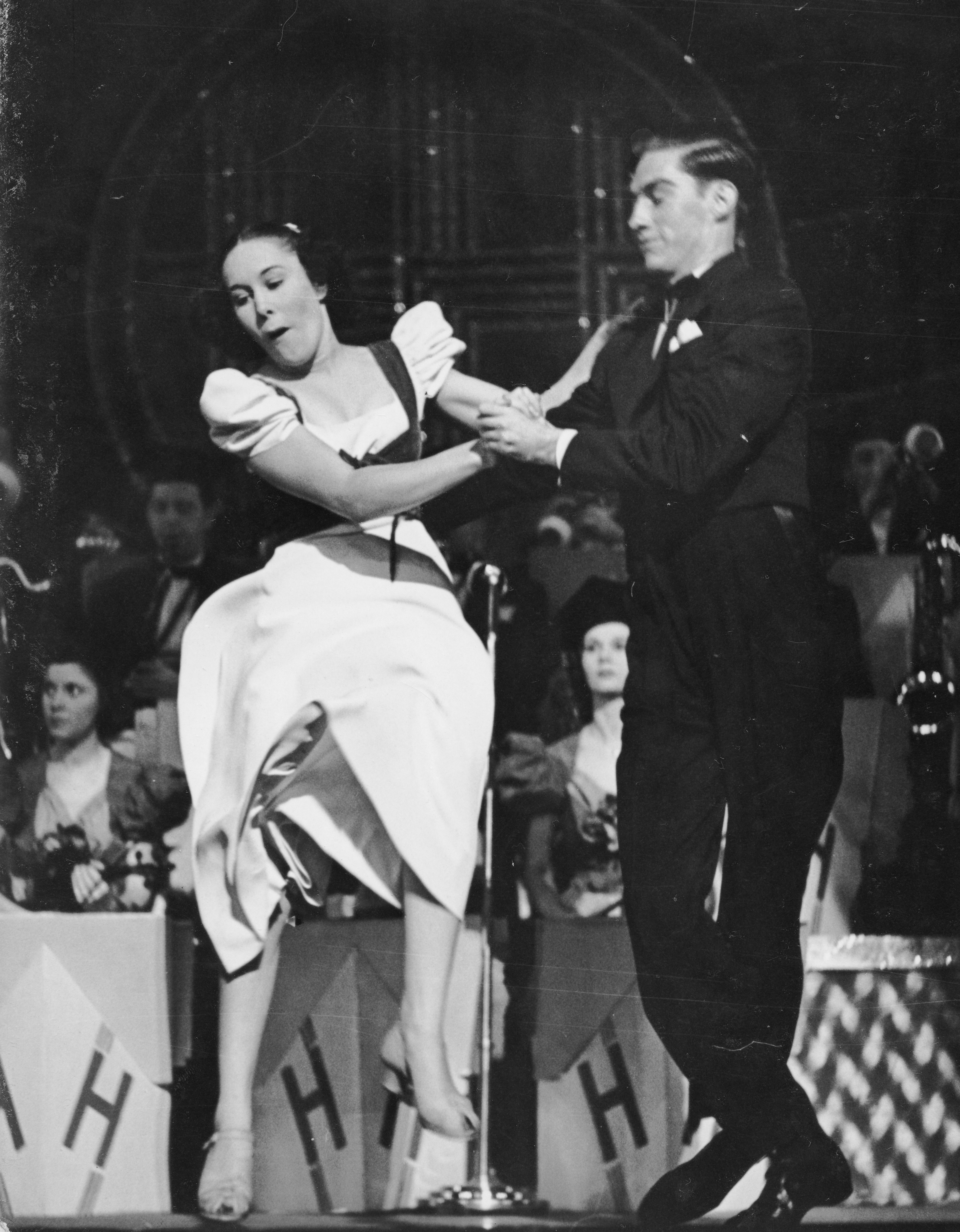
gainful employment, dancing with Tommy Dorsey’s Orchestra, and Benny Goodman, as well. So now ‘the kids’ were getting paid to do what, until then, they had done for free.

In between performances with big bands, they would return to the Stork Club, where they had become audience favorites, until that fateful night in 1939, when Darryl Zanuck and Bill Goetz happened to see them dance, and
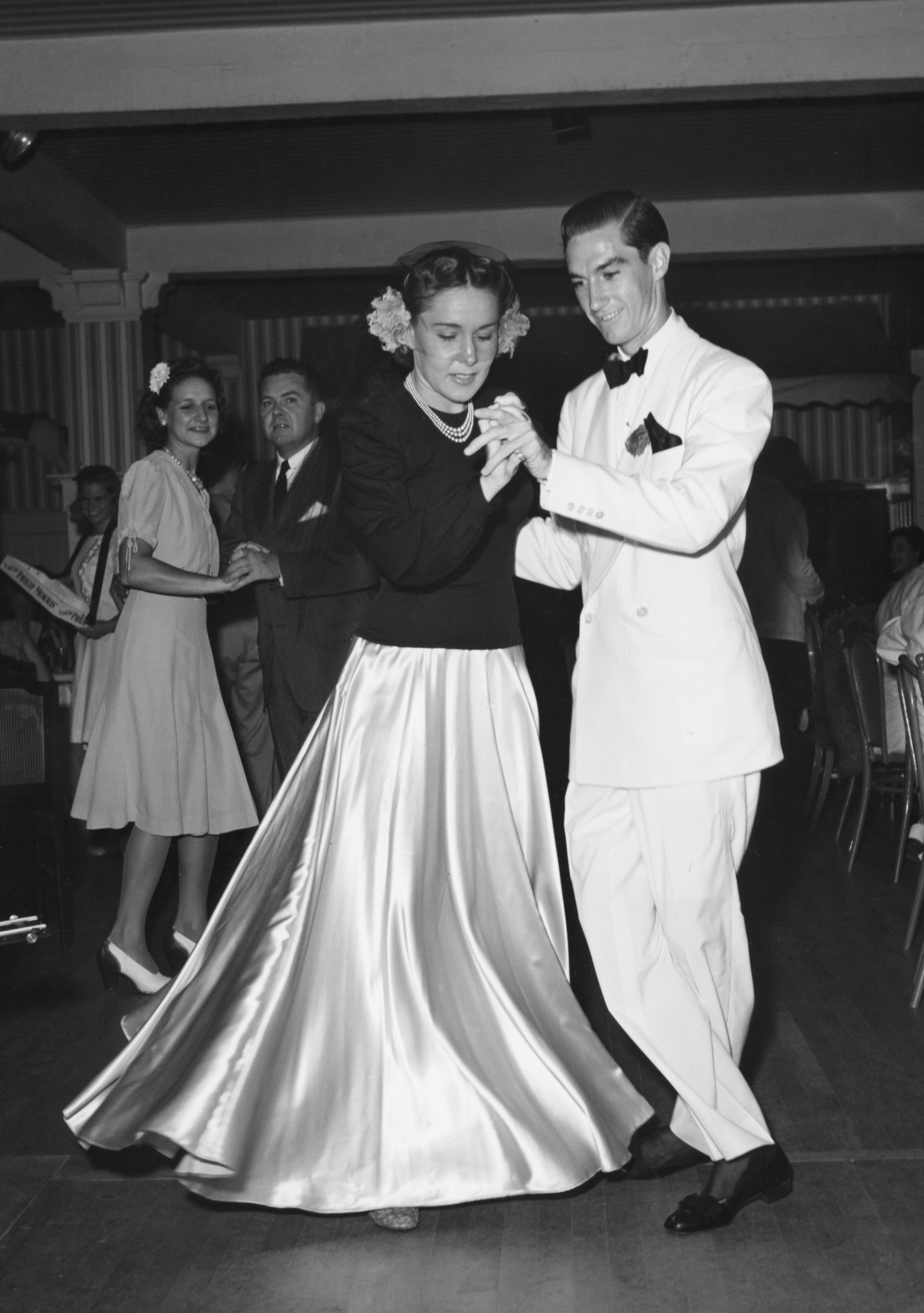
offered Tom and Sis an invitation to come to Hollywood as contract players for Twentieth Century Fox. Their Bronx days behind them, ‘the kids’, cheered on by the gang from the Club Fordham, boarded the train for Hollywood, and the next chapter of their lives.

*
© 2011 Shaun Costello
REMEMBER – THE J-GOD IS CANTANKEROUS AND HE KNOWS WHERE YOU LIVE
ATONE – YOU’LL BE GLAD YOU DID

GOYBOY SHABBOS GOY SERVICE opens its doors and lends a helping hand on this day of atonement. All of our helpers are certified graduates of the GOYBOY Shabbos Goy Academy.


YOM KIPPUR IS UPON US, and, once again, it’s time to atone. Remember, the J-God is a cantankerous, and vengeful God, and he knows where you live. Think Bernie Sanders with a bushy white beard. Use your toaster, and expect a lightning strike. Play it safe – call for GOYBOY.
THE MACING OF AMERICA
AMERICA – YOU’RE GETTING MACED, YOU’RE GETTING HOSED, AND YOU’RE GETTING NOWHERE!

Thanks to our extraordinarily right of center Supreme Court’s ruling earlier this year, Americans have no shot whatsoever at campaign reform in the next decade. Publically funded elections? Sure, a nice idea. Go tell it to the Supremes. Not only is Congress in bed with the corporate colossus, but the Federal Bench climbed in, as well. And that bed is getting pretty crowded. Comparing these Wall Street demonstrations, as many have done, to Vietnam era unrest is not only naive, but patently untrue. Instead of rolling up their sleeves and making Congress accountable, thousands of well intentioned, albeit naively so, Americans are camped out in tent cities in urban parks, participating in a preposterous re-enactment of Woodstock. Young people are being maced, while the Wall Street brokerage community spends weekends sipping pina colada’s at their beach houses in the Hamptons. The individual citizen has NO capability to impact the Banking Community, but we DO have the power to hold Congress, which sanctions the Banking Community, accountable, if only Americans could understand that and act on it. The source of America’s plight is the malignant curruption in Washington. Do you know your Senator’s voting record for the last year? I’ll bet you don’t, even though that voting record is readily available over the internet. I guarantee you that that voting record will surprise you. Even the ‘good guys’ in Congress vote against the welfare of their constituents from time to time, because that’s how the system functions. That’s how deals are made. That’s how corrupt the system is.
HOLDING CONGRESS ACCOUNTABLE! Doesn’t sound like much fun, does it? Nowhere near as entertaining as holding signs,

shouting protest rhetoric, getting maced, singing folk songs, squatting in urban Tent Cities, and experiencing a sense of communal righteousness in the re-enactment of the political upheaval of a long-gone era. And what exactly do these protesters think will come of their exhausting, and well-intentioned efforts? Do they actually think that, way up there in the air conditioned forty third floor offices of Goldman Sachs, brokerage executives are looking down at the spirited upheaval of sign-waving demonstrators, and having second thoughts? Do you really think that the CEO of Goldman is calling the CEO of Bank of America to tell him, “You know Brian, maybe these people are right? Maybe we should clean up our act. Change the way we do business”. Do you really think that’s happening? Yeah, right. That phone call will be made on one condition, and one condition only – that Congress finally listens to the American electorate, and votes to sanction the Banking Industry into compliance with the law. Then, and only then, will America find its economic balance again. So, it’s up to you, people. You’re getting maced, and you’re getting hosed, and you’re getting nowhere. It all starts on the Hill – with Congress, You people voted those people into office.
Don’t you think it’s about time you held them accountable?
*
© 2011 Shaun Costello
 Shaun Costello's Blog
HUFFINGTON POST’S INFO GRAB CONTINUES
LIKE TWO PEAS IN A POD
Like Bogart and Bacall. Like Gable and Lombard.
Like Madonna and the NBA.
Arianna and Mark – together at last. And the cash keeps flowing.
As a long time reader and commenter on Huffington Post, I was surprised when, in December of 2013, my comments were no longer welcome. Instead, I was told that I needed to sign back in to my Huffington Post account through Facebook. The reason given was that Huff Post needed to verify my identity. After several years as a commenter, Huff Post needed to know who I was. Of course the stench of this deceit was obvious to anyone with any sense at all. Huffington Post had gone into the information business – mine, yours, anyone’s.
By signing in to Huff Post through Facebook, all of the personal information stored in my Facebook account would now be available to Huff Post. Included in this information of course, would be all the personal information stored in the accounts of all those who are on my Facebook friends list. Your Facebook account, in terms of the personal information stored in it, is like a little Ponzi Scheme, with you at the top of the pyramid, and the rest of the structure built from the information about all those on your FB friends list. This pyramid of personal data is available to any opportunistic FB advertiser whose despicable but effective method includes: Click “Like” if you like kittens. Of course, naïve Facebook members who click “Like” are now going to be hounded by the advertiser, who, if they had looked closely enough, turns out to be a pet food and services company who now has, not only all the personal information in their FB account, but all the personal information from all the people on their FB friends list. This is why Mark Zuckerberg is a billionaire, folks. And why YOU are NOT.
OK, back to my battle with Huff Post. Feeling a sense of righteous indignation, I contacted Huffington Post to complain about my dilemma, and their preposterous info grab. I sent off two emails, one to the normal channels for reader complaint, and the other to Arianna Huffington directly. Arianna, to her credit, has responded in the past to my emails. Not this time – there was no response. After a week or so of Huff Post’s silence, I noticed an additional possibility to address my frustration. Listed among contact possibilities was DIRECTOR OF COMMUNITY. So I sent off an email to this personage, and got a response that very day.
His name was Tim McDonald, Huffington Post’s Director of Community. He seemed reasonable enough, even though he vehemently denied that Huff Post was collecting personal information through Facebook that it would later market in the great, world-wide, internet information bazaar. For the purpose of full disclosure dear reader, I am going to paste in here, my entire correspondence with Mr. McDonald – from my very first plea for reinstatement, to our dubious final agreement that Mr. McDonald himself would personally see to my identity verification without going through the farce of the Facebook revelation which, of course, he never really did. As I assemble this chronicle of complaint, it is Wednesday January 15th, and I still can not comment on Huffington Post. I am no longer a welcome participant in Huff Post’s public dialogue. No, I am cast out into the darkness, a leper without portfolio, because I dared to suggest that Huffington Post was selling information it collects through the naiveté of it’s readership. So here is my correspondence with Mr. McDonald. You, dear reader, should judge this farce for yourselves. You, members of Arianna Huffington’s wretched refuse, are a jury of peers. Read, and judge accordingly:
Shaun Costello
December 16,2013
I am a long-time reader and commenter on Huffpost, but can no longer comment and refuse to give up the personal information of many people who have trusted me with it. You can no longer comment on an article on Huffpost unless you verify your ID through Facebook, which automatically releases all the personal information stored in your Facebook account to Huffpost. In so doing you are also releasing to Huffpost all of the personal information of everyone on your Facebook friends list. This is just an attempt by Huffpost to create a bigger archive of personal informarion which Huffpost has every intention of marketing. I lodged a complaint with Huffpost, and CC’d the complaint to Arianna huffington by email. She has responded to my emails in the past. Let’s see what happens. Huffpost used to be the good guys, but they are quickly becoming internet Nazis. It’s been a week now, and no response from Huffpost.
Tim McDonald
Shaun Costello
Tim McDonald
Shaun Costello
Tim McDonald
Shaun Costello
Tim McDonald
Shaun Costello
Tim McDonald
Shaun Costello
Tim McDonald
January 15, 2014 | Categories: Fiction and non-fiction from Shaun Costello, Uncategorized | Tags: Arianna Huffington, Bottom Feeders, Click "Like", commenting on Huffington Post, Facebook, Fraud, Greed, Huff Post, Huffington Post, Info Grab, Internet, Mark Zuckerberg, Ponzi Schemes, Selling information, Tim McDonald, Your information is for sale | 8 Comments